
In the dynamic landscape of technological innovation, where advancements in artificial intelligence are reshaping industries at an unprecedented pace, Snowflake has emerged as a beacon of remarkable growth. The company's recent financial disclosures underscore a compelling narrative of strategic foresight and robust execution, particularly within the burgeoning realm of AI-powered data solutions. This success story unfolds amidst a backdrop of fluctuating market sentiments, where even established tech titans like Nvidia are experiencing scrutiny. Yet, Snowflake's trajectory suggests a distinct advantage, driven by its pivotal role in empowering businesses with intelligent data capabilities.
Snowflake's Stellar Ascent: A Deep Dive into Its AI-Driven Triumph
On August 27, in a pivotal moment for the technology sector, the financial world's gaze was fixed on Nvidia's highly anticipated quarterly report. Despite the semiconductor behemoth surpassing analyst expectations with substantial year-over-year increases in both revenue and earnings, market anxieties surrounding its operations in China cast a shadow, leaving its stock largely unchanged the following day. However, another artificial intelligence powerhouse, Snowflake, unveiled its quarterly figures on the very same day, captivating investors with an impressive surge in its stock value. This performance was not merely a fleeting moment of triumph; over the past year, Snowflake's stock has spectacularly outpaced Nvidia's, signaling a significant shift in market perception and investor confidence.
Snowflake, a visionary in the cloud-based data platform domain, empowers its clientele to securely store, process, and analyze vast quantities of data. Its cutting-edge data cloud platform is seamlessly integrated across leading cloud computing infrastructures, including Amazon Web Services, Microsoft Azure, and Google Cloud. Furthermore, Snowflake facilitates a vibrant marketplace where its users can access a rich array of applications and data shared by fellow customers. The strategic integration of AI tools, designed to unlock deeper insights from customer data, has proven to be a resounding success, culminating in Snowflake's exceptional fiscal second-quarter results for the period concluding July 31.
During this remarkable quarter, Snowflake's revenue ascended to a formidable $1.1 billion, marking a robust 32% year-over-year increase—a notable acceleration of three percentage points from the corresponding period last year. This impressive growth is inextricably linked to the burgeoning adoption of Snowflake's sophisticated AI solutions. The company's customer base expanded by 19% annually, with a significant proportion—just over half—actively leveraging Snowflake's AI capabilities. According to CEO Sridhar Ramaswamy, AI is becoming a fundamental driver for customer acquisition, influencing nearly 50% of new client acquisitions in the second quarter. Once integrated into the platform, AI transforms into a cornerstone of their strategic operations, powering 25% of all deployed use cases, with over 6,100 accounts engaging with Snowflake's AI solutions weekly.
Beyond attracting new clientele, AI has also been instrumental in catalyzing increased spending from Snowflake's existing customer base. This is vividly reflected in the company's net revenue retention rate, which stood at an impressive 125% last quarter. A figure exceeding 100% indicates that existing customers are deepening their engagement, either by expanding their utilization of Snowflake's services or acquiring additional offerings. The synergistic growth in both customer numbers and their expanding usage has led to a six-percentage-point year-over-year increase in Snowflake's non-GAAP (adjusted) operating margin. Consequently, the company's adjusted earnings nearly doubled from the previous year, reaching $0.35 per share. With a robust revenue pipeline and a vast, expanding addressable market, Snowflake is exceptionally well-positioned for sustained upside.
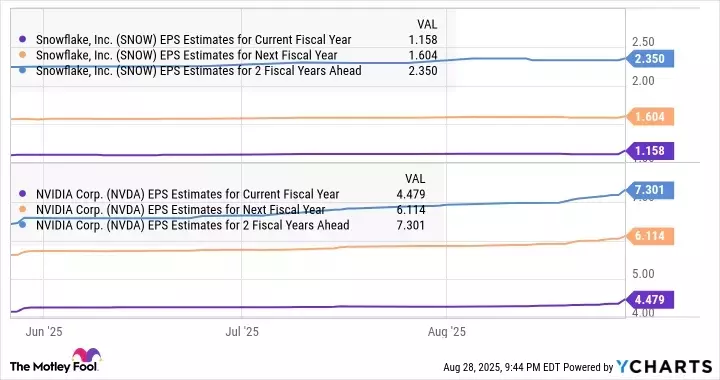
Looking to the horizon, Snowflake's future appears exceedingly bright. Its remaining performance obligations (RPO) swelled by an impressive 33% in the last quarter, reaching $6.9 billion. This strong indicator has prompted the company to revise its fiscal 2026 product revenue forecast upward to $4.4 billion, from an earlier estimate of $4.33 billion. Snowflake is on the cusp of tapping into an even larger market, with its total addressable market (TAM) projected to more than double over the next five years, reaching an astonishing $355 billion by 2029. Analysts predict that Snowflake's earnings growth will continue to surpass that of Nvidia, cementing its position as a dominant force in the AI and data cloud sectors. Despite its significant gains, Snowflake's valuation, at 19 times sales compared to Nvidia's 30, presents an attractive proposition for growth-oriented investors.
From an observational standpoint, Snowflake's ascendancy offers a profound insight into the evolving dynamics of the technology market. While the spotlight often shines on hardware innovators like Nvidia, the true enduring value may increasingly reside with companies that enable the seamless and intelligent utilization of data. Snowflake's success underscores the critical role of software and platform providers in the AI revolution. Their ability to deliver tangible, immediate value through innovative AI tools resonates deeply with enterprises striving for digital transformation. This trajectory suggests that investment focus might gradually shift towards entities that facilitate data-driven insights and operational efficiencies, rather than solely those providing the foundational computational power. For investors and industry observers alike, Snowflake's impressive narrative serves as a potent reminder that in the AI era, it's not just about building the engine, but also about crafting the most effective and accessible vehicles to harness its power.
