
In the dynamic landscape of technological innovation, particularly within the realm of artificial intelligence, two companies, Nvidia and Palantir, have emerged as focal points for investors. Both have witnessed remarkable ascents, propelled by the burgeoning interest in AI. However, a nuanced examination of their business models, market positioning, and valuation metrics reveals distinct risk profiles and potential trajectories. This analysis aims to illuminate the comparative advantages and inherent vulnerabilities of each, providing a comprehensive perspective for those navigating the complex choices in AI-driven investments.
Detailed Investment Comparison: Nvidia and Palantir in the AI Era
In the vibrant tapestry of the tech and business world, few phenomena have captured as much attention as the meteoric rise of artificial intelligence. This profound shift has not only reshaped industries but also dramatically influenced the valuation of numerous tech enterprises, as eager investors strive to capitalize on nascent growth avenues. Notably, two titans have disproportionately reaped the rewards of this AI fervor: Nvidia and Palantir.
Nvidia's journey has been nothing short of spectacular, propelling it to the zenith as the globe's most valuable publicly traded entity. Concurrently, Palantir has witnessed an astounding surge in its stock price, climbing over 810% since the commencement of 2024. While both companies have demonstrably delivered exceptional generational returns, the critical question for discerning investors remains: which of these growth-oriented stocks presents a more compelling investment proposition?
Nvidia's AI Dominance and Future Aspirations
Nvidia stands as an indispensable pillar in the AI ecosystem, renowned for its cutting-edge graphics processing units (GPUs). These powerful components serve as the fundamental backbone for data centers, enabling the intricate processes of training, deploying, and scaling AI technologies. In its recent fiscal period, Nvidia's data center division recorded an impressive 56% year-over-year growth, contributing a colossal $41.1 billion, representing 88% of its total revenue. Although Nvidia's technological prowess extends to gaming consoles, automotive applications, and networking, data centers unequivocally represent its core strength. The company's strategic vision clearly indicates a full commitment to solidifying its position as the premier AI infrastructure provider. This strategic pivot has undeniably yielded significant dividends for Nvidia, a trend anticipated to persist. The company projects that AI infrastructure expenditures could escalate to between $3 trillion and $4 trillion over the forthcoming half-decade, largely driven by the substantial investments of AI's leading spenders, including the illustrious 'Magnificent Seven' stocks. Nvidia ambitiously aims to secure up to 70% of this colossal spending.
Palantir's Expanding Reach and Commercial Triumph
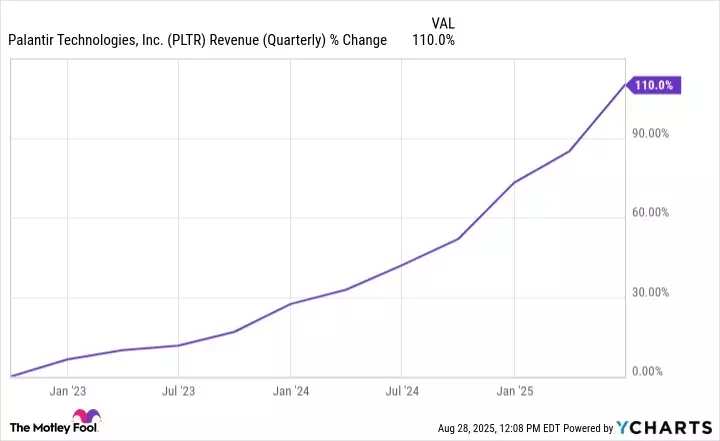
Palantir, a sophisticated software firm, harnesses the power of AI to transform vast datasets into actionable intelligence. While not as foundational to the AI infrastructure as Nvidia, Palantir's application spectrum is steadily broadening, fueling its impressive growth over the past few years. Initially, Palantir's primary clientele comprised governmental agencies, such as the Department of Defense, CIA, and FBI. However, the company has successfully expanded its footprint, demonstrating remarkable success within the commercial sector. Though its U.S. government segment continues to constitute the majority of its revenue (42% of the total), Palantir's U.S. commercial division is its most rapidly expanding sector. In the second quarter, U.S. commercial revenue surged by 93% compared to the previous year, reaching $306 million. The robust growth across both segments enabled Palantir to achieve its inaugural billion-dollar quarter, more than doubling its revenue in just three years. The company's innovative AI Platform (AIP) is largely credited for its recent commercial triumphs. As AIP gains wider adoption across diverse industries, Palantir is poised to further diversify its revenue streams, significantly bolstering its long-term appeal.
Navigating Potential Pitfalls: Challenges for Each Company
Nvidia faces a significant challenge stemming from the unpredictable U.S.-China trade relations. A prior ban on sales of its H20 chip (Nvidia's China-compliant AI chip) to China by the Trump administration in April was subsequently reversed in July. This reversal came with the condition that Nvidia would remit a 15% tax on AI chip revenue generated in China, a deal currently in its final stages. The ongoing geopolitical climate necessitates close monitoring of how these trade dynamics unfold. On the other hand, Palantir's vulnerability lies in its substantial reliance on U.S. government contracts. While these contracts offer lucrative prospects, they are inherently susceptible to fluctuations in government budgets and shifting political priorities. Given the current volatile political environment, the restructuring or complete cancellation of some of these contracts is not an improbable scenario. Despite the promising growth of its commercial operations, Palantir's operational stability remains tied to its government sector agreements.
Valuation Matters: A Crucial Differentiator
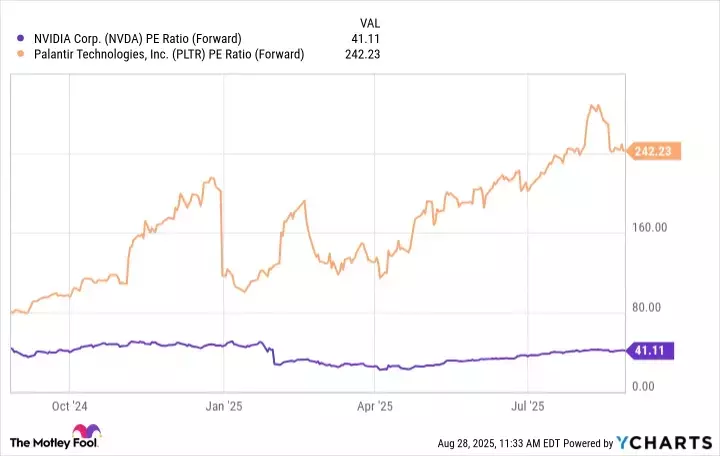
Beyond growth prospects, the valuation of these companies is an indispensable factor for investors. As of August 28, Nvidia's stock trades at 41 times its forward earnings, a figure generally considered elevated. However, Palantir's valuation stands at an astonishing 242 times its forward earnings. While Nvidia's 41 forward P/E ratio is undeniably steep by conventional standards, Palantir's valuation is historically unprecedented, leading an Economist article to provocatively suggest it might be “the most overvalued firm of all time.” When contemplating the superior investment, the concept of a "margin for error" becomes paramount, particularly with growth stocks known for their volatility, especially those buoyed by AI enthusiasm. While Nvidia possesses a limited margin for error given its valuation, Palantir, at its current market price, effectively has no room for misstep. Therefore, from a risk-adjusted perspective, Nvidia emerges as the more prudent choice between the two.
As a devoted observer of market trends and technological innovation, the ongoing narrative of AI's integration into global commerce is profoundly captivating. The comparison between Nvidia and Palantir serves as a microcosm of the broader investment dilemmas confronting those keen on this transformative sector. My takeaway from this insightful analysis is that while the allure of high-growth, disruptive technologies is undeniable, a disciplined approach to valuation and risk assessment remains paramount. Palantir's extraordinary valuation, despite its compelling technological offerings and expanding commercial footprint, introduces a level of speculative risk that demands extreme caution. Conversely, Nvidia, though also commanding a premium, demonstrates a more robust underlying business model and a more grounded, albeit still high, valuation. This underscores a vital lesson for investors: groundbreaking innovation must be tempered with realistic financial assessment. The long-term success in high-growth areas like AI will likely favor companies with sustainable models and reasonable risk profiles, rather than those whose valuations are built on pure speculative fervor.
