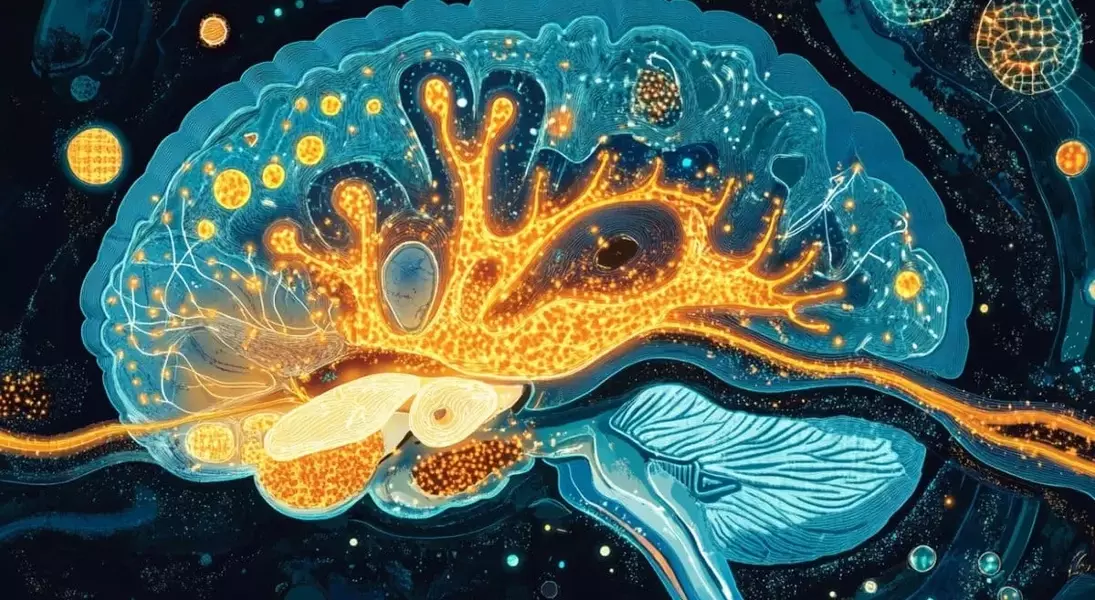
New research has uncovered serotonin's pivotal role in predicting future rewards, offering a fresh understanding of its activity concerning both pleasure and pain. The findings challenge conventional views and propose a unifying theory relevant across neuroscience, psychology, psychiatry, and artificial intelligence. Serotonin neurons encode a "prospective code for value," signaling expectations about upcoming outcomes and the rate at which these expectations change. This discovery aids in assessing potential actions' worth in dynamic environments, guiding daily decision-making.
Scientists from the University of Ottawa have unveiled that serotonin neurons encode expectations regarding forthcoming rewards and punishments. These neurons activate broadly based on surprise, pain, or pleasure, depending on expected value. Furthermore, the brain's value-signaling system through serotonin significantly differs from artificial systems, suggesting unique evolutionary adaptations in human cognition.
The Prospective Code: Understanding Value Prediction
This section delves into how serotonin encodes expectations for future rewards. By interpreting the signals sent by serotonin neurons, researchers can better comprehend their activation patterns during various stimuli. This biological code explains why serotonin responds to both rewards and punishments, with a preference for surprising rewards.
Serotonin's role as the brain's "pleasure chemical" has long been debated. However, this study reveals its broader function in encoding expected values. Antidepressants like SSRIs target the serotonin system, yet its precise role remains ambiguous. The prospective code theory suggests that serotonin neurons signal the likelihood of future rewards, aiding in mood regulation, learning, and motivated behavior. Dr. Richard Naud and his team propose that serotonin sends messages to the brain estimating the quality of the near future and the speed at which these estimates improve. This perspective integrates previous theories and aligns with reinforcement learning models, providing a comprehensive framework for understanding serotonin's function.
Bridging Neuroscience and Artificial Intelligence
This segment explores the implications of serotonin research for artificial intelligence. By comparing the brain's value-signaling system with artificial systems, scientists highlight significant differences in processing rewards. These insights underscore the uniqueness of human cognition and its evolutionary advantages.
Dr. Naud emphasizes that the brain operates distinctly from machines. Perturbing reward signals in machines leads to behaviors not observed in brains, indicating specialized neural mechanisms. The interdisciplinary approach merging reinforcement learning theory with insights into the dorsal raphe nucleus filtering properties offers a novel way to study serotonin's impact on behavior. Future research aims to decipher what the rest of the brain does with serotonin's messages, potentially employing reinforcement-learning frameworks. This work could inform advancements in AI, enhancing our understanding of learning and memory processes. As Dr. Emerson Harkin notes, serotonin's role extends beyond pleasure, encompassing complex predictions about the future, bridging gaps between neuroscience and technology. The study published in Nature represents a crucial step toward unraveling serotonin's role in learning and behavior, challenging existing paradigms and opening new avenues for exploration.
