In the quiet interlude between the intensive planting and harvest seasons, agricultural markets are unexpectedly on the verge of substantial transformations. Farmers, despite the relative calm of mid-July, must remain acutely aware of impending shifts. The United States Department of Agriculture's latest World Agricultural Supply and Demand Estimates (WASDE) report, released on July 11, provided little in the way of immediate market shocks, largely aligning with industry predictions. However, this apparent stability belies a looming period of volatility driven by evolving yield forecasts, the fluctuating strength of the dollar, and the ongoing repercussions of trade tariffs. These elements are set to significantly impact both the selling prices of crops and the underlying costs of agricultural production, demanding continuous attention and strategic decision-making from producers.
Detailed Insights into Market Dynamics
As summer progresses, the agricultural sector finds itself at a critical juncture, where seemingly minor shifts can precipitate major market realignments. The United States Department of Agriculture (USDA) plays a pivotal role in this landscape, with its forthcoming August 11 WASDE report anticipated to bring more definitive yield data derived from extensive farmer surveys. This follows the July 11 report, which, while maintaining projections for record corn production and an average corn yield of 181 bushels per acre, did slightly reduce corn acreage, leading to a modest 115 million bushel cut from June's output. Soybean yield forecasts remained steady at 52.5 bushels per acre, with only a marginal reduction in acreage, resulting in a 5 million bushel decrease in total projected production.
Discrepancies exist between official USDA estimates and field realities. Weekly Progress reports indicate robust corn conditions, with 74% rated good or excellent—a notable 12.5% above the long-term average. This suggests a potential yield of 188.7 bushels per acre, though statistical margins of error could bring this closer to 177.3 bushels per acre. The Vegetation Health Index (VHI) further supports a strong outlook, projecting corn yields around 182.7 bushels per acre. For soybeans, despite the complexities of double-crop seeding still underway, weekly ratings show a 6.5% increase year-over-year from average, pointing to yields of 53.6 bushels per acre, while the VHI model indicates 53.2 bushels per acre.
Geographically, current weather patterns reveal localized dry areas, particularly in the Western Corn Belt, northern Illinois, Indiana, and parts of Michigan. However, widespread severe drought conditions are absent, affecting only 12% of corn and 9% of soybean fields. Extended forecasts for the Plains and Midwest show no significant soil moisture deficits, and the absence of El Niño conditions, with neutral patterns expected through autumn, bodes well for yields, historically correlating with higher outputs in such years.
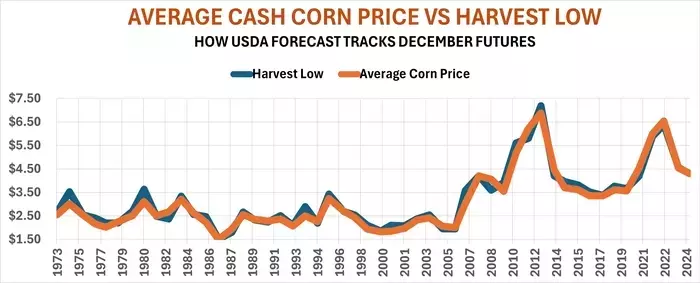
From a financial perspective, the USDA's price predictions remain largely static, with the 2025 average cash corn price holding at $4.20. Historically, this figure shows a strong correlation with December futures harvest lows, suggesting a value just under $4.25. Demand projections are clouded by uncertainties such as tariffs and other policy measures. While corn feed usage for the 2025 crop saw a slight reduction, soybean crush is expected to rise due to biofuel demand. However, soybean exports face headwinds from increased competition from Ukraine, Argentina, and Brazil, despite anticipated growth in Chinese imports.
The value of the U.S. dollar continues to be a critical determinant for export demand. Although a weaker dollar typically enhances the competitiveness of U.S. crops, the availability of inventory from international competitors, such as Europe, Brazil, and Argentina, remains a more significant factor. Nevertheless, currency market fluctuations, interest rate movements, and stock market volatility can still profoundly influence commodity prices. Recent instability, including a flirtation with 5% interest rates for the 30-year bond and the stock market reaching new all-time highs despite underlying concerns, underscores this unpredictability.
Beyond grains, energy markets are also in flux. Crude oil, priced in dollars, is influenced by currency strength, with recent dips attributed to tariff disputes and increased OPEC+ production. Seasonal demand and geopolitical tensions also contribute to price fluctuations. Products essential for agriculture, like propane and ultra-low-sulfur diesel, exhibit their own volatile trends. Propane prices, for instance, could see a demand surge if a record corn crop necessitates extensive drying. Fertilizer costs, impacted by geopolitical events and currency shifts, also remain volatile. Prices for phosphates, such as DAP, have seen significant increases, while Gulf urea prices fluctuate widely. Potash, however, has experienced more contained price movements despite new tariffs.
These interconnected markets are constantly seeking equilibrium, hinting at potential dramatic shifts in the near future. Predicting their exact trajectory remains a complex challenge, making continuous market monitoring an imperative for all stakeholders.
This intricate dance of agricultural markets, driven by a blend of environmental conditions, economic policies, and geopolitical currents, offers a compelling illustration of modern global interconnectedness. As a journalist, I find myself deeply impressed by the resilience and adaptability required of farmers in such an unpredictable environment. It's not merely about planting and harvesting; it's about navigating a labyrinth of global forces that can make or break a season. The constant need for vigilance, from understanding weather patterns to anticipating trade policy changes and currency fluctuations, highlights farming as a profession that demands not only brawn but also keen intellect and strategic foresight. For any observer, this narrative serves as a potent reminder of how deeply fundamental sectors like agriculture are intertwined with broader world events, underscoring the critical importance of informed decision-making in an increasingly complex world.
