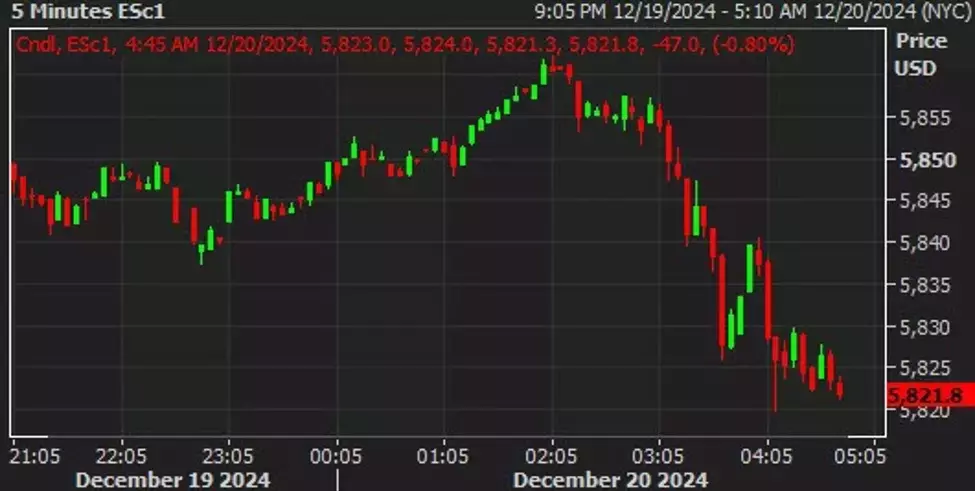
In a week marked by ongoing market turbulence, global stocks continue to experience significant downturns. Major indices across Europe and the United States are witnessing substantial declines, reflecting investor concerns over monetary policy shifts and rising long-term Treasury yields. The S&P 500 futures have dipped by 0.8%, while Dow and Nasdaq futures are also showing negative trends. European markets are similarly affected, with major exchanges recording losses ranging from 0.6% to 1.4%. This downward momentum has been fueled by a more aggressive stance from the Federal Reserve and broader economic uncertainties.
Market Performance: A Closer Look
During this period of financial volatility, key stock exchanges around the world have shown considerable weakness. In the United States, the S&P 500 futures are currently down by 0.8%, signaling ongoing investor apprehension. Meanwhile, the tech-heavy Nasdaq futures have dropped by 1.2%, indicating that technology stocks are particularly vulnerable to market fluctuations. The Dow Jones Industrial Average futures have also slipped by 0.6%, reinforcing the overall bearish sentiment in the market.
Across the Atlantic, European markets are faring no better. The DAX in Germany has declined by 1.4%, while France's CAC 40 is down by 1.2%. Even though the UK's FTSE 100 has experienced a relatively milder drop of 0.6%, it still reflects the widespread pessimism gripping global investors. Other European indices, such as Spain's IBEX and Italy's FTSE MIB, have suffered even steeper losses of 3.7% and 4.3%, respectively.
The week has been particularly challenging for smaller-cap stocks, with the Russell 2000 index plummeting by 5.3%. These movements underscore the growing unease among investors about the future direction of the economy and the potential impact of tighter monetary policies.
From a broader perspective, the rise in long-term Treasury yields has played a crucial role in exacerbating market instability. Investors are now closely monitoring central bank actions and economic indicators, as they seek clarity on how these factors will influence asset prices moving forward.
As we move through this turbulent period, the market's response highlights the delicate balance between economic growth and inflationary pressures. Investors are increasingly cautious, aware that any misstep could lead to further declines. The current environment calls for vigilance and adaptability, as stakeholders navigate the complexities of an evolving financial landscape.
For many, this downturn serves as a reminder of the importance of diversification and risk management in investment portfolios. It also underscores the need for policymakers to carefully consider the implications of their decisions on market stability. As the situation continues to unfold, the focus remains on identifying opportunities amid uncertainty and preparing for potential challenges ahead.
