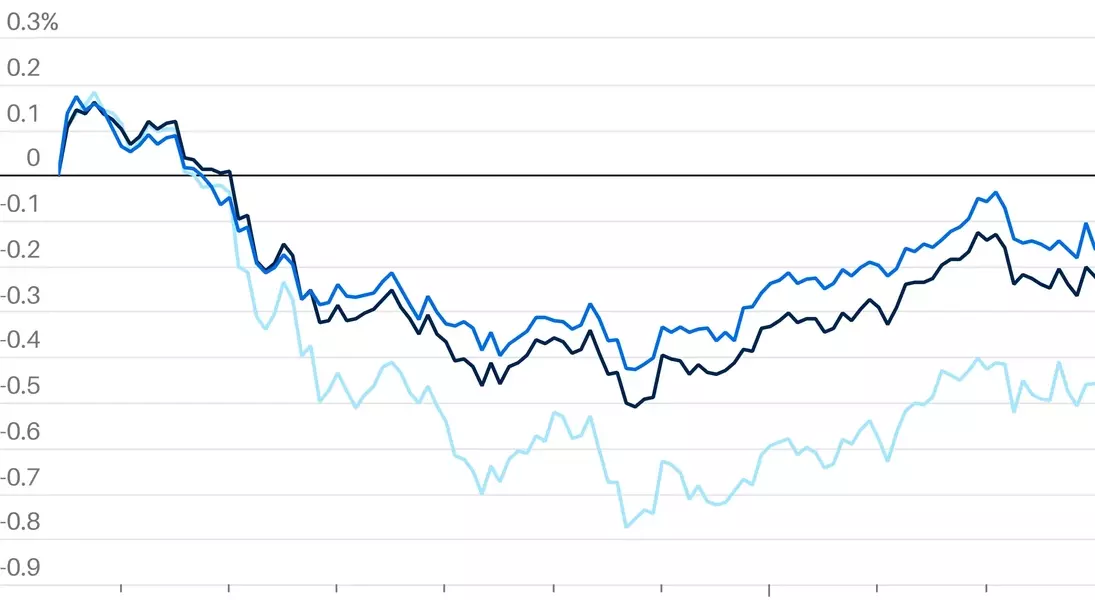
Financial markets experienced a downturn on Friday, with stock futures declining as investors prepared for the release of significant economic indicators. The week had already been challenging for market participants, marked by volatility and concerns over interest rate trends. The upcoming Personal Consumption Expenditures (PCE) report for November, set to be released at 8:30 AM Eastern Time, is expected to provide critical insights into inflationary pressures and influence the Federal Reserve's monetary policy decisions in the coming year.
Market Sentiment Shifts Amid Economic Uncertainty
The anticipation of key economic data has led to a shift in investor sentiment, resulting in a decline in major stock futures. Futures tied to the Dow Jones Industrial Average dropped by 0.5%, while those linked to the S&P 500 fell by 0.7%. The tech-heavy Nasdaq 100 contracts saw an even steeper drop of 1.1%. This trend reflects growing concerns about how inflation might impact future interest rates and overall market stability.
The week had been particularly tough for the markets, with the Dow Jones ending its longest losing streak since 1974 on Thursday. Despite a slight recovery, the index only managed to gain 16 points. Investors remain cautious, as any shifts in inflation could have far-reaching implications for the economy and corporate earnings. The PCE report is especially important because it serves as the Federal Reserve’s preferred gauge for measuring inflation. A higher-than-expected reading could signal further tightening of monetary policy, potentially leading to increased borrowing costs and slower economic growth.
Implications of the PCE Report on Monetary Policy
The release of the November PCE report is anticipated to play a pivotal role in shaping the Federal Reserve’s approach to interest rates. As the central bank’s preferred measure of inflation, this report will provide valuable insights into price trends and consumer spending patterns. Market analysts are closely watching for any signs that inflation may be easing or accelerating, which could influence the Fed’s decision-making process regarding future rate hikes.
Given the recent volatility in financial markets, the outcome of the PCE report could have significant ramifications. If inflation remains stubbornly high, it may prompt the Federal Reserve to adopt a more aggressive stance on raising interest rates, which could dampen investor confidence and lead to further market turbulence. Conversely, if the report indicates a slowdown in inflation, it could ease pressure on the central bank to tighten monetary policy aggressively. Investors are therefore bracing for the potential impact of this data on both short-term market movements and long-term economic outlook.
