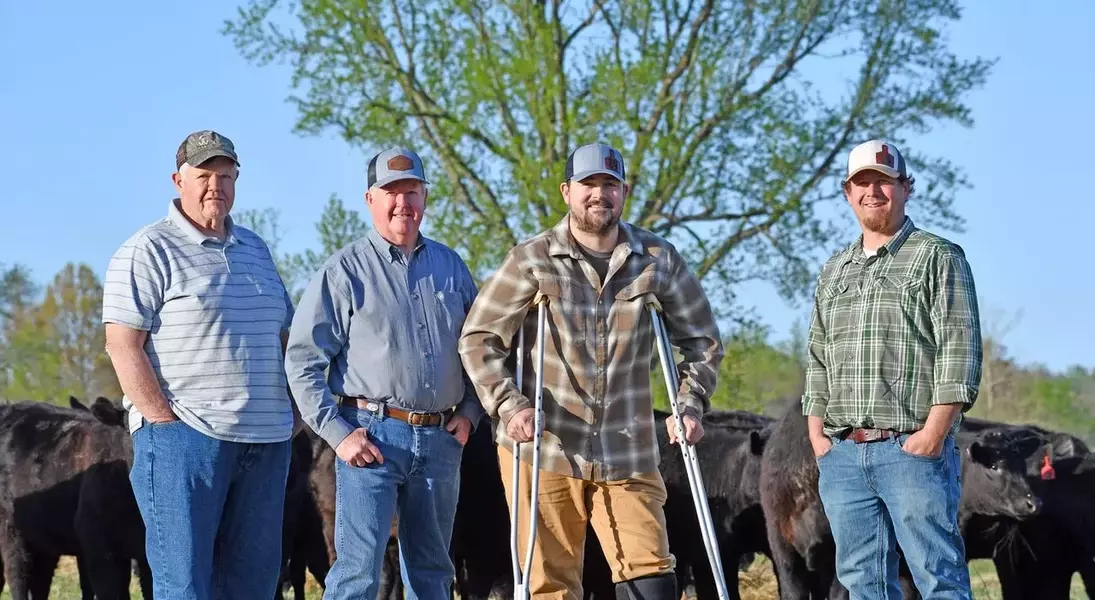
At the foot of the Ozark Mountains in Arkansas, the Carter family's 1852 Cattle Co. stands as a testament to enduring agricultural heritage and collaborative endeavor. This generational enterprise, managed by brothers Matt and Jon alongside their father Ron and uncle Rick, seamlessly integrates demanding professional careers with the rigorous demands of cattle farming. Their strategic focus on bred heifers and a commitment to streamlined operations highlight a modern approach to maintaining a historical family legacy in the livestock sector, spanning nearly 175 years.
The roots of the Carter family's agricultural venture delve deep into history, with the initial homestead established in 1852 by their ancestor, Rufus Harvison. Following Harvison's passing in 1879, the farm transitioned through generations to his daughter, who had married into the Carter lineage. Matt Carter reflects on this profound connection, noting that he and his relatives continue to manage cattle on the very same pastures where his great-great-great-grandfather once toiled. This continuous occupation of the land underscores a powerful sense of tradition and an unbroken chain of stewardship.
The family's landholdings have expanded considerably over time. From an initial 668 acres along Carter's Ridge Road near Sulphur Rock, the 1852 Cattle Co. recently acquired an additional 342 acres of the original Carter farm in 2023. This acquisition contributes to a total operational area of almost 1,500 acres, encompassing both owned and leased lands across five distinct farm properties. This strategic growth has enabled Matt and Jon to significantly increase their cattle operation, nurturing herds that can range from 200 to 300 heifers annually.
The division of labor within the Carter family is a remarkable display of teamwork. While Matt, Jon, and Ron hold full-time positions outside of farming—Matt as a manager at Greenway Equipment Store, Jon as a nurse practitioner, and Ron as a banker—they meticulously coordinate their schedules to ensure the farm runs smoothly. Rick, being retired from USDA Rural Development, provides additional support. Their passion for cattle began at an early age, with each brother receiving their first heifer around 13, and later, a 'graduation heifer' from their grandmother upon high school completion. These initial animals formed the foundation of their individual herds, whose bloodlines can still be traced today.
The primary focus of 1852 Cattle Co. is the breeding and sale of heifers. They acquire heifers in the spring, breed them, and then sell them as bred heifers later in the year or the following spring. This process demands careful timing and expert management, including monitoring pregnancies with veterinarians and performing genetic tests to ensure the health of unborn calves. While the initial investment in heifers has risen considerably from $440 to around $2,000, the Carters aim to achieve a significant profit margin, exemplified by recent sales of bred heifers for $3,000 each. They acknowledge the volatile nature of the cattle market but remain committed to their long-term strategy, always prepared for market fluctuations by considering the option of retaining heifers to calve out and raise their offspring.
The Carters' commitment extends beyond profit margins to sustainable and efficient farming practices. They emphasize reduced inputs, such as feeding minimal grain to mature cows and relying on grazing pastures for much of the year. During the winter, hay is provided until mid-April, with 1,800 to 2,000 bales produced on-farm each summer. Modernizing their equipment has been crucial to efficiency, as reliable machinery saves time for these part-time farmers. Family involvement is central, with the younger generation actively participating in daily farm tasks and learning from their elders, ensuring the knowledge and dedication required for such a demanding lifestyle are passed down. Despite external careers, the unwavering commitment to the daily needs of their herd and the preservation of their ancestral land remain paramount for the Carter family.
