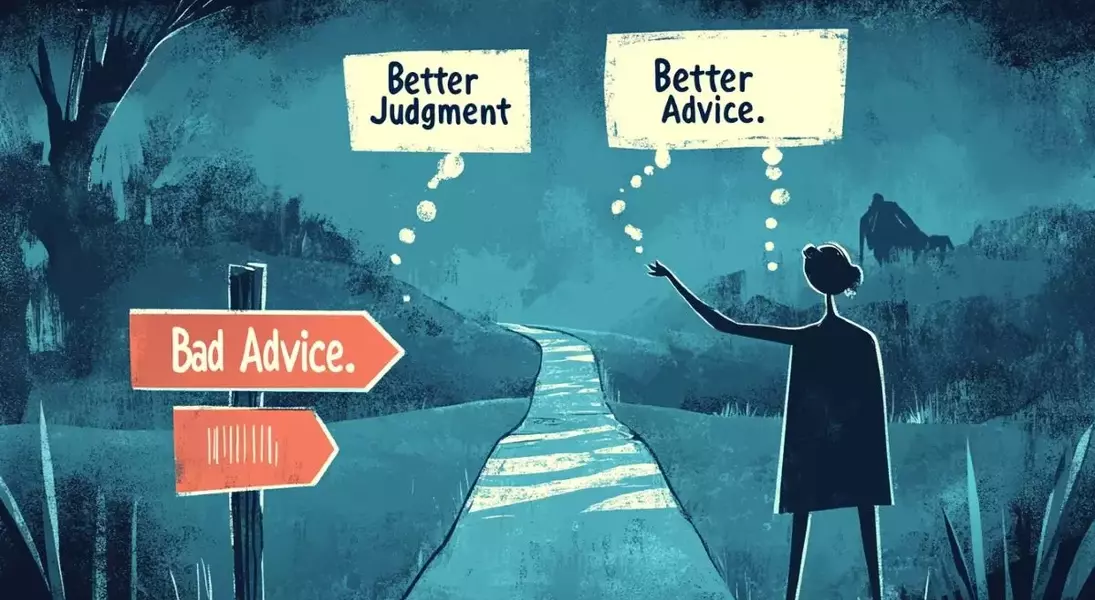
A recent study from Cornell University has uncovered an intriguing psychological phenomenon: individuals experience heightened feelings of responsibility and regret when they follow misguided advice compared to making poor decisions independently. Researchers discovered that disregarding one's own judgment in favor of another's input significantly amplifies thoughts about missed opportunities, leading to a stronger sense of personal accountability. Surprisingly, participants tended to blame themselves more for negative outcomes rather than attributing fault to the adviser. This research suggests that adhering to personal instincts can mitigate future feelings of remorse and culpability.
The investigation was led by Professor Kaitlin Woolley and Associate Professor Sunita Sah. Their study involved a series of experiments with over 3,200 participants. In one notable experiment, subjects were presented with two lotteries, one clearly offering superior rewards. An adviser, possessing no additional information, recommended the less favorable option. Participants who followed this advice often received minimal prizes, leading them to reflect on how they could have made better choices. These findings extend beyond trivial decisions, impacting significant life choices such as career paths.
The researchers found that the presence of an adviser did not diffuse responsibility as expected. Instead, it intensified self-blame and the perception of control over the outcome. Participants frequently pondered alternative scenarios where they had ignored the advice and achieved better results. This introspection magnified their feelings of regret and culpability.
This effect is particularly relevant in major life decisions. For instance, individuals may find themselves questioning what might have been if they had chosen a different career path. The research underscores the importance of trusting one's own judgment and rejecting suggestions that conflict with personal intuition. Contrary to popular belief, following someone else's advice does not shield individuals from blame or regret; instead, it intensifies these negative emotions.
The implications of this research are profound. It challenges the common assumption that external advice can alleviate personal responsibility. Instead, it highlights the value of staying true to one's own instincts and judgments. By doing so, individuals can potentially avoid the amplified feelings of regret and self-blame that come from going against their better judgment.
