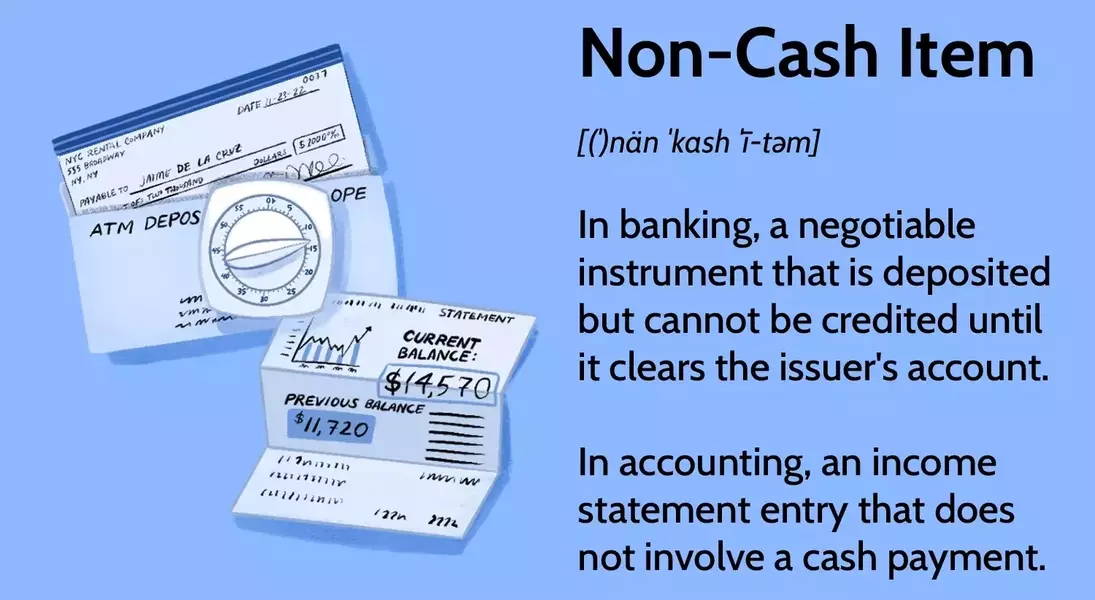
Non-cash transactions are vital elements in both banking and financial reporting, influencing a company's perceived profitability without directly altering its cash position. These items, ranging from checks awaiting clearance in banking to depreciation and amortization in accounting, provide a comprehensive view of an organization's financial landscape. However, they also introduce a degree of subjectivity and estimation, which can pose challenges for accurate financial assessment.
Understanding these non-cash components is essential for both internal financial management and external investment analysis. Their impact on income statements, balance sheets, and overall financial health necessitates a thorough and discerning approach. Investors, in particular, must look beyond the immediate figures to grasp the underlying financial realities, recognizing the potential for discrepancies arising from estimated values. A comprehensive evaluation of a company’s financial strength requires careful consideration of how these non-cash elements are recorded and their implications for long-term performance.
The Dual Nature of Non-Cash Transactions: Banking and Accounting Perspectives
Non-cash items encompass distinct concepts within the banking and accounting sectors, yet both ultimately relate to financial movements that do not involve immediate physical currency. In banking, these typically involve instruments like checks or bank drafts, which, upon deposit, require a processing period before funds are officially credited to an account. This intermediary phase, often referred to as 'float,' means that while the transaction has been initiated, the actual transfer of cash is pending. Thus, these banking non-cash items influence account balances and liquidity management, albeit indirectly, until the clearing process is complete.
Conversely, in accounting, non-cash items primarily refer to expenses recorded on an income statement that do not result in an outflow of cash during the reporting period. Central to accrual accounting, these items are crucial for aligning revenues with the expenses incurred to generate them, offering a more precise reflection of a company's profitability. Notable examples include depreciation, which accounts for the gradual reduction in value of tangible assets, and amortization, which does the same for intangible assets. Although these expenses reduce reported income and, consequently, tax liabilities, they do not diminish the company's cash reserves, thereby creating a divergence between a company's reported earnings and its actual cash flow.
Depreciation and Amortization: Key Non-Cash Expenses and Their Financial Implications
Depreciation and amortization stand out as two of the most prevalent non-cash expenses, playing a pivotal role in financial reporting by allocating the cost of assets over their useful lives. Depreciation is specifically applied to tangible assets, such as machinery or buildings, reflecting their wear and tear and obsolescence over time. For instance, when a manufacturing firm invests significantly in new equipment, rather than expensing the entire cost in the year of purchase, its accountants spread this cost over the asset's expected operational period, deducting a portion annually. This method ensures that the expense is recognized systematically, matching it with the revenue generated by the asset.
Similarly, amortization applies to intangible assets, like patents, copyrights, or goodwill, distributing their cost over their economic life. Both depreciation and amortization reduce a company's reported taxable income without any corresponding cash outlay in the current period. This characteristic makes them critical for understanding a company's true financial performance and tax efficiency. However, the calculation of these non-cash charges often relies on estimates—such as an asset's useful life and its salvage value—which can introduce an element of uncertainty. Inaccurate estimates may distort a company's financial picture, potentially leading to over- or under-reported earnings and requiring careful scrutiny from investors to evaluate the underlying financial health.
