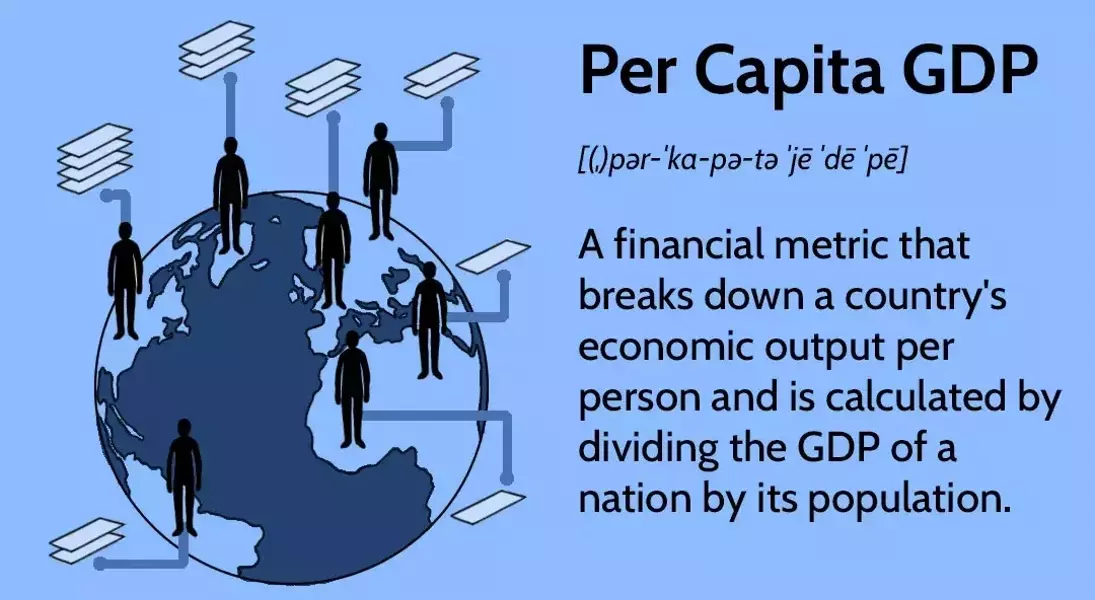
This article explores GDP per capita as a key economic indicator, detailing its calculation, implications, and global trends. It aims to clarify how this metric provides insight into a nation's economic health and standard of living, contrasting it with overall GDP and examining factors influencing its growth.
Unlocking National Wealth: The Power of GDP Per Capita
Defining Economic Output Per Person
GDP per capita serves as an economic yardstick that quantifies a country's total economic output on a per-person basis. It's a crucial tool for economists to gauge the prosperity of nations and compare their economic development. Typically, countries with higher GDP per capita are industrialized, developed, and often have smaller populations.
How GDP Per Capita Reveals National Prosperity
GDP per capita is a globally recognized metric for evaluating the economic prosperity of nations. Its widespread use stems from the ease of tracking and calculating its components worldwide. While income per capita also assesses global prosperity, GDP per capita is more broadly applied.
At its core, GDP per capita illustrates the economic production value attributable to each individual citizen. This figure directly reflects a nation's wealth and serves as a fundamental measure of prosperity.
Distinguishing Per Capita GDP from Overall GDP
While GDP measures a country's total economic productivity, GDP per capita offers a more nuanced view by accounting for population. The Bureau of Economic Analysis (BEA) regularly reports U.S. GDP, providing insights into economic health. Legislators use these figures for fiscal policy, and central bankers consider them for monetary policy decisions. GDP per capita, however, adds the dimension of individual contribution to economic output, making it essential to understand how both GDP and population influence this figure.
The Broad Implications of GDP Per Capita
Governments utilize GDP per capita to monitor their economic growth relative to population changes, offering valuable insights into national demographic influences. Analyzing the individual contributions of GDP and population helps in understanding economic expansion or contraction.
For instance, if GDP per capita increases while the population remains stable, it could indicate technological advancements boosting productivity. Technology is a transformative force that can elevate per capita rankings even if population levels are static or decreasing.
Addressing Negative GDP Per Capita Trends
Even with consistent economic growth, GDP per capita can decline if population growth outpaces economic expansion. This is generally not a concern for established economies, where economic growth typically surpasses population increases. However, countries with low initial GDP per capita, rapidly expanding populations, and minimal economic growth, such as some African nations, may face a continuous decline in living standards.
The Interplay of GDP and Population Dynamics
Both GDP and population significantly influence GDP per capita. Therefore, countries with the highest overall GDP might not necessarily have the highest GDP per capita. For example, global GDP per capita saw an average decrease of 1.9% in 2023, according to World Bank data. Despite large populations, economies like China and India have achieved significant GDP per capita growth rates this century, thanks to financial reforms.
Nations Leading in GDP Per Capita
The International Monetary Fund (IMF) identifies the following countries as having the highest GDP per capita in 2025:
| Highest GDP Per Capita | |
|---|---|
| Country | GDP Per Capita (USD) |
| Luxembourg | $141.08 thousand |
| Switzerland | $111.72 thousand |
| Ireland | $107.24 thousand |
| Singapore | $93.96 thousand |
| Norway | $90.32 thousand |
| Iceland | $90.11 thousand |
| United States | $89.68 thousand |
| Macao SAR | $84.28 thousand |
| Qatar | $72.76 thousand |
| Denmark | $71.97 thousand |
Many of these nations have relatively small populations, such as Luxembourg with approximately 688,000 residents. They often thrive as energy exporters, financial hubs, or robust export-oriented economies.
Nations Trailing in GDP Per Capita
Conversely, the IMF projects the following countries to have the lowest GDP per capita in 2025:
| Lowest GDP Per Capita | |
|---|---|
| Country | GDP Per Capita ($) |
| Burundi | $156.5 |
| South Sudan | $334.14 |
| Malawi | $448.29 |
| Yemen | $455.46 |
| Central African Republic | $548.83 |
| Madagascar | $575.74 |
| Sudan | $594.9 |
| Mozambique | $684.97 |
| Congo | $743.65 |
| Niger | $752.15 |
Forecasting Future Global Economic Trends
The IMF regularly issues global GDP growth forecasts, which directly impact projections for GDP per capita growth. For 2025 and 2026, the IMF anticipates global GDP growth of 3.3%. This is largely attributed to an optimistic outlook for the U.S. economy, which helps offset declines in other major economies, alongside a reduction in global inflation.
Advanced economies are expected to see moderate growth, increasing from 1.7% in 2024 to 1.9% in 2025 and 1.8% in 2026. Developing economies, while maintaining higher growth rates than advanced economies, are projected to experience consistent, albeit modest, growth of 4.2% in both 2024 and 2025, rising slightly to 4.3% in 2026.
Calculation of GDP Per Capita
GDP per capita is determined by dividing a country's total Gross Domestic Product by its population, serving as an indicator of the nation's standard of living.
Leading Nations by GDP Per Capita
Highly industrialized and developed nations typically exhibit the highest GDP per capita. The IMF identifies Luxembourg, Switzerland, and Ireland as the top three countries in this category for 2025.
Distinction Between GDP Per Capita and Per Capita Income
GDP per capita quantifies a nation's economic output per person, reflecting its overall prosperity. In contrast, per capita income measures the average income earned per person, which gauges the standard of living and quality of life within a population.
Nations with the Lowest GDP Per Capita
According to IMF data, Burundi, South Sudan, and Malawi are projected to have the lowest GDP per capita among the countries for which data is available in 2025.
Countries with the Largest Populations
As of 2025, India holds the distinction of having the highest population globally, with an estimated 1.46 billion people, as reported by the World Population Review.
Concluding Thoughts on GDP Per Capita
GDP per capita is an invaluable metric for evaluating a country's average prosperity and well-being. By incorporating population figures, it facilitates meaningful comparisons of economic productivity across diverse nations, providing a comprehensive view of global economic health.
