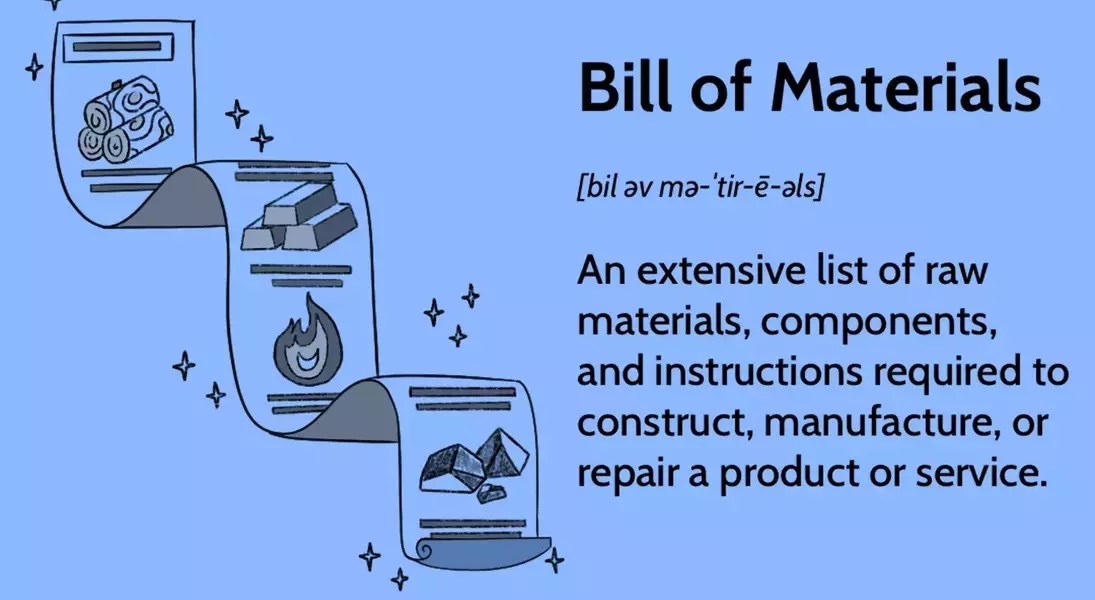
A bill of materials (BOM) serves as a comprehensive blueprint for constructing, manufacturing, or repairing a product. It details the raw materials, components, and step-by-step instructions needed to ensure efficient production. BOMs are crucial for both engineering design and manufacturing, as they ensure an efficient assembly process by detailing every required part and component. Accurate BOMs help in reducing waste, streamlining production, and ensuring necessary parts are available, thus avoiding costly production delays. BOM displays come in two formats: explosion displays break down assemblies into individual components, while implosion displays aggregate parts into their overarching assemblies. BOMs play a pivotal role in inventory management and production scheduling within enterprise resource planning (ERP) and materials requirement planning (MRP) systems.
A bill of materials (BOM) functions as a fundamental guide for manufacturing, detailing all necessary elements and steps to produce an item. This document places the final product at the top, followed by its constituent parts and raw materials, effectively acting as a central information hub. In the engineering phase, an engineering BOM delineates the design specifications, while a manufacturing BOM provides the framework for the assembly line. Each entry in a BOM specifies the product code, part name, serial number, revision level, description, quantity, measurement unit, dimensions, weight, and other relevant specifications. It also includes details about alternative and substitute parts, as well as those indicated in technical drawings.
Effective utilization of a BOM is paramount for manufacturers to optimize their assembly processes. An accurate BOM guarantees that all required parts are accessible precisely when needed, fostering an uninterrupted and efficient production flow. Conversely, inaccuracies in a BOM can lead to significant production delays, as time must be spent sourcing missing components, consequently inflating operational expenses. Moreover, manufacturing BOMs are integral to the architecture of Enterprise Resource Planning (ERP) and Material Requirements Planning (MRP) systems, underpinning inventory management and production scheduling. These systems rely on precise BOM data to forecast material needs, manage stock levels, and coordinate production activities, thereby minimizing waste and maximizing efficiency.
BOM information is presented in one of two formats: explosion or implosion. An explosion display systematically breaks down a complex assembly into its individual constituent parts, offering a granular view of every component. For instance, a computer can be exploded into its primary elements such as hard drives, processing chips, random access memory modules, and central processing units. Each central processing unit can then be further exploded into its arithmetic unit, control unit, and register components. Conversely, an implosion display aggregates lower-level parts into their respective higher-level assemblies. This means the requirements for the arithmetic unit, control unit, and register are consolidated to form the requirements for the central processing unit, which in turn are integrated into the overall requirements for the computer. This dual display capability allows for flexible analysis, catering to different perspectives within the product development and manufacturing lifecycle.
In essence, a bill of materials is an indispensable tool in both engineering and manufacturing, meticulously cataloging all parts and raw materials essential for product fabrication. By maintaining an accurate BOM, businesses can significantly cut down on material waste, streamline their production lines, and guarantee the timely availability of components. This strategic approach to material management is vital for controlling operational costs and enhancing overall efficiency in the competitive landscape of modern manufacturing.
