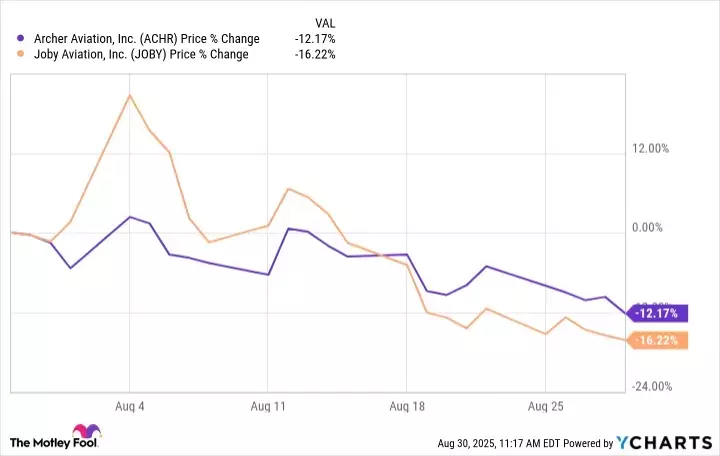

In the burgeoning sector of urban air mobility, two prominent players, Archer Aviation and Joby Aviation, have recently experienced notable dips in their stock performance. Despite these short-term fluctuations, both companies demonstrate robust operational progress and strategic maneuvers that signal a strong long-term outlook. This period of market correction, rather than indicating fundamental weakness, could present a strategic entry point for forward-thinking investors who recognize the profound, multi-decade transformation these companies aim to bring to the transportation landscape. Their current valuations, while reflecting ambitious growth projections, are tempered by recent declines, making the future of eVTOLs a compelling narrative for patient capital.
Archer Aviation's journey from a conceptual enterprise to a manufacturing frontrunner, coupled with Joby Aviation's focus on vertical integration and strategic partnerships, underscores their potential to revolutionize travel. Each company has secured substantial financial backing and achieved significant milestones, from accelerated production schedules and high-profile collaborations to groundbreaking flight demonstrations. The volatility observed in their stock prices is an inherent characteristic of innovative sectors operating on long development timelines. However, the foundational advancements and the expanding addressable market suggest that these enterprises are not merely chasing hype but are actively building the infrastructure for a new era of air travel, inviting investors to look beyond immediate returns towards a future shaped by electric vertical takeoff and landing technologies.
Archer Aviation's Strategic Ascent in Urban Air Mobility
Archer Aviation, an emerging force in the electric vertical takeoff and landing (eVTOL) industry, has showcased remarkable progress, transitioning from a nascent concept to a formidable manufacturing entity. Despite a recent 12.2% decline in its stock price over the last 30 days, the company's fundamentals appear robust. Archer concluded the second quarter of 2025 with an impressive $1.7 billion in cash reserves, significantly outpacing its closest rivals. The initiation of production for six Midnight aircraft marks a pivotal moment, aligning with its role as the official air taxi provider for the 2028 Los Angeles Olympics. This high-profile partnership not only elevates Archer's public profile but also serves as a crucial validation of its technology and operational capabilities, potentially streamlining its certification process through government support and national priority status.
Furthermore, Archer's strategic pivot towards defense, evidenced by its acquisitions of Overair's patent portfolio and a defense composite manufacturing facility, is designed to secure military contracts and diversify revenue streams during its commercial rollout. This strategy mitigates risks associated with a purely commercial timeline, ensuring financial stability and advanced technological development. The company's international expansion into key markets such as the UAE, Ethiopia, and Indonesia, including a multiyear collaboration with Abu Dhabi Aviation, highlights its ambition for global market penetration. These strategic initiatives collectively underscore Archer's long-term vision and its potential to establish a dominant position in the evolving urban air mobility sector, despite current market volatility.
Joby Aviation: Pioneering Vertical Integration and Market Expansion
Joby Aviation has made significant strides in the eVTOL space, emphasizing vertical integration and strategic collaborations to solidify its market leadership. Despite a 16.2% dip from its recent peak share price, Joby’s operational achievements remain noteworthy. The company made history in August 2025 by successfully conducting the first piloted eVTOL flight between two public airports, a testament to its technological prowess and commitment to safety. With a substantial cash reserve of $991 million, Joby is well-positioned to continue its trajectory as a leader in urban air mobility. Its acquisition of Blade Air Mobility's passenger business is a game-changer, providing immediate access to established demand pipelines and real operational routes. This strategic move effectively secures a foundational customer base, ensuring that Joby will have passengers ready for service as soon as regulatory certifications are obtained, thereby significantly de-risking its market entry strategy.
The strategic investment from Toyota Motor Corporation further strengthens Joby's competitive edge. Toyota’s involvement brings invaluable supply chain discipline and manufacturing expertise, critical components for scaling production—a common hurdle for aerospace start-ups. This partnership signals confidence in Joby's ability to transition from prototyping to mass production efficiently and effectively. While Joby’s current valuation of $12 billion reflects a venture-style multiple, the recent market pullback, which has shed nearly $2 billion from its peak valuation, offers a more grounded entry point for investors. Joby’s commitment to building a comprehensive, vertically integrated ecosystem, supported by strong financial backing and strategic alliances, positions it for sustained growth in the long-term urban air mobility market, making it an attractive prospect for patient investors willing to weather initial market turbulences.
