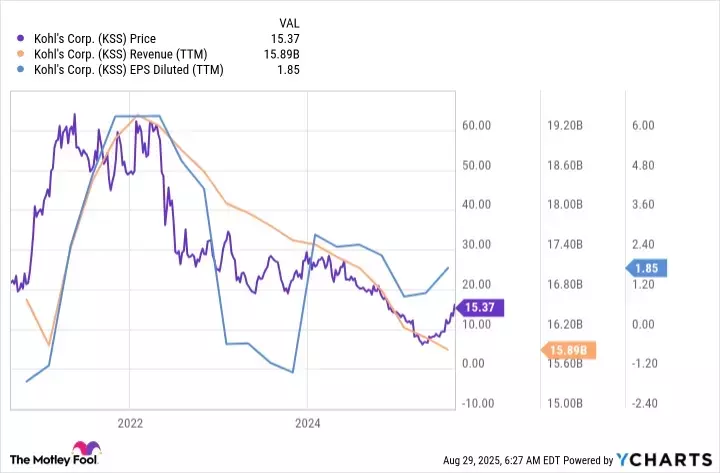

Kohl's recent second-quarter performance sparked considerable market interest, with its stock experiencing a significant jump after exceeding analyst expectations. While the headline figures painted a positive picture, indicating a potential rebound for the beleaguered department store chain, a more thorough analysis reveals underlying vulnerabilities. The improved earnings, though encouraging, do not fully mask a persistent decline in key operational metrics, suggesting that the company's path to sustainable recovery remains fraught with challenges. Investors are urged to look beyond the immediate financial beat and consider the broader context of the retailer's strategic direction and market position, especially given the continued leadership vacuum at the CEO level.
Despite the recent uptick in stock value following its better-than-expected second-quarter earnings, Kohl's continues to navigate a complex and uncertain retail landscape. The company's financial health, characterized by a prolonged period of weak revenue and earnings since the initial post-pandemic recovery, necessitates a cautious approach. The absence of a permanent CEO introduces further instability, as future strategic shifts under new leadership could significantly alter the current operational trajectory. Therefore, while the immediate financial results offer a glimmer of hope, the long-term prognosis for Kohl's hinges on addressing these fundamental issues and demonstrating a sustained ability to attract and retain customer loyalty.
Kohl's Q2 Performance: A Mixed Bag of Surprises and Concerns
Kohl's recently reported its second-quarter earnings, surprising Wall Street by significantly surpassing profit estimates, which led to a notable increase in its share price. The company announced adjusted earnings of $0.56 per share against an anticipated $0.29, alongside revenues of $3.35 billion, slightly above the $3.32 billion forecast. This unexpected positive outcome provided a temporary boost to investor confidence, particularly given the retailer's recent struggles and the ongoing challenges within the broader department store sector. The market's initial reaction underscored the relief that the company was performing better than feared.
While the earnings beat was a welcome development, a deeper dive into the specifics of Kohl's second-quarter report reveals that the company is still in the midst of a challenging turnaround. Despite exceeding analyst expectations, total revenue saw a year-over-year decline of 5.1%, and crucial same-store sales, a key indicator of retail health, decreased by 4.2%. These figures highlight that the company continues to face difficulties in attracting and retaining customers, a fundamental issue that a single positive earnings surprise cannot fully resolve. The fact that the company managed to cut costs and improve gross margin suggests internal operational efficiencies, but without a corresponding growth in customer engagement and sales, the long-term sustainability of this recovery remains questionable. The comparison to competitors, such as Dollar General, which reported healthy increases in both sales and customer traffic, further underscores the uphill battle Kohl's faces in revitalizing its brand and market presence. The narrative for Kohl's appears to be less about a robust resurgence and more about mitigating further decline, positioning it as a risky proposition for all but the most speculative investors.
Navigating Uncertainty: Leadership Void and Turnaround Progress
A significant factor contributing to the uncertainty surrounding Kohl's future is the ongoing search for a permanent CEO. The departure of the previous chief executive without a successor in place creates a leadership void that could impede any long-term strategic planning and execution. This lack of stable leadership makes it difficult to assess the durability of any operational improvements, as a new CEO might introduce a completely different vision, potentially undoing current initiatives. The company's future direction remains fluid until a permanent leader is appointed, making it challenging for investors to project its trajectory with confidence.
The current state of Kohl's turnaround efforts suggests that while the company has made some progress in financial management, it has not yet achieved a fundamental shift in its market standing. The observed improvements in gross margin and cost reduction are positive signs of internal optimization, but these gains are overshadowed by the persistent decline in customer-facing metrics like revenue and same-store sales. For a true turnaround, Kohl's needs to not only control costs but also re-engage its customer base and boost sales volume. The absence of a permanent CEO further complicates this, as strategic decisions that could drive customer traffic and brand relevance are either on hold or subject to revision. Until the company can demonstrate a consistent ability to attract shoppers back into its stores and stabilize its top-line performance under consistent leadership, the current recovery is best viewed with caution, and its stock primarily suited for investors with a high tolerance for risk and a strong belief in its eventual long-term resurgence.
