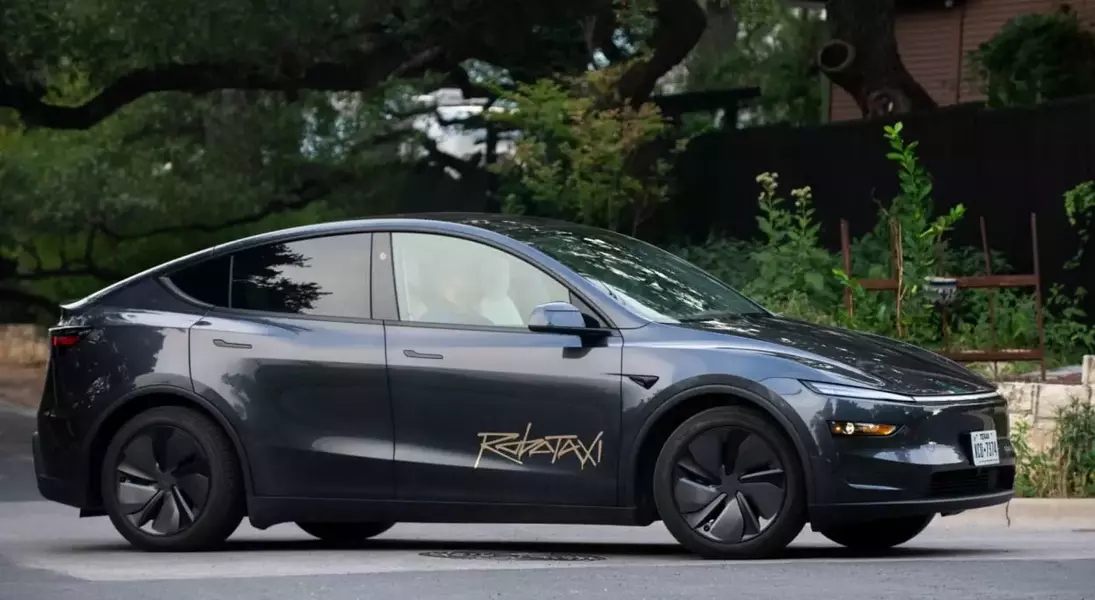
Tesla's autonomous driving technology is poised for a significant leap, with ambitious plans to transform urban transportation. The company envisions a future where its self-driving vehicles become a common sight across major U.S. cities, fundamentally altering how people commute and interact with mobility services.
Revolutionizing Urban Mobility: Tesla's Bold Vision for Driverless Taxis
From Limited Scope to Widespread Availability: Tesla's Robotaxi Rollout Plan
Tesla's CEO, Elon Musk, has unveiled an audacious timeline for the company's autonomous taxi service, Robotaxi. While operations are currently confined to a specific zone in Austin, Texas, Musk articulated a vision during a recent earnings call for Robotaxi to serve approximately half of the United States' population by the conclusion of 2025. This aggressive expansion hinges on securing necessary regulatory approvals across various states, including California's Bay Area, Nevada, Arizona, and Florida, among others.
Navigating Regulatory Pathways: The Path to Broader Robotaxi Access
Musk emphasized a cautious approach to the deployment of Robotaxi, acknowledging the critical role of regulatory bodies in granting permission for widespread operation. Despite this prudence, he anticipates an accelerated growth trajectory for the service areas and the number of operational vehicles, describing it as a \"hyper-exponential rate.\" This projection underscores Tesla's confidence in its full self-driving (FSD) technology, which forms the backbone of the Robotaxi initiative.
Scaling Up Operations: Tesla's Strategy for Rapid Robotaxi Expansion
The current scale of Tesla's Robotaxi service is relatively modest, utilizing an estimated 10-20 Model Y vehicles in a restricted pilot program. However, the company's expansion strategy relies on a distinct advantage over rivals. Unlike competitors such as Waymo and Zoox, which equip their autonomous vehicles with a suite of additional sensors like lidar and radar, Tesla's Robotaxis are built upon standard production Model Y cars, relying primarily on cameras and advanced AI for navigation. This design choice could enable Tesla to scale its service much more rapidly, provided regulatory bodies greenlight its technology.
Competitive Landscape: Tesla's Approach Versus Industry Peers
The autonomous vehicle market features several prominent players, each with a unique operational model. Waymo, a subsidiary of Alphabet, has already established a presence in multiple major U.S. cities, including San Francisco, Los Angeles, and Phoenix, with plans for further expansion into Miami and Washington D.C. by 2026. The contrast in technological approaches—Tesla's camera-centric system versus competitors' reliance on a broader array of sensors—highlights divergent philosophies in achieving full autonomy and market penetration.
