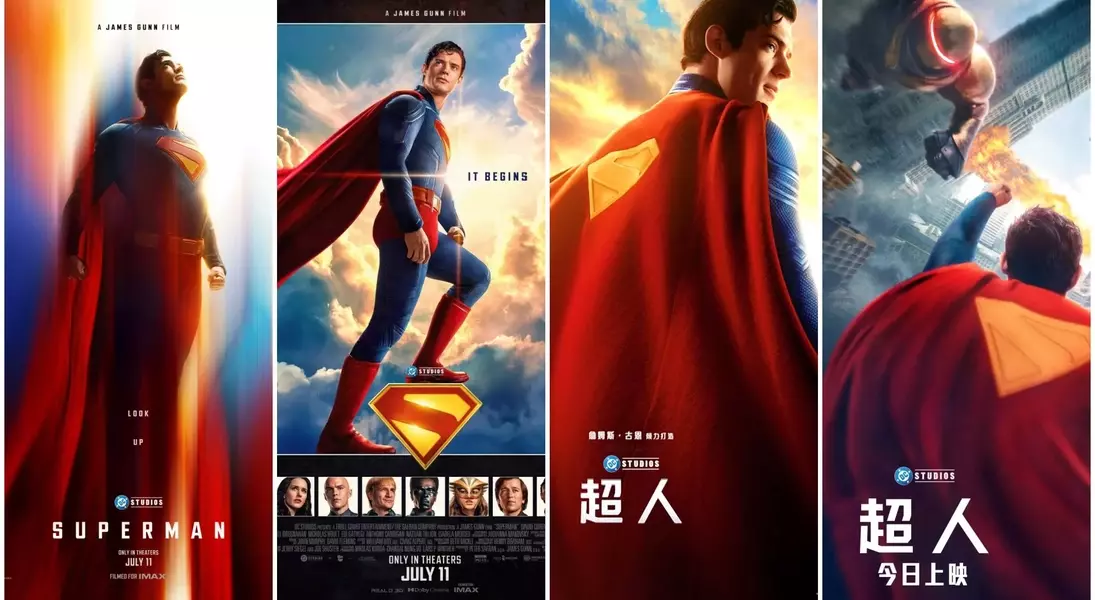
James Gunn's latest Superman cinematic release has achieved considerable success within its home market, yet its performance on the global stage has presented a more complex narrative. The film, a significant undertaking for DC Studios under Gunn and Peter Safran's leadership, garnered a robust domestic opening. However, its international box office figures fell short of initial expectations, signaling a potential shift in the global distribution landscape for major Hollywood productions.
Historically, the character of Superman, deeply entwined with American ideals, has seen varying degrees of international acceptance. Early cinematic depictions often embraced the character's 'American Way' ethos. However, as global markets became increasingly vital to a film's financial viability, studios began adjusting their marketing strategies. For instance, in 2006, Warner Bros. and director Bryan Singer opted to omit the 'American Way' slogan when promoting 'Superman Returns' to a worldwide audience, a clear acknowledgment of the evolving international sensitivities. This strategic pivot proved somewhat effective, with nearly half of 'Superman Returns'' global revenue stemming from foreign markets.
Later, Zack Snyder's 2013 rendition, 'Man of Steel'—notably omitting 'Superman' from its primary title—further underscored the growing importance of international sales, with overseas ticket purchases contributing significantly more than domestic earnings to its total global gross. The trend continued with Snyder's 'Batman v Superman: Dawn of Justice' in 2016, where foreign markets, particularly China, became the dominant source of revenue, accounting for over 60 percent of the film's total. This pattern was once common, with major Hollywood features frequently seeing 60 to 70 percent of their earnings from outside the U.S.
However, the global film distribution landscape has undergone considerable transformation, particularly post-pandemic. Geopolitical factors, including shifting relations with key markets like China, have impacted the profitability of Hollywood blockbusters. The Chinese government, for example, has increasingly favored domestic productions, making it challenging for Western films to secure prime exhibition slots. Moreover, the political climate, implicitly referenced by Gunn, contributes to an anti-American sentiment that can affect a film's reception abroad. Despite these challenges, Gunn intentionally softened the patriotic overtone in his 'Superman' film, altering 'the American way' to 'the human way' in a bid for broader appeal.
Despite a strong overall showing that saw 'Superman' cross the $400 million global mark in under two weeks, its international share remained at 42 percent during its opening weekend, indicating a significant divergence from past performance metrics. While the film has demonstrated resilience in mid-week performance, its overseas struggles are further compounded by intense competition. Notably, Universal and Amblin's 'Jurassic World Rebirth,' released shortly before 'Superman,' has achieved remarkable international success, including a strong performance in China, a market where 'Superman' has struggled to gain traction. The film's strongest international markets currently include the U.K., Mexico, Australia, France, and China. Industry analysts acknowledge the difficult position DC and 'Superman' find themselves in, with one studio executive remarking on the perceived disappointment in its international figures, despite adequate overall performance.
While 'Superman' has shown strength domestically, its path to global dominance faces hurdles posed by a changed geopolitical environment and fierce market competition. The film's efforts to resonate more universally reflect a strategic adaptation to these shifts, yet the international box office continues to present a complex and evolving challenge for superhero franchises.
