Charles Schulz's legendary comic strip, Peanuts, captivated audiences for half a century, from 1950 to 2000, leaving an indelible mark on popular culture. Beyond its extensive run of nearly 18,000 daily strips, it introduced a rich tapestry of characters, including the thoughtful Linus van Pelt and the ever-present Charlie Brown. Yet, among this memorable ensemble, none shone brighter than Snoopy, the philosophical beagle whose silent wisdom, conveyed through thought bubbles, consistently offered readers a unique blend of humor and insight. His ability to navigate life's absurdities with a lighthearted yet profound outlook cemented his status as a cherished icon.
Snoopy, despite being a dog incapable of spoken dialogue with his human companions, possessed a rich inner world of thoughts and observations. Schulz masterfully translated these into poignant thought bubbles, providing a window into Snoopy's comedic yet often deeply reflective mind. The comic strip, while never overtly serious, skillfully balanced lightheartedness with moments of profound introspection. Snoopy's philosophical musings, delivered with a charming lack of self-importance, frequently prompted readers to pause and contemplate their own lives, demonstrating the enduring power of his seemingly simple advice.
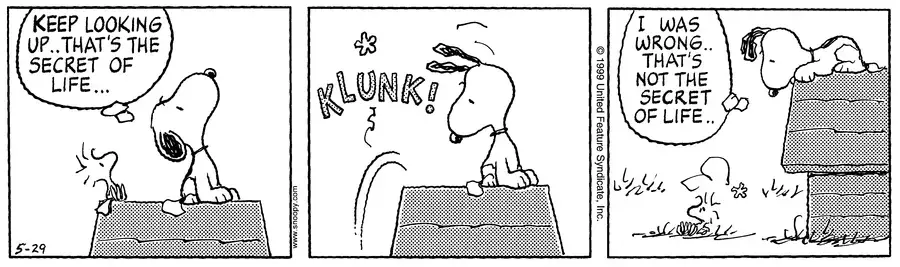
One particular moment, captured in a strip from May 29, 1999, perfectly encapsulates Snoopy's essence. Perched atop his iconic red doghouse with his trusted friend Woodstock, Snoopy gazes skyward and declares, "Keep looking up...that's the secret to life." This optimistic pronouncement, however, is immediately followed by a humorous twist. As Woodstock, positioned too close to the edge, tumbles out of sight, Snoopy re-evaluates, looking down at the ground to admit, "I was wrong...that's not the secret to life..." This sequence beautifully illustrates the inherent optimism tempered by a dose of reality that defined the Peanuts strip throughout its five-decade run. The directness of the sentiment, coming from a character who literally spent much of his existence staring upwards from his doghouse, is precisely what makes it so impactful.
Snoopy's existence, like life itself, was not without its share of disappointments – rejections, inclement weather, empty food bowls, and unpublished novels. Yet, his characteristic response was rarely to dwell on these setbacks. Instead, he embraced the unexpected, embodying a philosophy of hoping for the best while remaining prepared for life's inevitable detours. This sound advice, offered by Charles Schulz decades ago, continues to resonate, reminding us that resilience and a pragmatic optimism are timeless virtues.
The enduring appeal of Snoopy's philosophy lies in its ability to mirror the complexities of the human experience. His thoughtful yet humorous takes on life's challenges, as exemplified by his 'keep looking up' moment, continue to provide comfort and inspiration. It is a testament to Schulz's genius that a silent beagle could convey such profound truths, offering generations of readers a gentle reminder to maintain perspective, embrace change, and find joy even in the face of adversity.
