The conventional wisdom in investing suggests that smaller companies, due to their inherent risk and volatility, should generally offer superior returns to compensate investors. Yet, a look back at the past ten years presents a counter-narrative, revealing that larger, more established companies have in fact delivered more substantial gains. This intriguing shift in market dynamics compels a deeper examination of the factors at play and their implications for future investment strategies. While historical performance is never a guaranteed indicator of future results, the recent trends in small-cap underperformance versus large-cap dominance highlight a unique period shaped by specific economic and technological forces. This analysis aims to shed light on why this divergence occurred and what it might mean for the investment landscape in the coming decade, suggesting a potential recalibration of expectations for both small and large capitalization assets.
Assessing the investment landscape reveals a distinct divergence in performance between small-cap and large-cap equities over the last decade. While small-caps are traditionally associated with amplified growth potential, demanding higher risk tolerance from investors, their recent track record has been less stellar than anticipated. This period has been shaped by an unusual market environment, where a select group of leading companies experienced remarkable expansion. The expectation that smaller enterprises would yield greater net gains, despite their elevated risk and fluctuations, has not been consistently met.
A Decade of Underperformance for Small-Cap Stocks
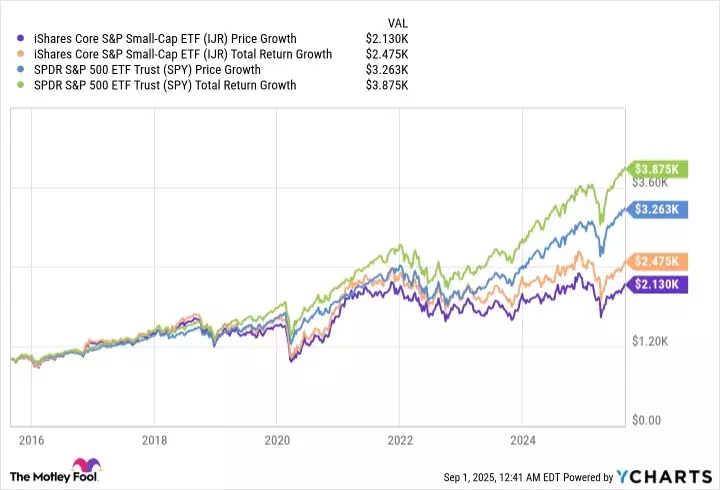
Over the past ten years, small-cap stocks have surprisingly underperformed their large-cap counterparts, despite the expectation of higher returns for greater risk. An initial investment of $1,000 in a broad small-cap ETF, like the iShares Core S&P Small-Cap ETF (IJR), would have grown to $2,130, or $2,475 with dividends reinvested, by early September 2025. While this represents a notable gain, it pales in comparison to the performance of large-cap investments over the same period. This unexpected trend challenges the long-held investment principle that small-cap stocks, given their increased risk and volatility, should inherently deliver superior returns.
Specifically, a $1,000 investment made simultaneously in the SPDR S&P 500 ETF Trust (SPY), which tracks the performance of the S&P 500 large-cap index, would have appreciated to $3,263, or an impressive $3,875 with dividends reinvested. This translates to an average annual gain of 14.5% for SPY, significantly outperforming IJR's average yearly gain of 9.5%. This considerable disparity in returns indicates that the past decade has been an anomaly, largely influenced by the exceptional growth of a few dominant large-cap companies. This era saw these corporate giants drive overall market performance, overshadowing the contributions of smaller firms. Such a scenario suggests that the traditional risk-reward relationship for small-caps did not hold true during this specific period, prompting investors to re-evaluate their portfolios and strategies for future market conditions.
The Shifting Tides: Future Prospects for Market Dynamics
The unusual market dynamics of the past decade, heavily influenced by the outsized success of a handful of mega-cap companies, suggest that future market environments might unfold quite differently. This period has seen an influx of startups, many of which struggle with profitability, leading to questions about their long-term viability. The current landscape implies that investors may need to adopt a more discerning approach to smaller companies, focusing on those with robust fundamentals and sustainable business models. This heightened scrutiny could naturally filter out weaker prospects, leading to a market where only the most promising small-cap entities attract significant investment.
Looking ahead, a shift toward a more selective investment climate for small-cap stocks could paradoxically create a more favorable environment for quality companies within this segment. If investors become more rigorous in their evaluation of startups, only those with strong business cases and clear paths to profitability will secure funding. This evolutionary pressure could result in a healthier, more robust small-cap market characterized by fewer, but higher-performing, publicly traded companies. Consequently, the coming decade may see a return to the traditional expectation of small-cap stocks delivering superior returns, but with a renewed emphasis on quality and fundamental strength rather than speculative growth, thereby creating a compelling, long-term opportunity for strategic investors.
