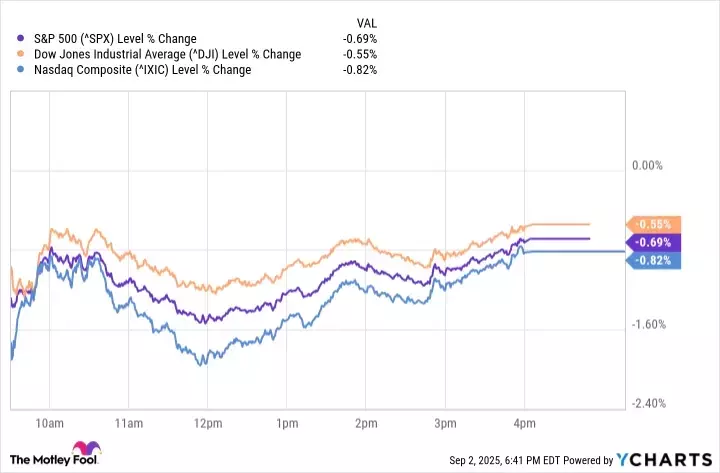
Major U.S. stock indices, including the S&P 500, Nasdaq Composite, and Dow Jones Industrial Average, began September with notable declines. This downturn reflects a confluence of factors, including historical seasonal patterns, increasing bond yields, and lingering concerns about inflation and trade tariffs. The market's cautious stance is further exacerbated by political uncertainties surrounding Federal Reserve independence and government debt. As investors brace for upcoming economic data, the prevailing sentiment is one of apprehension regarding future market trajectory and monetary policy.
The market's performance at the outset of September underscores a broader risk aversion among investors. With all three major benchmarks experiencing losses, the tech sector, in particular, displayed vulnerability to rising yields. The consistent downward trend across these diverse indices highlights a pervasive sense of caution as the financial community navigates a complex economic landscape. The focus remains keenly on forthcoming economic indicators, which are expected to heavily influence the Federal Reserve's next strategic moves, shaping the investment environment for the coming months.
Market Weakness Initiates September Trading
The commencement of September saw significant U.S. stock indices, comprising the S&P 500, Nasdaq Composite, and Dow Jones Industrial Average, register declines. This market downturn is largely due to anticipated seasonal patterns, rising bond yields, and amplified worries regarding inflationary pressures and trade tariffs. Market participants are keenly awaiting new economic reports, as these are poised to influence the Federal Reserve’s next policy steps, adding to the prevailing cautious market mood.
U.S. markets opened September on a defensive note, with all three major benchmarks experiencing declines. The S&P 500 dropped by 0.69% to 6,415.54, the Nasdaq Composite fell by 0.82% to 21,279.63, and the Dow Jones Industrial Average slipped by 0.55% to 45,295.81. This widespread weakness signals a risk-off sentiment among investors. The tech sector, notably, showed increased susceptibility due to elevated bond yields and persistent worries about inflation and tariff uncertainties. Analysts have pointed to the historical \"September Effect,\" where the S&P 500 typically sees an average decline of 0.8% during the month. This seasonal headwind, coupled with political tensions over Fed independence and concerns about government debt, further amplified the bearish outlook. Traders are now focusing on crucial economic reports, including jobs data and inflation updates, which will provide vital insights into the Federal Reserve's potential policy adjustments. This combination of seasonal trends and macroeconomic uncertainty sets a cautious tone for the market at the start of September.
Navigating Economic Headwinds and Policy Anticipation
The current market landscape is characterized by prevailing economic headwinds and a strong anticipation of future policy decisions. Historical data indicates that September often brings seasonal market weakness, a trend that appears to be unfolding this year. Heightened political tensions concerning the Federal Reserve's autonomy and the nation's burgeoning government debt are contributing to a negative market bias. Investors are closely monitoring upcoming economic reports, as these will be critical in guiding the Federal Reserve's next policy moves and determining market stability.
The market's performance in early September is heavily influenced by a combination of seasonal factors and macroeconomic uncertainty. Historically, September has been a challenging month for equities, a pattern known as the \"September Effect,\" which typically sees the S&P 500 decline. This year, the effect is compounded by rising bond yields, which make equities less attractive, and renewed concerns about inflation and tariff uncertainty, further dampening investor confidence. Political tensions surrounding the Federal Reserve's independence and the ongoing debate over government debt also contribute to the cautious sentiment, amplifying the downside risks. As a result, investors are adopting a defensive posture, repositioning their portfolios in anticipation of potential market volatility. The upcoming release of key economic indicators, such as employment figures and inflation data, will be pivotal. These reports are expected to provide the Federal Reserve with crucial information to inform its next policy decisions, including potential interest rate adjustments, which could significantly impact market direction and stability. The confluence of these factors creates a complex and uncertain environment for traders and investors alike.
