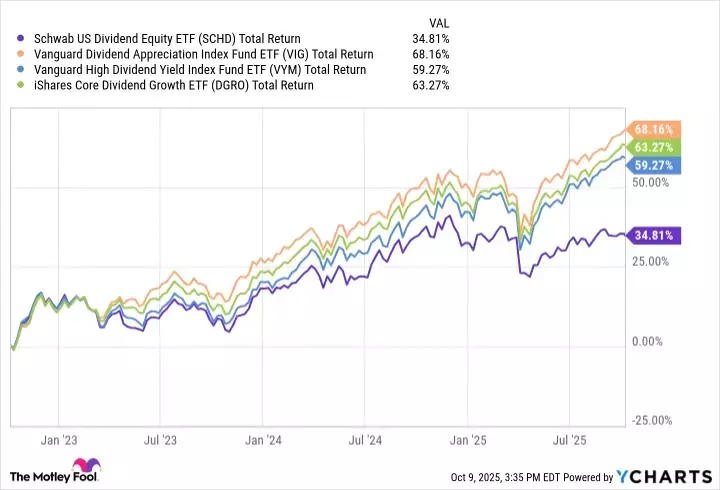

This analysis explores the recent underperformance of the Schwab U.S. Dividend Equity ETF (SCHD) compared to other dividend-focused exchange-traded funds. It delves into the structural differences between various dividend ETFs, highlighting SCHD's unique emphasis on value stocks. The article suggests that while this focus has contributed to its lagging performance during the recent AI-driven growth stock rally, it may position SCHD for a strong rebound as market trends potentially shift.
Unlocking Value: Why SCHD's Underperformance Could Signal Future Gains
Navigating the Nuances of Dividend ETFs: More Than Meets the Eye
While many dividend funds might appear similar at first glance, a closer examination reveals distinct operational strategies and portfolio compositions. Even though the primary goal of such funds and their underlying assets is to generate consistent cash flow, their approaches to achieving this can vary significantly.
Schwab's Dividend Fund: A Closer Look at its Recent Trajectory
Investors holding the Schwab U.S. Dividend Equity ETF (SCHD) have noted its recent struggles when compared to other prominent dividend ETFs, such as the Vanguard Dividend Appreciation ETF, the iShares Core Dividend Growth ETF, and the Vanguard High Dividend Yield ETF over the past three years. This disparity in returns has led some to question the wisdom of their investment choice and consider immediate adjustments.
No Need for a Course Correction: Understanding SCHD's Unique Position
Despite the recent performance gap, there's no inherent flaw in choosing SCHD. In fact, the very factors that have contributed to its relative underperformance in the recent past could be precisely why it now presents an compelling opportunity for those seeking income-generating investments. This situation highlights a fundamental difference in investment philosophies among dividend ETFs.
Distinctive Approaches: Unpacking the Differences Among Dividend Funds
The Schwab U.S. Dividend Equity ETF aims to track the Dow Jones U.S. Dividend Index, which, as its name suggests, is concentrated on dividend-paying companies. Similarly, the Morningstar US Dividend Growth Index, which underpins the iShares Core Dividend Growth ETF, and the S&P U.S. Dividend Growers Index, the foundation for the Vanguard Dividend Appreciation ETF, also target dividend-oriented firms.
The Subtle Yet Significant Variations in Index Methodologies
These indices, however, are not identical, and their subtle differences have a substantial impact. For instance, the S&P U.S. Dividend Growers Index mandates that companies must have increased their dividend payments for at least ten consecutive years while excluding those with exceptionally high yields, which might be deemed unsustainable. In contrast, the Morningstar US Dividend Growth Index only requires five years of uninterrupted dividend increases, though it also generally avoids stocks with suspiciously high yields.
Contrasting Portfolios: The Impact of Index Selection on Holdings
The practical implications of these differing methodologies are evident in the top holdings of these funds. Currently, Vanguard's Dividend Appreciation fund features Broadcom, Microsoft, and JPMorgan Chase among its top three positions, whereas the iShares ETF's largest holdings include Apple, Microsoft, and Johnson & Johnson. While some overlap exists, their portfolios are notably distinct. The Vanguard High Dividend Yield ETF, tracking the FTSE High Dividend Yield Index, prioritizes high-yielding stocks, with Broadcom, JPMorgan, and Exxon-Mobil as its leading components. Its trailing yield stands at 2.45%, compared to iShares' 2.2% and Vanguard Dividend Appreciation's 1.6%.
The Schwab ETF's Unique Composition and its Recent Challenges
The Schwab U.S. Dividend Equity ETF's top positions include AbbVie, Lockheed Martin, and Cisco Systems, followed by Merck and ConocoPhillips. This portfolio composition largely explains its underperformance since early 2023; it holds fewer of the market's high-flying growth stocks and instead focuses on value stocks, which have been less favored recently. Yet, this very characteristic, coupled with its substantial trailing dividend yield of approximately 3.7%, makes it an attractive proposition for income-focused investors at this juncture.
Deciphering the Downturn: Why Dividend-Paying Value Stocks Lagged
In hindsight, the Schwab fund's recent subdued performance is understandable. The rise of artificial intelligence, particularly since the introduction of OpenAI's ChatGPT in late 2022, ignited a significant rally in technology stocks, including those few that pay dividends. This AI boom also benefited financial institutions like JPMorgan, which facilitate capital raising and acquisitions crucial for companies capitalizing on the AI revolution.
Headwinds for Value: Factors Affecting SCHD's Holdings
Conversely, many of the Schwab U.S. Dividend Equity ETF's core holdings faced various challenges. Pharmaceutical companies such as AbbVie and Merck contended with regulatory pressures and the looming expiration of key patents. Furthermore, inflation and subsequent interest rate hikes, traditionally more impactful on growth stocks, surprisingly presented a greater challenge for value names in this specific market cycle.
The Unprecedented Market Dynamics and the 'Magnificent Seven' Influence
It's crucial to acknowledge the extraordinary nature of the past three years. The leadership of growth stocks was predominantly driven by the AI surge, creating a unique growth opportunity resilient to broader economic conditions. Data indicates that without the stellar performance of the "Magnificent Seven" tech giants, the S&P 500's returns since early 2023 would have been considerably lower, by about one-third. It's also undeniable that value stocks like Merck, Cisco, and ConocoPhillips simply couldn't offer the same level of excitement as tech stocks in the post-pandemic, AI-centric investment landscape.
The Inevitable Swing: Anticipating a Reversal in Market Leadership
However, market cycles are inherently cyclical, and a shift is inevitable, likely sooner rather than later. As Morningstar analyst David Sekera recently observed, value stocks remain undervalued, trading at a 3% discount, while core stocks are at a 4% premium and growth stocks at a 12% premium. He further noted that since 2010, the growth category has only traded at a higher premium in 5% of instances. This market dynamic favors dividend ETFs focused on value stocks, like the Schwab U.S. Dividend Equity ETF, over those emphasizing growth stocks. A catalyst is all that's needed to trigger this transition.
Harbingers of Change: Warnings from Market Leaders
Such a catalyst might be on the horizon. JPMorgan CEO Jamie Dimon recently expressed significant concern about a potential market correction, assigning it a higher probability than what he believes the market currently prices in. This sentiment echoes Federal Reserve Chairman Jerome Powell's previous assessment that U.S. stocks are "fairly highly valued." These warnings from influential figures serve as a significant red flag, coming from individuals who typically maintain a composed demeanor to avoid inciting panic. While a market setback could temporarily affect all funds, including the Schwab U.S. Dividend Equity ETF, the more critical consideration is the aftermath. A bearish jolt might prompt investors to reassess their risk exposures, shifting their focus away from tech stocks and towards value names that also provide attractive income. Astute investors will aim to position themselves strategically before this shift occurs.
