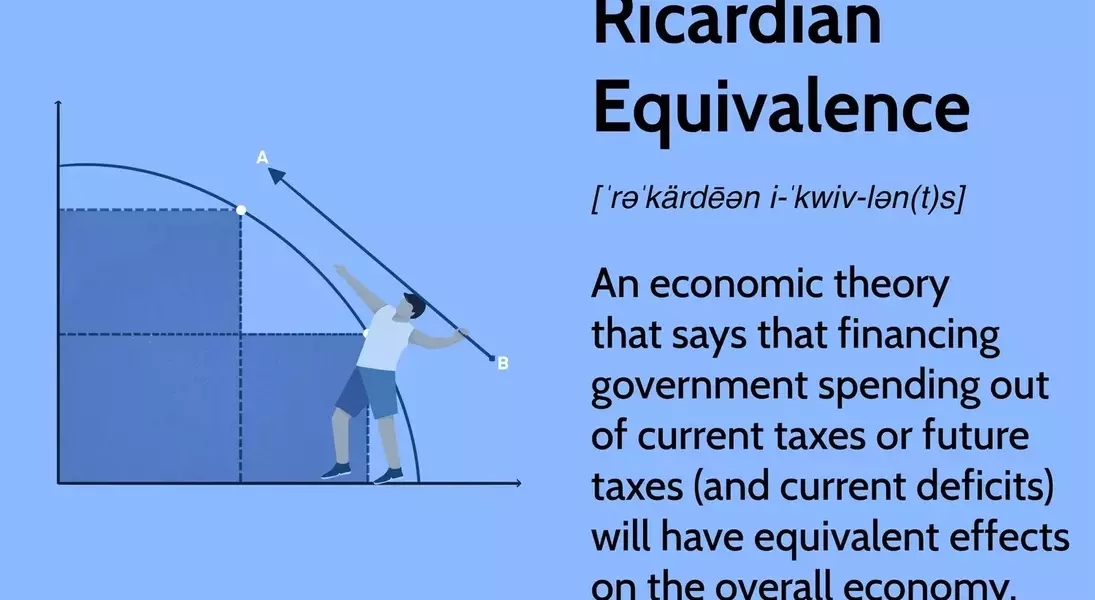
Ricardian equivalence is an economic theory that suggests that the method of financing government expenditure, whether through current taxation or debt (which implies future taxation), has no real impact on the economy. This is because rational consumers, anticipating future tax burdens from government borrowing, will adjust their saving behavior accordingly. While the theory offers a profound challenge to traditional Keynesian views on fiscal policy, its practical application is often constrained by a set of highly idealized assumptions that may not always hold true in real-world economic scenarios.
This principle asserts that governmental fiscal decisions, specifically how public outlays are funded, ultimately have a negligible effect on overall economic activity. The underlying premise is that individuals possess a forward-looking rationality, enabling them to foresee that any current government borrowing will eventually necessitate future tax levies to service the accumulated debt. Consequently, they are expected to increase their present savings to meet these anticipated future obligations, thereby neutralizing any stimulative effect that deficit spending might otherwise have on aggregate demand. This perspective, championed by economists like David Ricardo and later formalized by Robert Barro, underscores a debate at the heart of macroeconomic policy regarding the efficacy of fiscal interventions.
Understanding Ricardian Equivalence
The Ricardian equivalence theory posits that the means by which governments fund their expenditures—either through immediate taxation or by issuing debt to be repaid through future taxes—ultimately yields the same economic outcome. This neutrality stems from the idea that individuals, operating with perfect foresight and rationality, recognize that government borrowing today implies higher taxes tomorrow. Therefore, they pre-emptively increase their savings to offset this future tax liability, effectively shifting the future burden of debt into the present. This behavior ensures that the aggregate demand for goods and services remains unchanged, as a rise in government spending is met by an equivalent decrease in private consumption. David Ricardo first articulated this concept, and Robert Barro later revitalized and expanded it using modern macroeconomic frameworks like rational expectations and the permanent income hypothesis. Barro's work, in particular, suggests that the traditional Keynesian view—that government deficit spending can stimulate economic activity—is flawed, as private agents counteract such policies through their saving decisions.
The fundamental assertion of Ricardian equivalence is that the mode of government financing—taxation versus debt—does not alter the economy's real variables, such as aggregate consumption, investment, and output. When a government incurs debt to finance current spending, it is essentially deferring the tax burden. Rational economic agents, however, are assumed to understand this intertemporal budget constraint. They anticipate that the government will eventually need to collect more taxes to repay the debt, including interest. In response, these agents will save a larger portion of their current income, rather than consuming it, to build a reserve for their future tax obligations. This increased private saving offsets the decrease in public saving (due to government borrowing), leading to no net change in national saving or investment. Consequently, any attempt by the government to use fiscal policy, such as tax cuts financed by debt, to stimulate demand would be ineffective, as individuals would simply save the tax cut rather than spend it. This implies that the economic impact of government spending is solely determined by the level of spending itself, not by how it is financed.
Assumptions and Criticisms of the Theory
The Ricardian equivalence theory rests on several critical assumptions that underpin its conclusion of fiscal policy neutrality. First, it assumes that individuals are rational and forward-looking, capable of perfectly anticipating future economic conditions, including tax changes. This implies that consumers have a complete understanding of the government's budget constraints and their implications for future tax liabilities. Second, the theory posits that individuals face no borrowing constraints, meaning they can freely borrow or lend at the same interest rate as the government, allowing them to perfectly smooth their consumption over their lifetimes. Third, taxes are assumed to be lump-sum, meaning they do not distort economic decisions related to work, saving, or investment. Fourth, the theory incorporates intergenerational altruism, suggesting that current generations care as much about future generations' well-being as their own, thus internalizing the tax burden passed on to their descendants. Finally, it assumes an absence of uncertainty regarding future income streams and tax obligations, enabling precise calculations of lifetime resources. The validity of Ricardian equivalence largely hinges on how closely these idealized assumptions reflect actual economic behavior and market realities.
Despite its theoretical elegance, Ricardian equivalence faces substantial criticisms due to the unrealistic nature of its underlying assumptions. A major challenge comes from the assumption of perfect capital markets and no borrowing constraints. In reality, many individuals and households face credit limitations, higher interest rates, or limited access to financial markets due to factors like low income or poor credit history. This prevents them from fully smoothing their consumption or perfectly offsetting future tax burdens through current savings, thereby breaking the equivalence. Moreover, the assumption of perfectly rational and forward-looking consumers is often contested; behavioral economics suggests that individuals can exhibit myopic behavior, focusing more on immediate gratification and short-term benefits rather than meticulously planning for distant future tax increases. The intergenerational altruism assumption is also debatable, as individuals typically have finite lifespans and may not fully internalize tax burdens that will fall on future generations. Furthermore, the theory often disregards the potential for Keynesian multiplier effects, where government spending can stimulate aggregate demand and lead to increased output and employment, particularly during economic downturns when there is excess capacity. These real-world complexities suggest that Ricardian equivalence may only partially apply under specific, limited conditions, and thus its practical relevance for fiscal policy is often questioned by economists and policymakers alike.
