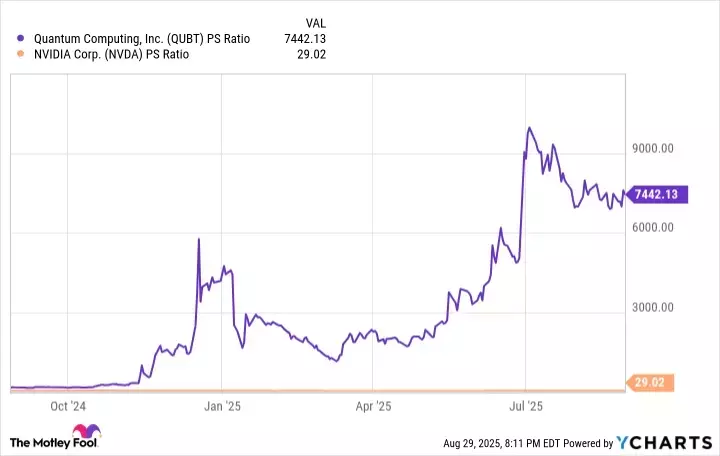

In the dynamic realm of advanced computing, two prominent entities, Quantum Computing Inc. (QCi) and Nvidia, are charting distinct courses to unlock the extraordinary potential of quantum technology. This detailed examination delves into their divergent methodologies, financial standing, and market valuations to offer an informed perspective on their respective positions in this burgeoning industry. The article concludes with an assessment of which company presents a more compelling investment opportunity, considering the early stages of quantum computing's development.
The Race for Tomorrow's Computing Power: QCi and Nvidia's Quantum Pursuits
As the digital frontier rapidly expands, numerous technology enterprises are zealously pursuing the advancements in quantum computing. These revolutionary machines possess the capacity to execute computations far beyond the scope of even today's most powerful supercomputers, marking them as a pivotal future investment domain.
Among the contenders, Quantum Computing Inc., frequently referred to as QCi, distinguishes itself as a dedicated quantum firm. In stark contrast, Nvidia stands as a venerable titan of the tech world, having already cemented its supremacy in the artificial intelligence semiconductor market.
QCi is channeling all its resources into the development and commercialization of quantum innovations. This focused approach minimizes the risk of strategic shifts that might divert attention to other business segments. The company's trajectory towards quantum advantage involves the utilization of photons, or light particles, to energize its devices. This photon-based methodology facilitates a broad spectrum of applications, exemplified by their successful bid for a contract with NASA, involving the development of remote sensing and imaging apparatus for challenging, long-distance environments.
However, despite these technological strides, QCi's innovations have yet to translate into significant revenue. In the second quarter, sales amounted to a mere $61,000, a substantial decline from $183,000 in the previous year. Concurrently, operating expenses surged by 91% year-over-year, leading to an operating loss of $10.2 million, nearly double the $5.3 million loss reported in 2024. Fortunately, a robust cash reserve of nearly $350 million on its second-quarter balance sheet offers a crucial buffer for sustained operations as the company endeavors to boost its sales figures.
Meanwhile, Nvidia is applying its extensive legacy of pioneering technological breakthroughs to the nascent field of quantum computing. Following its groundbreaking work with the graphics processing unit (GPU) in 1999, which became the cornerstone of the modern AI era, Nvidia is now introducing its quantum processing unit (QPU). This QPU is designed not to supplant the GPU but to integrate seamlessly with it, enabling real-time error correction—a critical function given the inherent instability of quantum particles during computation.
This innovative approach is expected to propel Nvidia's revenue forward, much as AI has. The company's GPU technology generated an impressive $46.7 billion in sales during its fiscal second quarter, concluding on July 27, marking a 56% year-over-year increase. Anticipating continued growth, Nvidia forecasts sales of $54 billion in the third quarter, a significant leap from the $35.1 billion recorded in the prior year. Once quantum advantage becomes a reality, quantum computers are poised to usher in the next phase of sustained revenue expansion for Nvidia.
As we navigate the thrilling prospects of quantum computing, it is evident that both QCi and Nvidia are contributing significantly to this transformative domain. From an investment standpoint, Nvidia appears to hold a more favorable position due to its established track record of innovation, robust financial performance, and a more attractive stock valuation, particularly when considering the price-to-sales ratio. While QCi's dedicated quantum focus is commendable, its current revenue challenges and elevated valuation suggest a higher risk profile for investors. Therefore, for those looking to tap into the future of computing, Nvidia offers a more stable and potentially rewarding pathway in these pioneering times.
