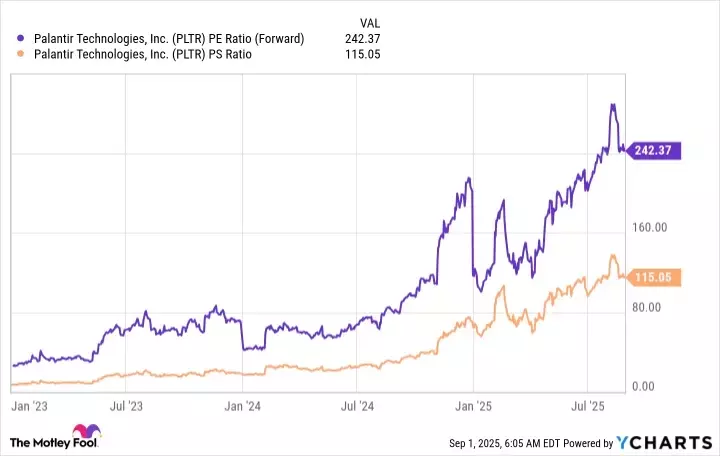

Palantir Technologies has recently experienced a meteoric rise in its market value, capturing the attention of investors with its impressive growth trajectory. However, a closer examination reveals that the market's enthusiasm may have propelled the company's stock to levels that embed highly optimistic future growth assumptions, making it a potentially precarious investment despite its robust operational performance.
Unpacking Palantir's Market Position and Financial Standing
In the vibrant financial landscape of 2025, Palantir Technologies has emerged as a standout performer, with its stock price experiencing a dramatic surge. While the company's shares have recently seen a slight retraction of over 15% from their peak, some market participants perceive this as an opportune moment for acquisition. Nevertheless, a thorough evaluation of critical financial metrics is paramount before committing investment capital to this data analytics giant.
Headquartered in Denver, Colorado, Palantir stands as a preeminent leader in the artificial intelligence domain. Its sophisticated platform excels at processing diverse data streams and furnishing decision-makers with precise, real-time insights. The integration of AI agents through its Artificial Intelligence Platform (AIP) further augments automation capabilities. Initially conceptualized for governmental applications, Palantir's innovative solutions have successfully transcended their original scope, finding substantial utility within the commercial sector.
The second quarter proved to be exceptionally strong for Palantir. The commercial division showcased remarkable vitality, recording a 47% increase in revenue to an impressive $451 million. Concurrently, the government segment demonstrated equally compelling growth, with revenue climbing 49% to reach $553 million. Unlike numerous high-growth software enterprises, Palantir distinguishes itself through its significant profitability, converting a substantial 33% of its revenue into net income. This exceptional performance underscores the company's robust operational health and strong market penetration.
Despite these compelling operational achievements, a critical aspect that warrants careful consideration is the current valuation of Palantir's stock. Even with its recent downturn, the shares are trading at an astonishing 242 times forward earnings and a price-to-sales ratio of 115. These figures position Palantir as one of the most, if not the most, richly valued companies in the contemporary market. To put this into perspective, even AI powerhouse Nvidia, which reported a 56% revenue growth, trades at a significantly lower 39 times forward earnings. Such elevated valuation multiples suggest that the market has already factored in an extraordinary level of future growth into Palantir's stock price, potentially diminishing the margin of safety for new investors.
Hypothetical financial modeling illustrates the extent of these baked-in expectations. Assuming a highly aggressive 50% compound annual growth rate (CAGR) for Palantir's revenue over the next five years, coupled with a 35% profit margin and no change in outstanding shares, the company would generate $26 billion in revenue and $9.1 billion in profits. Under these optimistic conditions, the stock would only then reach a valuation of approximately 41 times forward earnings, effectively meaning five years of exceptional growth are already discounted into today's price. However, these assumptions are overly sanguine. Industry analysts project a more modest 34% revenue growth for Palantir next year, and sustaining high growth rates becomes increasingly challenging as a company expands. A more realistic 30% CAGR suggests it could take eight years for Palantir to align with a more customary 40 times forward earnings multiple.
Given the exorbitant valuation and the seemingly unrealistic growth expectations currently priced into Palantir's stock, prospective investors should exercise considerable caution. The high starting point of the investment presents a significant hurdle, potentially leading to subdued long-term returns even if the company continues to perform admirably.
The narrative surrounding Palantir Technologies underscores a fundamental truth in financial markets: even the most impressive business performance can be overshadowed by an overly ambitious valuation. While Palantir's innovative strides in AI and its dual-pronged growth in government and commercial sectors are undeniably remarkable, the current stock price appears to demand a level of future expansion that is exceptionally challenging to achieve. This situation serves as a powerful reminder that investment success hinges not only on identifying strong businesses but also on acquiring them at sensible valuations. For discerning investors, patience and a keen eye for intrinsic value remain invaluable virtues, particularly when confronted with the dazzling allure of high-flying technology stocks.
