
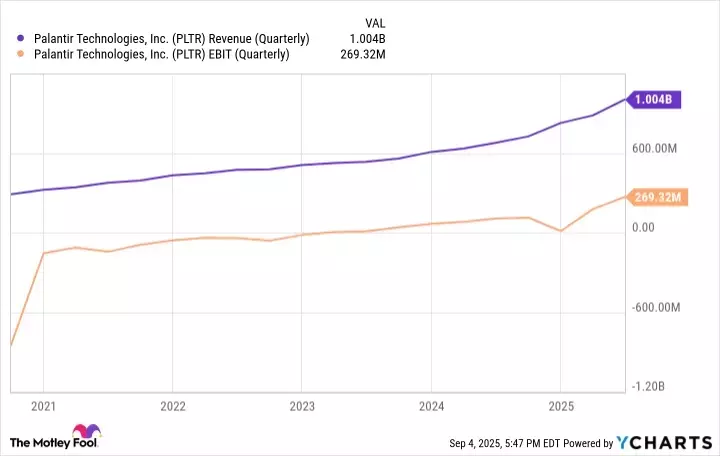
Palantir Technologies, a prominent player in the data mining software sector, has recently experienced significant financial upturn. This surge is largely attributed to the successful launch of its Artificial Intelligence Platform (AIP) in mid-2023, which seamlessly integrates advanced AI models into its core Foundry and Gotham software. This strategic innovation has not only accelerated the company's revenue trajectory but also propelled its profitability beyond initial expectations. Consequently, Palantir's market valuation has reached extraordinary levels, prompting widespread discussion among investors about the long-term sustainability of such an elevated stock price. The company's distinctive operational model, which focuses on providing tailored, labor-intensive data solutions rather than generic software, appears to be a key differentiator in the competitive enterprise software landscape. However, whether Palantir's future growth can genuinely support its current high valuation remains a central point of inquiry.
Before its public listing in September 2020, Palantir had a long-standing history spanning 17 years, initially aiding the U.S. government in counter-terrorism efforts by extracting crucial insights from vast datasets. This foundational expertise in "finding needles in haystacks" was subsequently extended to commercial enterprises, marking a significant pivot that largely accounts for its recent boom. The company's software is built on the concept of ontology, which meticulously maps an organization's components, interconnections, and operational processes, allowing for highly customized applications across diverse industries. Unlike many enterprise software providers that offer standardized solutions, Palantir engages deeply with individual clients, adapting its platform to their specific needs. This bespoke approach, coupled with its recent ventures into industry-specific operating systems, highlights its commitment to delivering specialized and effective data management tools.
Palantir's competitive advantage, often referred to as its 'moat,' is evident in its exceptional growth figures and robust profit margins, signaling a unique operational effectiveness. In the most recent quarter, the company reported a remarkable 48% increase in overall revenue, with U.S.-based revenue climbing an impressive 68%, and U.S. commercial revenue surging by 93%. Even its government sector revenue, despite recent governmental cost-cutting initiatives, saw a substantial 53% rise. These impressive revenue figures were complemented by a significant expansion in profit margins. GAAP (Generally Accepted Accounting Principles) operating margins expanded from 16% to 27%, while adjusted (non-GAAP) operating margins, which account for stock-based compensation and other factors, improved from 37% to 46%. This simultaneous acceleration in growth and margin expansion indicates Palantir's ability to increase revenue without a proportional increase in spending, suggesting either strong pricing power or an overwhelming demand for its products that minimizes the need for extensive marketing efforts.
A notable disclosure from CEO Alex Karp during a recent analyst call was his offhand remark about the potential for Palantir's U.S.-based revenue to increase tenfold within the next five years. While the exact scope of this prediction—whether it pertains to total U.S. revenue or specifically U.S. commercial revenue—is not definitively clear, the context suggests a focus on the latter. Achieving a tenfold increase in U.S. commercial revenue over five years would necessitate an approximate 58% compounded annual growth rate. Given that the company's U.S. commercial revenue grew by 93% last quarter, this projection, although ambitious and challenging to sustain as the business scales, does not appear entirely unattainable. Last quarter's U.S. commercial revenue stood at $306 million, indicating an annualized run rate of approximately $1.2 billion. Thus, a tenfold increase would translate to roughly $12 billion in revenue by the end of 2030, exclusively from U.S. commercial operations.
Considering that U.S. government revenue was $426 million last quarter (a $1.7 billion annualized run rate, growing at 53%) and international business generated $267 million (a little over $1.05 billion annualized run rate), an optimistic scenario unfolds. If the U.S. commercial segment grows tenfold, the U.S. government business triples to $5 billion, and the international segment merely doubles to $2 billion, Palantir could potentially generate close to $20 billion in total revenue over the next five years. However, even with this highly favorable outlook, if net margins expand to an impressive 50%—a figure significantly higher than even tech giants like Microsoft (which has net margins of about 35.6% today)—Palantir would still only be generating approximately $10 billion in earnings. With its current market capitalization already at $367 billion, this implies that the stock is trading at roughly 37 times an earnings figure that is not only highly optimistic but also contingent on unprecedented sustained growth and substantial profit expansion. Furthermore, the time value of money, extending over a five-year horizon, must also be taken into account. Therefore, while Palantir's remarkable growth has certainly brought the potential for exceptional earnings expansion into view, the market appears to have already incorporated, and perhaps even exceeded, this sanguine forecast into the current stock price. Nevertheless, Palantir's distinct position and capacity for further innovation mean it remains a company worthy of close observation, particularly if its stock experiences a significant market correction, presenting a more favorable entry point for investors.
