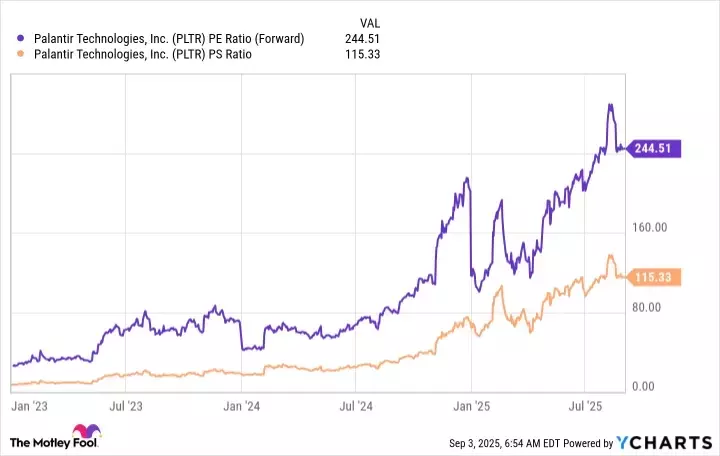

Palantir, a prominent player in the artificial intelligence landscape, has demonstrated exceptional expansion in recent years, establishing its technology as a cornerstone for AI deployment across various sectors. Its proprietary software is adept at ingesting diverse data inputs, processing them through advanced AI models, and delivering critical insights to facilitate informed decision-making. This capability has proven invaluable for both governmental agencies and commercial enterprises, where the efficient utilization of data can significantly impact operational effectiveness. Initially developed for government applications, Palantir's platform successfully transitioned to the commercial market, replicating its success by enabling businesses to automate complex tasks and enhance execution, thus improving efficiency and reducing operational costs. This unique value proposition has fueled substantial revenue growth, particularly highlighted by its recent quarterly performance, which saw a significant surge in commercial revenue, especially within the U.S. market.
Despite Palantir's compelling growth trajectory and its pivotal role in the evolving AI ecosystem, a critical examination of its current stock valuation reveals a potentially challenging investment outlook. The company's shares are trading at exceptionally high multiples relative to its sales and forward earnings, indicating that the market has already factored in an aggressive growth forecast. Even under highly optimistic assumptions—such as a sustained 50% compounded annual growth rate over the next five years and a substantial profit margin—the projected future earnings still suggest that the stock's current price is exceedingly ambitious. Such a demanding valuation necessitates a level of performance that few companies can consistently achieve, raising concerns about the potential for significant investor returns in the medium term. The historical pattern of shareholder dilution further complicates the picture, suggesting that maintaining profitability and share value will require extraordinary operational excellence and market expansion.
In conclusion, while Palantir's technological prowess and market penetration are undeniable, especially given its robust growth in AI adoption, investors should approach its stock with caution. The current market price appears to embed an overly optimistic future, potentially limiting upside for new investments. Prudent investors might consider whether the high premium accurately reflects achievable growth, or if it sets an impossibly high bar. Ultimately, the company's journey highlights the dynamic interplay between innovation, market demand, and investor expectations, urging a balanced perspective between revolutionary technology and realistic financial projections. The path forward for Palantir will undoubtedly continue to showcase the transformative power of AI, while also serving as a testament to the importance of discerning value in a rapidly evolving market.
