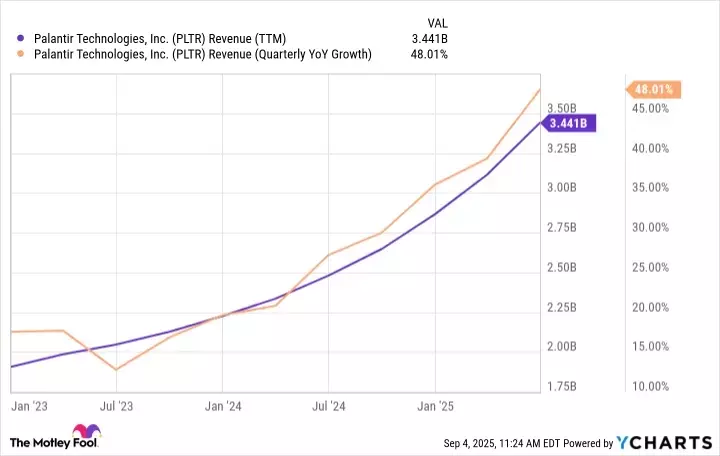

In the dynamic landscape of artificial intelligence, Palantir Technologies has emerged as a significant player, with its stock experiencing an impressive surge over the past year. This growth is largely attributed to its innovative Artificial Intelligence Platform (AIP), which has demonstrated remarkable capabilities in enhancing productivity across various sectors. Despite this success, market analysts and contributors from The Motley Fool offer diverse viewpoints on the company's investment appeal. While some highlight its transformative potential and accelerating revenue, others caution against its elevated valuation metrics, suggesting that the stock might be entering 'bubble' territory. Understanding these contrasting perspectives is crucial for investors contemplating their position in this leading AI enterprise.
Palantir's ascent in the market has been nothing short of spectacular, with its shares climbing approximately 400% over the last twelve months. This extraordinary performance has placed the company firmly in the spotlight as a prominent artificial intelligence entity. The core of its success lies in the Artificial Intelligence Platform (AIP), a robust solution that has enabled clients, such as a major insurer, to drastically reduce complex workflows from two weeks to a mere three hours. Similarly, another client achieved more in a single day than a hyperscaler could in four months, underscoring the platform's efficiency and impact.
Despite these compelling operational achievements and strong revenue acceleration since mid-2023, the financial community remains divided on the sustainability of Palantir's current valuation. The company's market capitalization, hovering around $367 billion, is considered by some to be exceptionally high for a business with less than $4 billion in trailing twelve-month sales. Critics point to valuation metrics such as its price-to-earnings (P/E) ratio of approximately 514 and a price-to-sales (P/S) ratio of 114, which significantly dwarf the S&P 500's average P/S of 3.2. These figures lead some analysts to suggest that the stock’s price is far detached from its fundamental earnings, drawing parallels to historical market bubbles like Japan's Nikkei in the 1980s or Cisco Systems in 2000, where stock prices reached unsustainable peaks.
Conversely, proponents argue that such high valuations are not necessarily indicative of a bubble, especially for companies at the forefront of transformative technologies like AI. They acknowledge the inherent volatility of cutting-edge investments, noting that Palantir's stock has experienced several significant corrections (of at least 15%) from all-time highs over the last three years. However, despite these dips, the stock has still appreciated by nearly 2,000% over the same period. Unlike many companies during the dot-com bubble that lacked substantial profits or even meaningful revenue, Palantir has demonstrated solid financial performance, generating $3.4 billion in revenue, $1.7 billion in net income, and nearly $800 million in free cash flow over the past year. This financial robustness, coupled with its innovative technology and strong client adoption, leads many to believe that despite its premium pricing, Palantir is a legitimate and promising long-term investment, provided investors are prepared to endure market fluctuations.
Ultimately, the investment thesis for Palantir Technologies is multifaceted, balancing its undeniable technological prowess and market traction against its demanding valuation. The company's Artificial Intelligence Platform continues to deliver significant value, attracting a growing commercial clientele. However, the prevailing market sentiment suggests that investors should brace for potential volatility. While its robust financials distinguish it from speculative ventures of the past, prudent consideration of its current pricing relative to its fundamentals is advised. As the AI sector evolves, Palantir’s journey will serve as a key case study in navigating the opportunities and risks associated with high-growth, innovation-driven companies.
