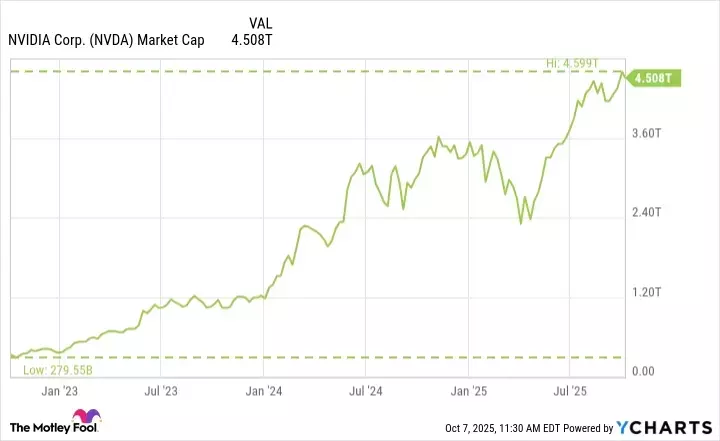

Nvidia's journey from a specialized graphics chip designer to a cornerstone of the artificial intelligence (AI) economy is nothing short of remarkable. The company's innovative hardware and software solutions have become indispensable for major hyperscalers like Microsoft, Amazon, Alphabet, Oracle, and Meta Platforms, who rely on Nvidia for training and deploying their sophisticated AI models. This surging demand has fueled an astonishing 16-fold increase in Nvidia's market value during the AI era, culminating in its current status as the world's most valuable company with a market capitalization of approximately $4.5 trillion.
Amidst this rapid ascent, the question naturally arises: Is there still room for growth, or have potential investors missed their window of opportunity? According to Phil Panaro, a distinguished analyst at The Boston Consulting Group, the answer leans towards significant untapped potential. Panaro boldly forecasts that Nvidia could achieve an astounding $20 trillion valuation within the next five years, signifying a potential gain exceeding 340% from its present market standing. This ambitious projection is underpinned by three key transformative forces that are expected to redefine the AI landscape over the coming decade.
Panaro's vision for Nvidia's future success is built upon the understanding that the AI revolution is still in its nascent stages, with global adoption estimated to be less than 1%. As AI permeates various sectors such as healthcare, finance, logistics, retail, and manufacturing, the demand for advanced computing power is poised for exponential expansion. Nvidia's hardware and its CUDA software platform provide a robust foundation for AI development, creating substantial switching costs that solidify its market position. Furthermore, the burgeoning fields of Web3 and decentralized applications, along with an anticipated surge in government adoption of AI for critical functions like logistics, fraud detection, and cybersecurity, are expected to drive unprecedented demand for Nvidia's cutting-edge technologies. These factors collectively position Nvidia not merely as a chip manufacturer, but as an essential 'toll collector' in the evolving AI ecosystem.
While the exact timing and magnitude of Nvidia reaching a $20 trillion valuation by 2030 remain subject to market dynamics and future innovations, Panaro's projection serves as a powerful testament to the company's profound potential. Nvidia has meticulously crafted a resilient and highly profitable business model that seamlessly integrates hardware, software, and interconnected ecosystems. Regardless of whether this specific milestone is met, the trajectory suggests that Nvidia's growth narrative is far from complete. Therefore, for investors with a long-term perspective, Nvidia represents a compelling buy-and-hold opportunity, embodying the spirit of innovation and progress that defines our technological age.
