Nvidia is currently at the forefront of the artificial intelligence revolution, capitalizing on the escalating demand for AI data centers. With its leading market share in AI computing chips, the company continues to achieve new heights, solidifying its position through strategic alliances and technological advancements.
A notable development in Nvidia’s journey is its significant collaboration with OpenAI. This partnership entails a substantial $100 billion investment from Nvidia into OpenAI, designed to expand OpenAI's computing infrastructure. This investment will directly translate into increased sales for Nvidia's computer chips and provide Nvidia with a vested interest in the rapidly growing AI entity. Starting in 2026, OpenAI plans to integrate Nvidia's innovative Rubin chips, which are specifically engineered to enhance advanced AI video processing capabilities, further cementing Nvidia’s role in future AI development. However, despite these promising ventures, the company faces growing rivalry from major clients like Alphabet, Amazon, Microsoft, and Meta Platforms, all of whom are developing their own custom AI chips. Although these internal chips currently lag behind Nvidia's offerings in terms of power and efficiency, their ongoing development suggests a potential shift in the competitive landscape over time, urging Nvidia to maintain its technological edge.
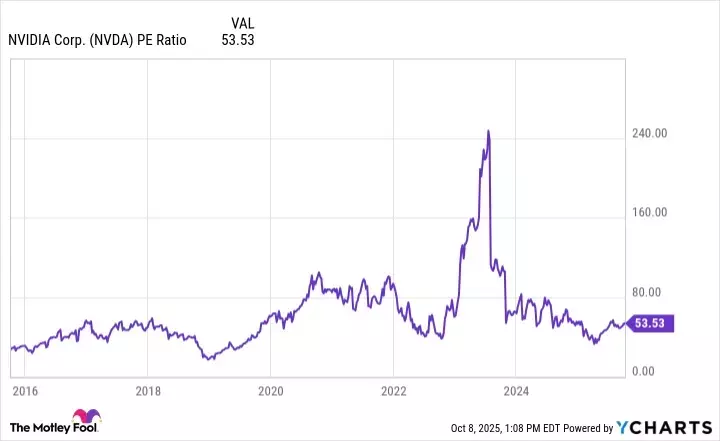
Considering the dynamic and often unpredictable nature of the AI industry, forecasting Nvidia's market capitalization in the coming five years presents a complex challenge. While the company's current leadership in AI computer chips seems secure for the near future, the sector's rapid evolution means that future spending on AI data centers could fluctuate. The current high price-to-earnings ratio reflects significant investor expectations for sustained growth, yet the possibility of a downturn in demand, though not immediately apparent, cannot be discounted. Consequently, the range of potential outcomes for Nvidia's revenue and profitability remains broad, suggesting that its market valuation could stabilize, decrease, or continue to climb depending on how the AI market matures.
In conclusion, while Nvidia has demonstrated exceptional performance and holds a dominant position in the burgeoning AI market, investors should approach its current valuation with caution. The company's future success hinges on its ability to navigate competitive pressures and the inherent uncertainties of a hyper-growth industry, requiring a balanced perspective rather than an uncritical embrace of its current high market capitalization.
