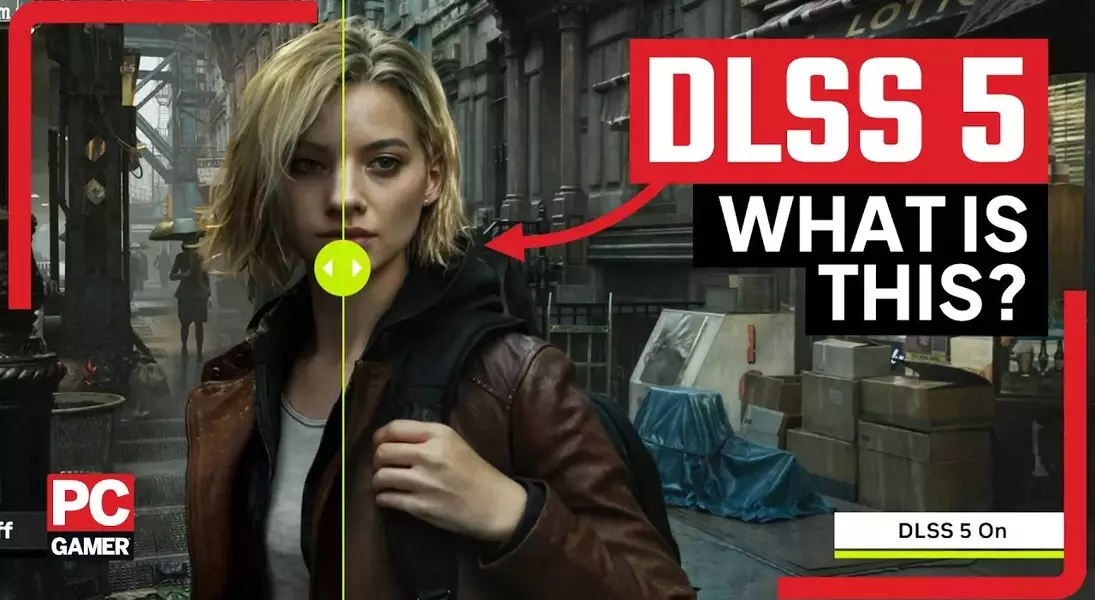
Nvidia's CEO, Jensen Huang, has publicly challenged the negative reception surrounding DLSS 5, asserting that the criticism is entirely misplaced. He clarifies that the latest iteration of their upscaling technology integrates AI-driven lighting and generative AI at the geometric and asset levels. While this can significantly alter character models, Huang insists that developers retain complete creative authority over these changes, debunking the notion that DLSS 5 compromises artistic integrity in game design.
The controversy stems from observations that DLSS 5's generative AI features might lead to uniform visual styles across various games, potentially undermining the unique artistic visions of developers. However, Huang argues that the system is designed to be highly customizable. Developers can intricately fine-tune the generative AI to achieve specific aesthetic outcomes, whether it's applying a 'toon shader' effect or making game elements appear as if they are 'made of glass.' This level of control, he suggests, transforms DLSS 5 into a versatile tool for creative expression rather than a restrictive preset.
A key point of contention revolves around the extent of this developer control. It remains unclear whether DLSS 5 will offer a limited selection of pre-defined visual presets or provide a deeply customizable toolkit. The fear among some is that if the former holds true, it could lead to a homogenization of game aesthetics. Conversely, if developers can truly delve into and manipulate aspects like lighting, materials, and asset generation, then DLSS 5 could empower them to create visually stunning and unique experiences.
Huang's remarks strongly support the idea of extensive developer agency, emphasizing that 'content-control generative AI' is distinct from general generative AI, allowing for precise creative direction. He labels this approach 'neural rendering,' highlighting its sophisticated nature.
Beyond the artistic debate, the practical implementation of DLSS 5 faces significant challenges, particularly concerning its computational requirements. Current demonstrations at Nvidia's GTC event utilize two RTX 5090 graphics cards: one to run the game engine and another to handle DLSS 5 processes. This setup is prohibitively expensive and impractical for most consumers. Nvidia claims to have a single-GPU solution in development, but its absence from public demonstrations raises doubts about its readiness and efficiency. For DLSS 5 to achieve widespread adoption, it must operate effectively on more affordable GPUs, such as the RTX 5060, rather than exclusively high-end models.
Despite these hurdles, DLSS 5 holds immense promise for rendering realistic lighting through ray tracing and path tracing, significantly reducing the computational burden associated with complex light calculations. To deliver on this potential, the technology must evolve to be far more efficient than its current demo configuration suggests. Nvidia aims to release DLSS 5 later this year, necessitating rapid advancements in its performance and accessibility to meet the demands of the broader gaming community and fulfill its ambitious promises.
