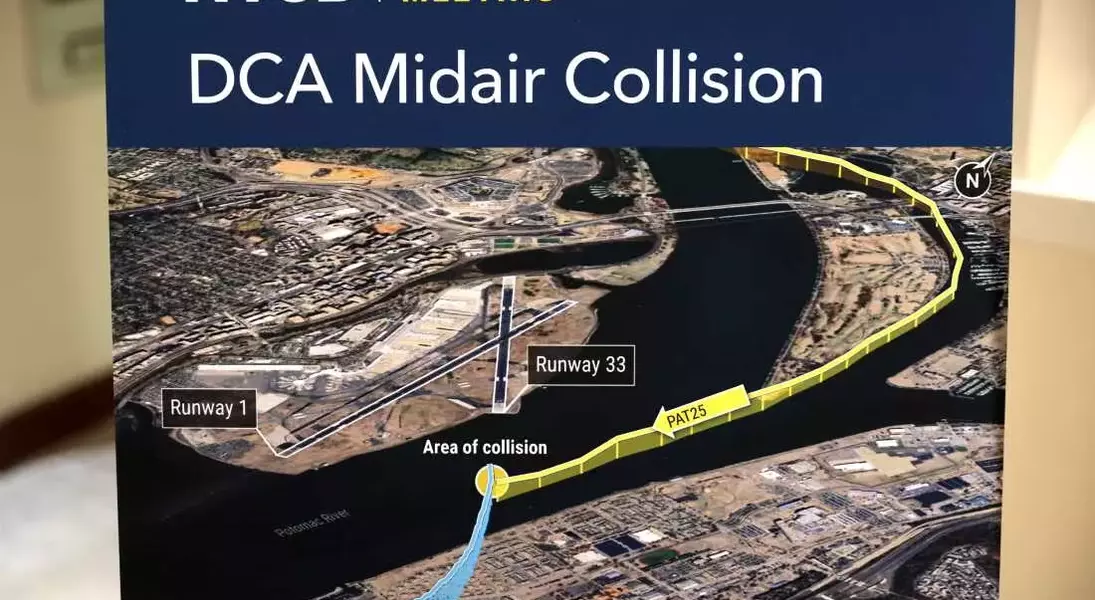

A recent extensive investigation conducted by the National Transportation Safety Board (NTSB) has definitively attributed the fatal mid-air collision near Washington D.C. to a cascade of deeply rooted systemic failures. This tragic incident, involving an Army Black Hawk helicopter and an American Airlines regional jet, resulted in the loss of 67 lives. The findings underscore a complex interplay of factors, including inadequate air traffic management, equipment malfunctions, and human misjudgments, ultimately painting a picture of profound institutional oversight deficiencies.
NTSB Investigation Uncovers Critical Lapses Leading to Catastrophic Mid-Air Collision
In the aftermath of the devastating January 29, 2025, mid-air collision involving an American Airlines regional jet and a U.S. Army Black Hawk helicopter near Ronald Reagan Washington National Airport, the National Transportation Safety Board (NTSB) launched a comprehensive year-long inquiry. The NTSB's chair, Jennifer Homendy, on January 27, 2026, unequivocally stated that the disaster was not attributable to a singular cause but rather to "deep, underlying systemic failures" that created a perilous environment. This marked the deadliest aviation accident in the U.S. in decades.
The investigation revealed a multitude of contributing factors. A critical instrument failure within the Army helicopter, for instance, likely misled its pilots into believing they were flying 100 feet lower than their actual altitude. Compounding this, air traffic control in the tower experienced a chaotic situation, characterized by incomplete and potentially confusing communications between the local controller and the helicopter crew. Homendy reserved her sternest critique for the Federal Aviation Administration (FAA), accusing the regulatory body of neglecting clear warning signs. She highlighted that the FAA had received over 80 reports of serious near-misses between helicopters and commercial aircraft in the vicinity in recent years but had failed to act on this data. Furthermore, the FAA was found to have neglected its responsibility to annually evaluate helicopter routes for safety, particularly in such densely trafficked airspace.
Local air traffic controllers at Ronald Reagan Washington National Airport had repeatedly voiced concerns to the FAA regarding insufficient separation distances—as little as 75 feet—between helicopter traffic along the Potomac River and the approach path to Runway 33, which American Airlines Flight 5342 was attempting to land on. Despite these urgent warnings, the FAA failed to implement corrective measures. On the night of the collision, a single controller was tasked with managing both local air and helicopter traffic. The NTSB determined that this controller should have issued a safety alert immediately before the collision and that a supervisor should have reallocated responsibilities after the controller expressed feeling overwhelmed earlier in the shift.
Further analysis showed that air traffic controllers at DCA heavily relied on "visual separation," expecting helicopter pilots to visually identify and avoid approaching aircraft. However, the Army Black Hawk helicopter, engaged in a night training mission with night-vision goggles, had severely limited visibility. A NTSB simulation vividly illustrated the helicopter pilots' constrained view, suggesting they likely mistook the American Airlines jet for another aircraft aligning with Runway 1, thus misjudging its true flight path. While the Army helicopter was equipped with an ADS-B transponder, it was not operational during the incident. Crucially, the NTSB found that even if functional, it might not have prevented the crash, as the passenger jet was only capable of transmitting, not receiving, ADS-B signals. Consequently, the NTSB has issued nearly 50 new recommendations, including a pivotal suggestion that all aircraft required to use ADS-B out technology should also be mandated to use ADS-B in, enhancing situational awareness for all pilots.
This tragic event serves as a stark reminder of the critical importance of robust safety protocols and vigilant regulatory oversight in aviation. The NTSB's findings not only pinpoint specific failures but also emphasize the broader need for a proactive and responsive approach to aviation safety. The incident highlights how a series of seemingly disparate issues—from equipment malfunctions and human error to systemic regulatory negligence—can converge with catastrophic consequences. Moving forward, the aviation industry, particularly regulatory bodies like the FAA, must internalize these lessons and implement comprehensive reforms to prevent future tragedies. This involves not only addressing the technical and procedural deficiencies but also fostering a culture where safety concerns are promptly acted upon, and accountability is maintained at every level.
