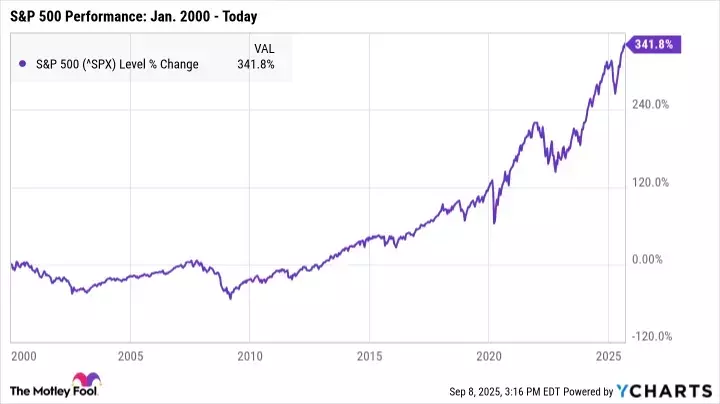

The financial markets have seen significant gains recently, yet a considerable portion of investors are approaching the next six months with caution, reflecting a 'bearish' sentiment. This apprehension is fueled by growing concerns about a potential economic downturn and the Federal Reserve's anticipated interest rate adjustments. Nevertheless, historical patterns provide a comforting message, indicating that market fluctuations are cyclical and temporary. This suggests that patience and a long-term investment horizon are key to navigating periods of volatility successfully.
The market's resilience through various historical crises, from the dot-com bust to the 2008 financial crisis and more recent challenges, underscores a consistent trend of recovery and subsequent growth. This enduring pattern reinforces the importance of a strategic, long-term approach for investors. Despite the inherent uncertainties and the inevitability of future economic contractions, maintaining a diversified portfolio of fundamentally sound assets can help mitigate risks and position investors for sustained prosperity over time.
Understanding Market Uncertainty and Investor Sentiment
Recent months have witnessed impressive surges in the stock market, with major indices like the S&P 500 and Nasdaq Composite experiencing substantial growth. Despite these positive trends, a significant portion of individual investors, approximately 43%, harbor pessimistic views regarding the market's performance over the next half-year. This prevailing apprehension stems from various economic signals, including the Federal Reserve's indications of potential interest rate reductions, influenced by a volatile labor market. Such concerns raise questions about the immediate future of stock market investments and whether current gains are sustainable amidst an environment signaling potential economic slowdowns. Investors are grappling with the dual reality of a rising market contrasted with underlying economic anxieties, prompting a deeper look into market stability and future trajectories.
The current market environment presents a paradox: strong performance alongside widespread investor anxiety. The Federal Reserve's dovish stance, driven by concerns over the labor market, is often interpreted as a precursor to economic tightening or even a recession. While experts may debate the exact timing and severity of the next economic downturn, the market's historical behavior offers crucial insights. Periods of significant growth are often followed by corrections, but these are typically temporary. Understanding the factors contributing to investor pessimism, such as shifting monetary policies and macroeconomic indicators, is essential. However, focusing solely on short-term forecasts can be misleading. Instead, a comprehensive view that incorporates both current market dynamics and a historical perspective is vital for rational investment decisions, especially when sentiments are swayed by speculative fears rather than fundamental analysis.
Historical Market Resilience and Long-Term Investment
The stock market has a well-documented history of overcoming downturns, with every recession and bear market eventually giving way to recovery and new periods of growth. Data indicates that while bear markets are typically short-lived, bull markets tend to extend over much longer durations, leading to significant cumulative returns over time. Even major economic crises, such as the dot-com bubble burst in the early 2000s and the Great Recession of 2008, which severely impacted market values, ultimately saw the S&P 500 not only recover but also achieve remarkable overall gains. This consistent pattern of recovery, despite significant past challenges like the COVID-19 related market disruptions and trade-related uncertainties, highlights the enduring strength and growth potential of broad market indices over decades.
This historical resilience is a powerful reminder for investors to maintain a long-term outlook, especially during times of heightened volatility. The key takeaway from past market cycles is that short-term fluctuations, while unsettling, are a normal part of the investment landscape. Rather than reacting to daily market movements or pessimistic forecasts, investors who commit to holding their investments for several years or even decades are statistically more likely to see substantial portfolio growth. Furthermore, success in volatile markets is not just about time in the market but also about the quality of investments. Selecting companies with robust financial health, strong competitive advantages, and capable leadership teams is crucial. Such fundamentally strong assets are better positioned to withstand economic pressures and lead the recovery during downturns, ensuring that a portfolio can not only bounce back but also continue its upward trajectory in the long run.
