
SoFi Technologies, a significant player in the fintech industry, has garnered considerable investor attention due to its impressive growth trajectory. The company, which operates exclusively as an online bank, has demonstrated remarkable expansion in its customer base and financial performance, positioning itself as a leader in the evolving digital banking landscape. Despite its compelling growth story, the stock's current market valuation raises questions about its immediate investment appeal.
SoFi Technologies, established as a digital-only banking platform, offers a comprehensive suite of financial services. Unlike traditional banks with physical branches, SoFi provides checking and savings accounts, investment solutions, various loan products, insurance, and credit cards. Despite being chartered only in January 2022, the company has rapidly accumulated over 11.7 million customers and manages $36.3 billion in assets. In its recent quarter, SoFi reported revenues of $855 million, generating a net income of nearly $98 million, underscoring its financial strength and operational efficiency.
The company's most striking achievement lies in its customer acquisition. While its current customer count is smaller than established banking giants like Wells Fargo and Bank of America, SoFi's growth rate is exceptional. Since the first quarter of 2020, when it primarily functioned as a fintech intermediary, SoFi has consistently expanded its member base every quarter. The latest data reveals a 34% year-over-year growth in members, reaching a record 11.7 million. This acceleration in customer growth highlights SoFi's effective strategy in attracting and retaining users in the digital financial space.
SoFi's success is deeply rooted in the broader societal shift towards digital platforms for daily activities. A recent survey conducted by the American Bankers Association revealed a strong preference for digital banking. Only 8% of respondents favored in-branch visits, and 4% opted for telephone banking. In contrast, 22% managed their accounts via laptops or PCs, with a staggering 55% using mobile applications as their preferred banking tool. This trend is particularly pronounced among younger demographics, who are more inclined towards digital solutions. SoFi's business model aligns perfectly with this evolving consumer behavior, especially as digitally native generations mature and become primary consumers of financial services.
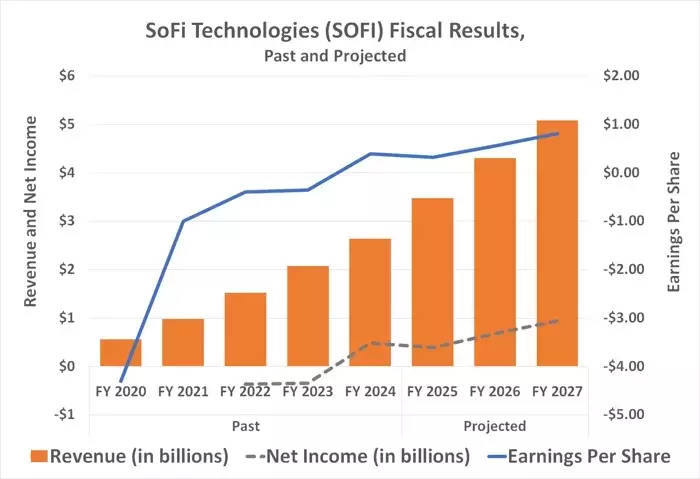
Looking ahead, the digital banking sector is projected to experience robust growth. According to market research by Technavio, the global digital banking market is expected to expand at an average annual rate of over 16% through 2029, with the U.S. market anticipated to lead this growth. Analysts forecast that SoFi's revenue and earnings will nearly double between last year and 2027, driven by this favorable market trend. Furthermore, SoFi is actively diversifying its service offerings beyond conventional banking. Recent initiatives include providing access to an expanded range of private investments and launching its own sponsored exchange-traded fund, the SoFi Agentic AI ETF. This proactive approach to developing new revenue streams and broadening its market reach signifies SoFi's commitment to sustained growth.
While SoFi Technologies presents a compelling growth narrative and a strong market position, its stock's rapid appreciation warrants careful consideration. The stock has more than doubled in value over the past year, surpassing analysts' consensus price targets. Trading at nearly 50 times next year's projected earnings, its valuation is notably high, especially for a banking institution. This suggests that while SoFi is a promising company, the current market price might not offer the most attractive entry point for new investors. A cautious approach, possibly waiting for a market correction, could be a more prudent strategy, although significant pullbacks are unlikely given the company's strong fundamentals and compelling story.
