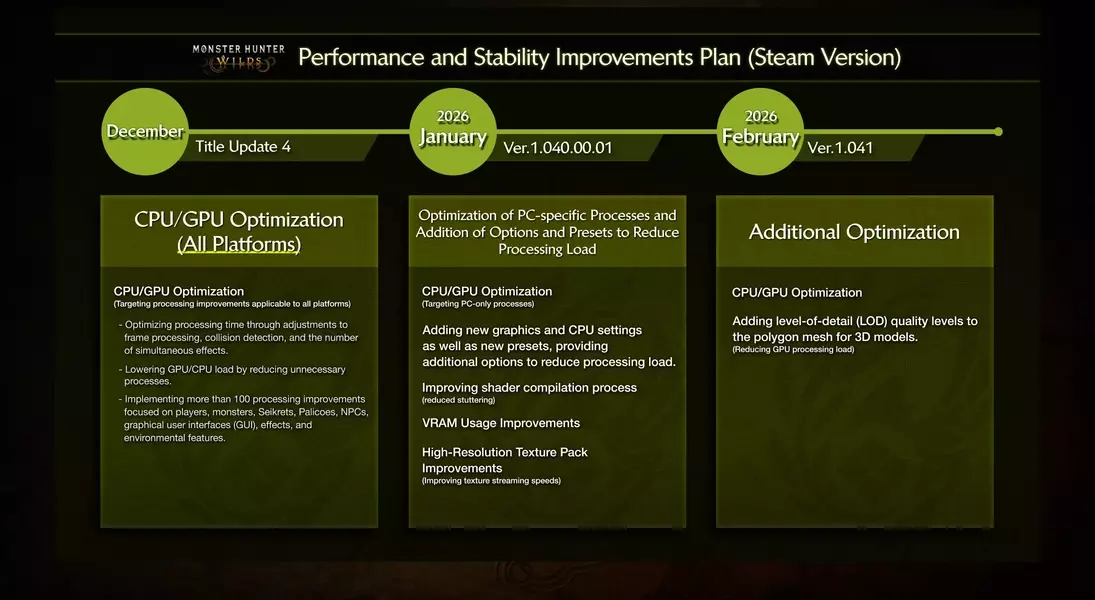

Capcom has detailed a comprehensive plan to revitalize the gaming experience for 'Monster Hunter Wilds,' aiming to address the persistent performance issues that have plagued the title since its release. The forthcoming Title Update 4, set to launch on December 16, promises not only to introduce fresh content, including the formidable elder dragon Gogmazios and innovative weapon and armor enhancement mechanisms, but also to deliver crucial multi-platform optimizations. This initiative reflects Capcom's commitment to improving the game's stability and playability, a move eagerly anticipated by the player community.
The journey for 'Monster Hunter Wilds' has been challenging, marked by player frustration over technical shortcomings that even caught the attention of Capcom's investors. The game's performance issues became a notable point of discussion, with the company publicly acknowledging the need for significant improvements. The upcoming Title Update 4 is positioned as a pivotal step in rectifying these concerns, offering a ray of hope for a smoother and more enjoyable gameplay environment.
While the initial December update will lay the groundwork with general performance enhancements across all platforms, PC players can look forward to more specialized improvements in a subsequent patch scheduled for January. This dedicated PC-focused update will delve deeper into CPU and GPU optimizations tailored specifically for the platform. Following this, a third patch in February will introduce advanced level-of-detail (LOD) quality settings for 3D models, further aiming to alleviate GPU load and refine visual fidelity.
Capcom's roadmap for these updates emphasizes a methodical approach to tackling performance. The Title Update 4 is designed to boost CPU and GPU efficiency by streamlining frame processing, refining collision detection, and managing simultaneous visual effects more effectively. Additionally, the update seeks to reduce system load by eliminating unnecessary processes and implementing over a hundred processing refinements that touch upon various in-game elements, from players and monsters to Palicoes and NPCs.
The January patch for PC will continue this optimization drive, targeting processes unique to the PC ecosystem. While the inclusion of new graphics and CPU settings, alongside fresh presets, is mentioned, the core expectation rests on the underlying 'processing optimizations' to make a tangible difference. The February update's focus on LOD quality levels suggests an attempt to enhance the game's visual adaptability and reduce rendering demands, potentially resolving instances of simplistic 'origami monsters' encountered by players.
Given past experiences with updates, the gaming community remains cautiously optimistic. While the prospect of finally achieving a stable and high-performing 'Monster Hunter Wilds' is appealing, the timing of these fixes, nearly a year post-launch, has prompted some players to question the initial release state. Despite early sales contributing to Capcom's record profits, the long-term impact of the game's initial reception on the 'Monster Hunter' franchise's reputation remains a pertinent consideration.
Capcom's phased approach to addressing the technical debt of 'Monster Hunter Wilds' signifies a concerted effort to restore player confidence and deliver the polished experience expected from a flagship title. These planned updates, spanning from general optimizations to platform-specific refinements and visual fidelity enhancements, underscore a commitment to resolving the game's core performance issues and enriching its overall content.
