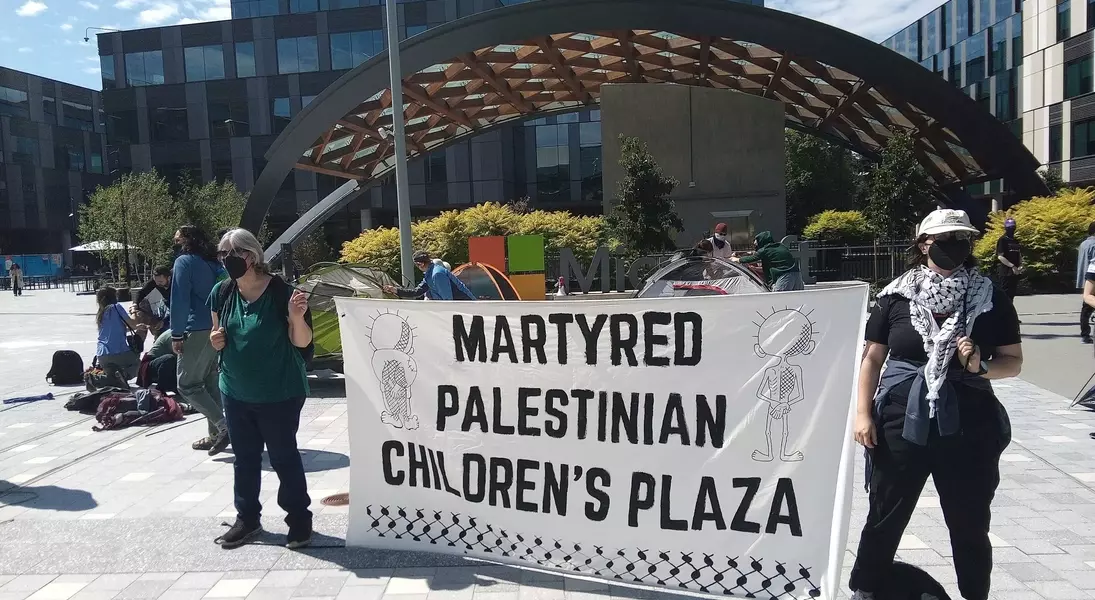
A recent demonstration at Microsoft's headquarters escalated employee protests against the company's contracts with the Israeli military. This event saw a group establish an encampment, highlighting their demands for Microsoft to cease its involvement with the Israeli defense sector. The protesters' actions reflect a growing internal and external pressure on technology firms to consider the ethical implications of their partnerships, particularly in conflict zones. This development follows a series of previous employee-led actions and public revelations regarding the scope of data handling for military purposes. The activists' call for a "Worker Intifada" signifies a broader movement advocating for corporate accountability and human rights within the tech industry.
\rProtest Intensifies at Microsoft Headquarters Over Israeli Contracts
\rOn a recent Tuesday, a significant protest unfolded at Microsoft’s sprawling headquarters in Redmond, Washington. A collective comprising current and former Microsoft employees, alongside concerned community members, initiated a bold occupation of a central plaza. This area, symbolically renamed “The Martyred Palestinian Children’s Plaza,” was declared a “Liberated Zone” encampment by the group, known as “No Azure for Apartheid.” Approximately 50 individuals gathered to commence the demonstration, establishing tents and creating poignant artistic tributes, including shrouds and a prominent sign advocating to “Stop Starving Gaza.”
\rCentral to their demands was the installation of a “negotiating table,” inviting Microsoft executives to engage in dialogue and terminate the company’s collaboration with the Israeli military. The protesters affirmed their commitment to maintaining the occupation until they are forcibly removed, emphasizing the gravity of their stance. This escalation follows earlier instances of dissent, such as the disruptions during Microsoft’s 50th-anniversary celebrations in April, where software engineers publicly challenged the company’s AI product usage by the Israeli military during speeches by CEO Satya Nadella and AI CEO Mustafa Suleyman. These individuals faced prompt termination of their employment.
\rFurther intensifying the situation, allegations surfaced in May regarding Microsoft Outlook emails containing terms like “Palestine,” “Gaza,” “genocide,” “apartheid,” and “IOF off Azure” being blocked, leading to accusations of censorship. The "No Azure for Apartheid" organization, a segment of the broader "No Tech for Apartheid" movement, characterized the plaza takeover as the most substantial action against Microsoft to date. This move was bolstered by a Guardian investigation earlier in the month, in collaboration with +972 Magazine and Local Call, which unveiled information suggesting the Israeli government intended to store recordings and data from up to one million Palestinian phone calls per hour. These reports indicated that such data had direct implications for Israeli military operations in Gaza and the West Bank.
\rIn response to these revelations and ongoing concerns, activists circulated a document titled “We will not be cogs in the Israeli genocidal machine: a call for a Worker Intifada.” Authored by "Microsoft workers, former workers, and community members of conscience," this manifesto implores Microsoft to sever all ties with Israel. It also passionately calls for an end to what they describe as “genocide and forced starvation” in the region, demanding reparations for Palestinians. Additionally, the document addresses internal issues, advocating for an end to discrimination against Palestinian, Arab, Muslim, and pro-Palestine workers within Microsoft, and demanding protection against workplace harm and harassment for all employees engaged in Palestinian advocacy. The document urges workers across all companies to advocate for their employers to “cut ties and divest from all genocidal partnerships,” including any existing relationships with Israel or Microsoft. For Microsoft's leadership, the document provides direct channels for negotiation, including an email address and an open invitation to the negotiating table established in the occupied plaza.
\rThis evolving situation at Microsoft underscores the increasing moral and ethical dilemmas faced by global technology corporations. As digital tools become inextricably linked with geopolitical conflicts, employees are leveraging their collective voice to advocate for responsible corporate conduct. The demand for transparency and accountability from tech giants like Microsoft reflects a growing awareness of the powerful impact their technologies can have on human lives and global events. The protesters' unwavering commitment to their cause, despite facing potential repercussions, highlights a fundamental tension between corporate profit motives and humanitarian principles. This event serves as a potent reminder that, in an interconnected world, even seemingly neutral technological advancements can become deeply entwined with complex political and ethical issues, prompting calls for greater scrutiny and corporate responsibility.
