
McDonald's, a household name synonymous with global fast food, boasts an expansive presence with over 44,000 establishments across more than 100 nations. While its vast scale underpins a resilient business model, questions arise regarding the potential for substantial stock price appreciation. The company's franchise-centric approach, where most locations are leased with royalty fees, provides a stable revenue stream. However, its mature market position suggests that dramatic, rapid growth in shareholder value might be a less likely scenario compared to nascent enterprises. Despite consistent dividend increases since 1976, past performance indicates a steady, rather than explosive, return on investment. Current financial metrics, including modest revenue and net income growth, coupled with a valuation aligning closely with market averages, hint at a future characterized by consistent, albeit moderate, gains. This outlook prompts investors to weigh the security of a well-established company against the allure of high-growth opportunities.
Unveiling McDonald's Investment Prospects
As of September 5, 2025, McDonald's (NYSE: MCD) stood at a price of $314.28, reflecting a slight dip of 0.85% for the day. This prominent fast-food corporation, which began its journey as a humble hamburger establishment in Southern California, has blossomed into an immense global network. Its widespread influence, spanning over 100 countries with approximately 44,000 locations, solidifies its position as a market leader.
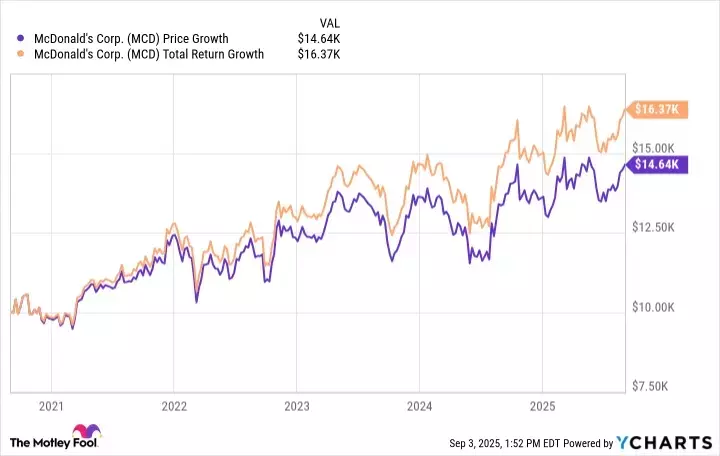
For individuals contemplating an investment in this culinary titan, the question of turning a $10,000 principal into a $50,000 fortune within a mere five-year span presents a compelling, yet complex, challenge. A retrospective glance at the past half-decade reveals that a similar initial investment would have yielded approximately $14,600, or closer to $16,400 when accounting for the company's unbroken streak of annual dividend increases since 1976. This historical data suggests that while McDonald's offers dependable returns, achieving an extraordinary fivefold increase within such a short timeframe might be an ambitious target.
The core of McDonald's financial stability lies in its unique business model: roughly 95% of its outlets operate as franchises. This system mandates that franchisees not only pay an initial fee but also lease properties from McDonald's and remit a royalty fee, typically between 4% and 5% of their sales. This structure, largely defined by fixed expenses, imbues the company with significant resilience, particularly during economic downturns.
However, recent financial disclosures for the first six months of 2025 indicated a revenue of $12.8 billion, representing a modest 1% year-over-year increase. Net income for the same period reached $4.1 billion, a 4% rise from the previous year. These figures, while stable, do not signal the accelerated growth typically associated with exponential stock gains. Furthermore, the company's price-to-earnings (P/E) ratio of 27, slightly below the S&P 500's average of 30, positions its valuation as conventional rather than undervalued, thereby limiting the potential for significant stock price surges driven by an expanding earnings multiple.
In essence, McDonald's is poised to continue benefiting from its widespread franchise operations and a consistent dividend payout strategy. This trajectory is expected to generate positive returns for investors. Nevertheless, the pace of its financial expansion implies that transforming a $10,000 investment into $50,000 within the forthcoming five years is an outcome that appears less probable, given the company's mature growth phase and market valuation.
From an observer's perspective, this analysis of McDonald's performance serves as a profound reminder that investment success is not solely about selecting a company with a strong brand or a stable business. It underscores the critical importance of aligning investment expectations with a company's stage of growth. For a behemoth like McDonald's, which has already achieved global saturation and market maturity, the era of explosive, multi-fold returns may well be in its past. Its value now lies in its unwavering stability, consistent dividend yield, and resilience against economic fluctuations – qualities that appeal more to long-term income investors rather than those seeking rapid capital appreciation. This insight teaches us that diversifying portfolios with a mix of established, dependable enterprises and carefully vetted high-growth ventures can be a more pragmatic approach to achieving varied financial objectives. It’s a compelling case for understanding that different companies offer different kinds of value, and tailoring one's investment strategy accordingly is paramount.
