
Nvidia, a prominent force in the artificial intelligence landscape, consistently demonstrates remarkable resilience and growth, even when confronted with market uncertainties. The company’s recent financial disclosures underscore its robust performance, characterized by significant revenue increases that surpass analyst predictions. This sustained upward trajectory is largely fueled by the relentless global demand for advanced AI chips, a sector where Nvidia holds a commanding lead. While its current valuation may seem elevated, the inherent strength of its business model and its pivotal role in the burgeoning AI industry suggest that its premium pricing is justified. Industry observers widely anticipate that Nvidia will continue to expand its market influence, with discussions now centering on when, rather than if, it will achieve the extraordinary milestone of a $5 trillion market capitalization.
Nvidia Continues to Outpace Projections with Strong Financial Results
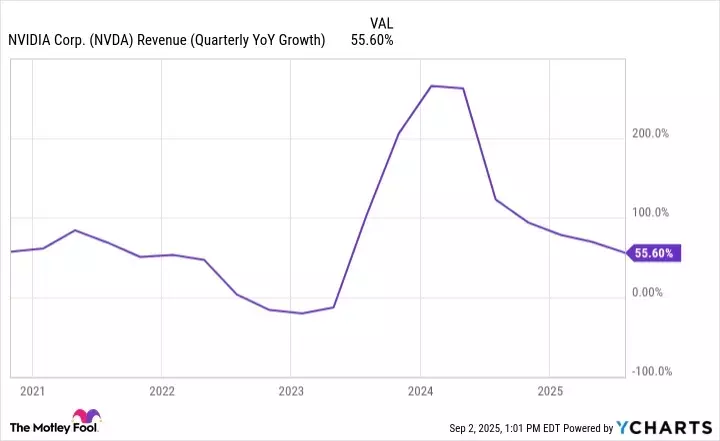
In a compelling demonstration of its market prowess, Nvidia recently unveiled its latest quarterly financial results, once again exceeding anticipated earnings. For the period concluding on July 27, Nvidia reported a staggering 56% year-over-year surge in revenue, reaching an impressive total of $46.7 billion. This figure comfortably surpassed the analyst consensus of just over $46 billion. Furthermore, the company’s adjusted earnings per share reached $1.05, a notable improvement over the estimated $1.01.
Crucially, the company's forward-looking guidance remains exceptionally strong, projecting a continued growth rate of over 50% for the upcoming quarter. While this indicates a natural deceleration from previous explosive figures, such a growth rate is an extraordinary feat for a company of Nvidia's immense scale and market capitalization. These robust numbers stand as a testament to the unwavering demand for its state-of-the-art AI chips, which are indispensable across various industries.
Despite previous market jitters, including concerns triggered by the emergence of budget-friendly AI models such as DeepSeek R1 from China, and the broader impact of tariff disputes in early April, Nvidia's stock has consistently shown an ability to rebound and ascend. These challenges, which momentarily impacted investor confidence and led to a temporary dip below the $100 mark, ultimately proved to be transient. The stock's inherent strength and its central role in the AI revolution have allowed it to repeatedly overcome adversity and reach new heights, reinforcing its position as the world's most valuable company with a market capitalization hovering around $4.1 trillion.
Looking ahead, the question is not if, but when, Nvidia will achieve the unprecedented $5 trillion market cap. While a 22% increase is still required to reach this monumental figure, the prevailing sentiment in the market is one of optimism. Given the continued robust expansion in the AI sector and Nvidia's indispensable technology, this target appears increasingly attainable. However, investors are keenly observing any signs of potential headwinds, such as shifts in technology companies' AI investment strategies or broader geopolitical factors, as these could introduce short-term volatility. Nevertheless, the long-term outlook for Nvidia remains overwhelmingly positive, suggesting that strategic investors will continue to find value in its shares despite present market fluctuations.
From an analytical standpoint, Nvidia's journey epitomizes the transformative power of technological innovation coupled with strategic market positioning. The company's consistent ability to surpass expectations and navigate external pressures with resilience offers valuable insights for both businesses and investors. It underscores the importance of a clear vision, continuous innovation, and adaptability in rapidly evolving technological landscapes. For the broader economy, Nvidia's trajectory highlights the profound impact of artificial intelligence as a foundational technology, driving not only corporate valuations but also reshaping industries and creating new paradigms of growth. The narrative of Nvidia serves as a compelling case study for sustained success in the digital age, urging us to consider the long-term potential of disruptive technologies rather than being swayed by short-term market noise.
