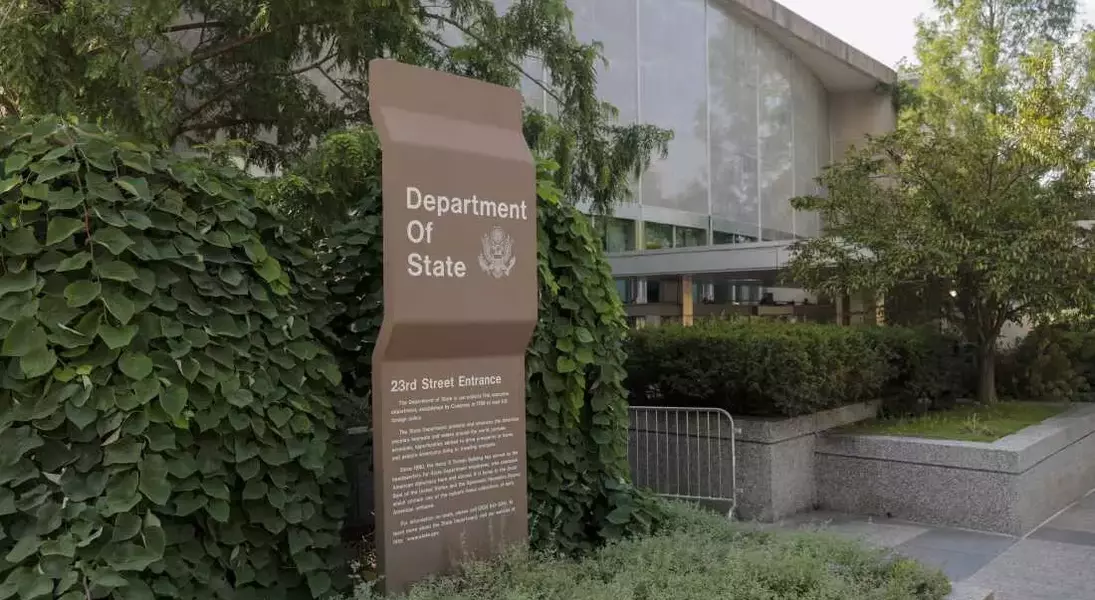
A recent legal challenge has emerged against the United States' State Department, brought forth by various civil rights groups and American citizens. This lawsuit contests a sweeping policy enacted by the Trump administration, which has effectively halted the processing of immigrant visas for individuals originating from 75 nations. The plaintiffs argue that this measure, which went into effect on January 21, aims to dismantle fundamental aspects of immigration law that have been in place for decades. They contend that the policy unfairly targets entire nationalities, preventing families and working individuals from accessing legal immigration pathways, despite existing legal provisions designed to protect such processes.
The plaintiffs in this case highlight that the vast majority of countries affected by this visa freeze are predominantly non-white and located outside of Europe. They point to the administration's stated justification for the policy—to prevent immigrants from nations whose populations are deemed to "extract wealth from the American people at unacceptable rates"—as a discriminatory and baseless claim. Legal experts involved in the suit emphasize that immigration law has historically allowed for temporary support and public benefits as part of the integration process, and that singling out individuals based on their national origin for potential public charge status is unprecedented and unlawful. The lawsuit asserts that this broad, nationality-based ban is a departure from established legal precedent and calls for the government to adhere to the rule of law, requiring individualized assessments for visa applicants rather than imposing blanket prohibitions.
Legal Battle Against Nationality-Based Visa Ban
A coalition of civil rights organizations and U.S. citizens has launched a lawsuit against the State Department, challenging a contentious policy that freezes immigrant visa processing for individuals from 75 countries. This legal action contends that the Trump administration's directive, which became effective on January 21, is an attempt to undermine long-standing immigration statutes. The plaintiffs argue that this measure unlawfully imposes a ban on legal immigration based solely on nationality, thereby stripping families and workers of their legally guaranteed rights to due process. This legal challenge underscores a fundamental disagreement over the interpretation and application of immigration law, with critics asserting that the policy disregards established legal frameworks and perpetuates discrimination.
The core of the lawsuit focuses on the discriminatory nature of the visa ban, asserting that it violates principles of equality under the law. The plaintiffs highlight that the policy disproportionately affects non-white populations from countries outside of Europe, effectively creating a barrier to legal immigration based on national origin. They cite a previous study from the Cato Institute, which indicated that immigrants, particularly those with lower skills, generally utilize fewer welfare benefits compared to native-born Americans, thereby refuting the administration's justification for the ban. The legal teams involved are advocating for the State Department to revert to individualized assessments of visa applicants, as mandated by existing law, rather than imposing a sweeping, discriminatory freeze that impacts nearly half of the world's nations.
Impact and Implications of the Visa Processing Suspension
The State Department's decision to suspend immigrant visa processing for numerous countries has sparked significant controversy and legal opposition. This policy, targeting nations like Afghanistan, Somalia, Brazil, and Russia, is framed by the administration as a measure to prevent immigrants from becoming a financial burden on American society. However, the lawsuit brought by civil rights groups and U.S. citizens argues that this justification is a pretext for a discriminatory policy that ignores decades of settled immigration law. The plaintiffs emphasize that the law has never deemed individuals inadmissible simply for potentially receiving non-cash public benefits, viewing such support as a legitimate part of the integration process for new arrivals into the U.S. economy and society.
One of the prominent examples cited in the lawsuit involves a Colombian physician who, despite being approved for an "Einstein Visa" due to extraordinary abilities, was deemed ineligible for an employment-based visa because Colombia is on the ban list. This case illustrates the arbitrary nature of the policy, which prevents highly skilled individuals from contributing to the U.S. workforce. Critics, including Efrén Olivares of the National Immigration Law Center, assert that the State Department, under Secretary Marco Rubio, failed to follow proper regulatory procedures before enacting such a broad measure. The lawsuit seeks to compel the government to adhere to legal requirements, ensuring that each visa applicant receives an individualized assessment rather than being subjected to a blanket ban based on their country of origin, thereby upholding the integrity of the immigration system.
