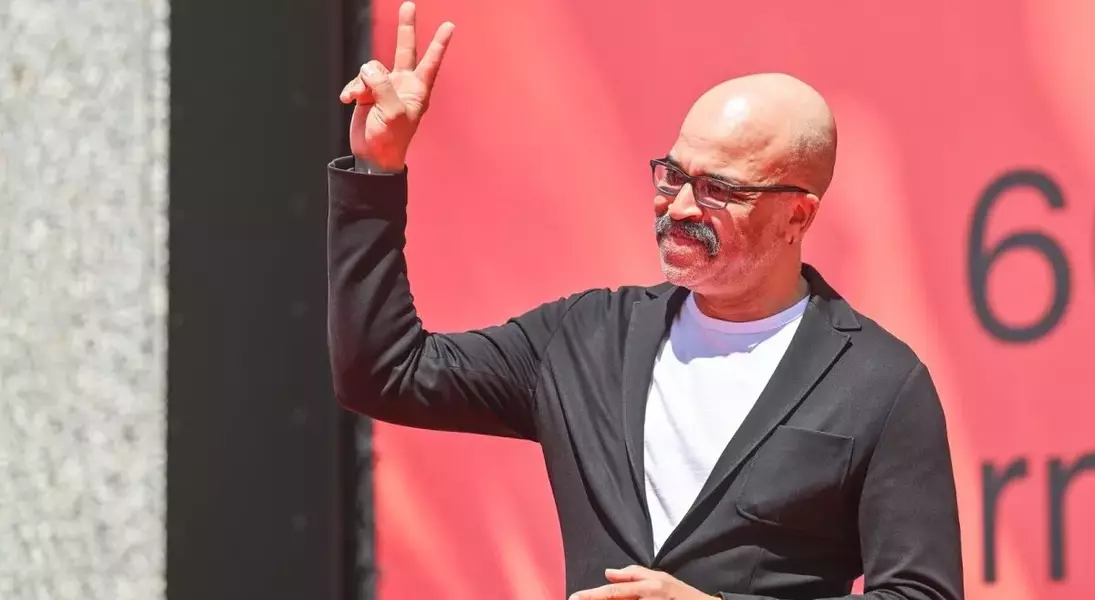
During the 60th Karlovy Vary International Film Festival, actor Jeffrey Wright engaged in a comprehensive discussion about his career, touching upon his role in the Batman series and his creative partnership with Wes Anderson. He also contemplated the increasing theatricality of modern politics, reflecting on how his background in political science unexpectedly intertwined with his acting profession. Wright emphasized his commitment to projects that resonate with him thematically and narratively, regardless of their scale, and paid tribute to Dustin Hoffman's profound impact on his artistic journey.
Jeffrey Wright's Insights on "The Batman" Franchise and His Artistic Collaborations
On a radiant Friday at the 60th Karlovy Vary International Film Festival, acclaimed American actor Jeffrey Wright addressed members of the press. Amidst discussions on the evolution of politics into a form of entertainment, Wright delved into his involvement in the esteemed "Batman" film series and his recurring collaborations with the distinctive director, Wes Anderson.
When questioned about his transition from political science to acting, Wright provocatively mused, "So, you think politics and theater are completely different things? I'm not so sure. I think our politics has gotten increasingly like show business – to the detriment of everyone who's involved." This reflection set the tone for a candid conversation about his professional choices and artistic principles.
Regarding his role as Commissioner James Gordon in "The Batman," Wright articulated his admiration for Matt Reeves' vision: "I think [director] Matt Reeves' interpretation of the franchise is really fresh, and rich in terms of the narrative, but also rich cinematically. I don't think he views this as frivolous comic book stuff, but he views it as an opportunity to explore contemporary themes through a really dynamic medium that is the Batman franchise." He revealed that he is currently filming the second installment, highlighting the depth and meaningfulness Reeves brings to the iconic saga. Wright drew parallels between Reeves' approach and the classic American cinema of the 1970s, citing directors like Sidney Lumet, Francis Ford Coppola, and Martin Scorsese, and actors such as Dustin Hoffman, as inspirations for the cinematic texture of the new "Batman" films. He asserted his dedication to projects that offer thematic and narrative richness, stating, "I wouldn't want to be a part of a big franchise just to be a part of a big franchise. But if it resonates with me in terms of the themes and the process and the narrative, then I'm in. It could be a big franchise. It could be an independent film. Doesn't matter to me!"
Turning to his partnership with Wes Anderson, Wright expressed profound enthusiasm for their work on films such as "The Phoenician Scheme," "Asteroid City," and "The French Dispatch." He lauded Anderson's unique aesthetic and unwavering vision, remarking, "He works in complete disregard of anyone else's opinion. He is authentically himself. He's his own genre." Wright deeply appreciates Anderson's blend of theatricality, surrealism, and irony. He fondly recounted how Anderson's scripts, particularly for "The French Dispatch," immediately resonated with him, igniting his creative imagination. "It's just wonderful to find collaborators that you know you sympathize with. And that he's invited me back to work with him again on a couple of films subsequent to that one is just really gratifying. It always feels really, really fulfilling creatively and intellectually to work with him," Wright shared, underscoring the intellectual and creative fulfillment he derives from their collaborations.
Earlier that day, Wright had emphasized the critical importance of "genuine freedom" during a public introduction to a screening of "Basquiat." His contributions to the festival will be further recognized at Saturday's closing ceremony, where he is slated to receive KVIFF's prestigious President's Award. The festival, celebrating a double anniversary, has drawn an array of cinematic luminaries, including Jesse Eisenberg, Juliette Binoche, Maggie Gyllenhaal, Harvey Keitel, and legendary cinematographer Robert Richardson, alongside Dustin Hoffman, whose work greatly influenced Wright.
Wright reiterated Hoffman's formative influence, particularly performances in "Midnight Cowboy," "Papillon," and "Marathon Man." He recounted, "When I saw Midnight Cowboy, I said, 'Wow, that's a crazy place, that New York. I want to go there.' When I saw him in Papillon or Marathon Man, and I saw the way he worked, the craft that was so evident, the thoughtfulness, the theatricality that resonated through his work, I said, 'If I'm going to be an actor, that's a model for how to go about it' because it seemed meaningful and it was just compelling to me. I've been influenced by many performances and many actors, but I don't think there's anyone whose way of working impacted me more than Dustin Hoffman."
Jeffrey Wright's reflections at Karlovy Vary offer valuable insights into the contemporary film industry, highlighting the convergence of art and social commentary. His dedication to meaningful roles, whether in large franchises or independent productions, and his profound respect for collaborators like Matt Reeves and Wes Anderson, underscore a thoughtful approach to his craft. Furthermore, his admiration for cinematic legends like Dustin Hoffman reminds us of the enduring legacy of impactful performances and the continuous inspiration they provide across generations of actors. Wright’s perspective challenges us to seek depth and authenticity in artistic endeavors and to recognize the subtle ways in which various fields, even seemingly disparate ones like politics and entertainment, can intersect and influence each other.
