Intel's latest Xe3 graphics architecture, embodied in the Arc B390 integrated GPU within Panther Lake processors, demonstrates remarkable performance, surprisingly comparable to dedicated graphics cards. While initial tests of the Panther Lake laptop confirmed its potent capabilities, a deeper examination of its core metrics reveals both significant strengths and a key limitation. Utilizing specialized microbenchmarks, researchers delved into the iGPU's instruction processing efficiency, memory bandwidth, and latency to understand its fundamental characteristics. This analysis pits the B390 against various competitors, including previous-generation integrated solutions and even a full-fledged discrete GPU, showcasing Intel's progress in integrated graphics technology.
Detailed Analysis of Intel's Xe3 iGPU in Panther Lake Processors
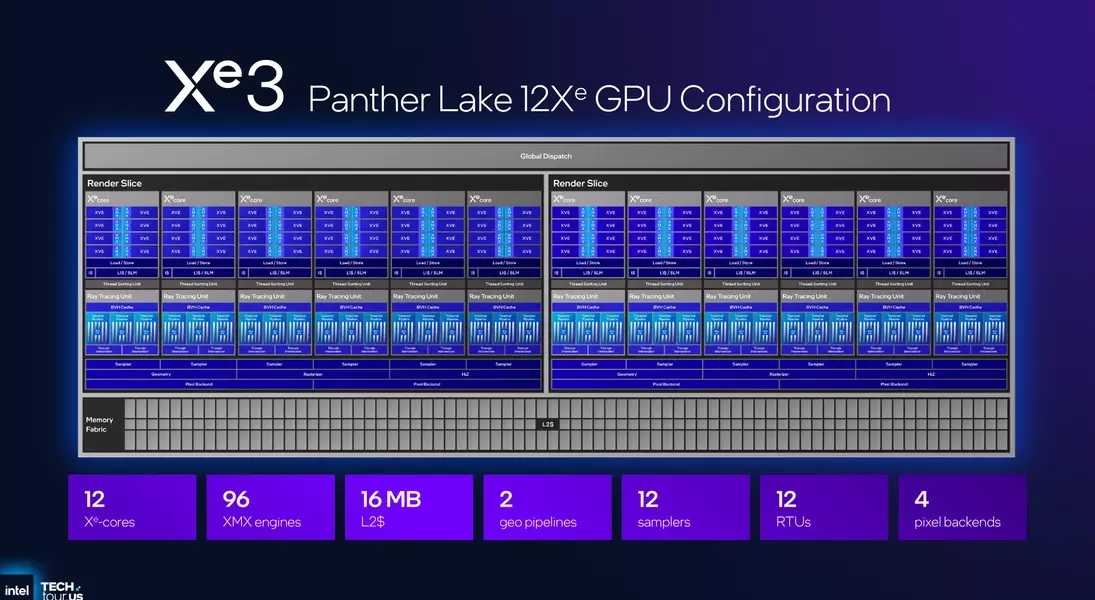
The journey to understand Intel's Xe3 architecture began with the practical evaluation of a Panther Lake-equipped laptop. This hands-on experience validated early expectations, confirming the architecture's exceptional performance. The Arc B390, despite featuring 1536 shaders, a 16 MB L2 cache, and a boost clock of 2.5 GHz, significantly outperforms many integrated graphics units. Its direct competitors, excluding AMD's Strix Halo chips, are primarily AMD's Radeon 890M and Nvidia's GeForce RTX 5050. However, for a more profound comparison, benchmarks were conducted against the Radeon 780M, RTX 4050, and surprisingly, Intel's own first-generation Alchemist-powered Arc A770.
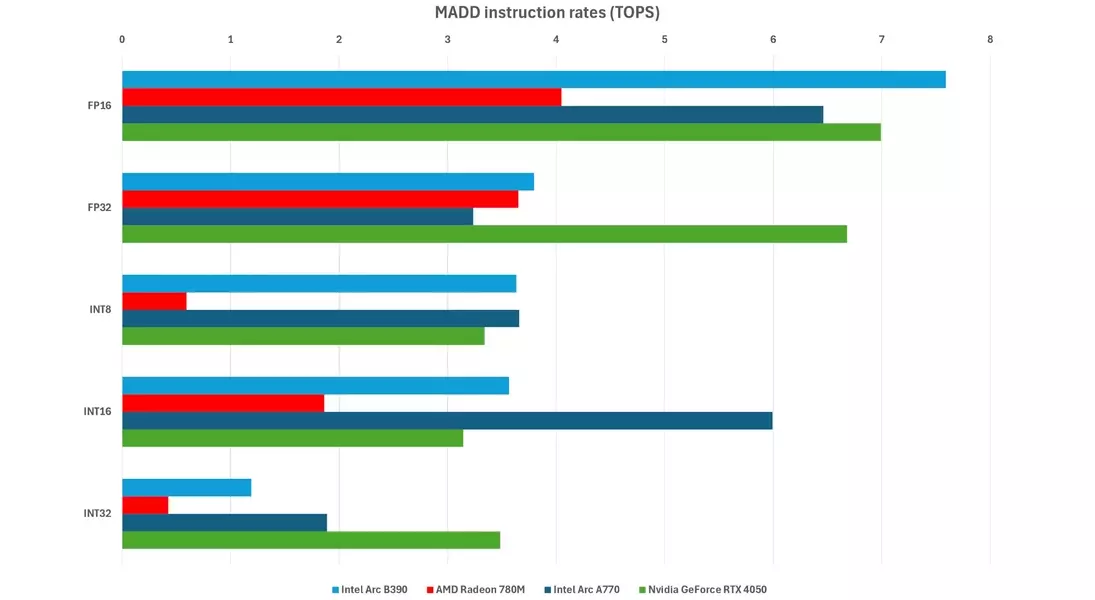
To rigorously assess the B390, critical aspects such as peak instruction throughput, cache and VRAM bandwidth, and memory latencies were investigated using Nemez's GPUPerfTest. This tool allowed for a detailed comparison across various data formats, particularly focusing on fused multiply-add (MADD) instructions, which are fundamental to graphics rendering. The B390 demonstrated impressive MADD throughput, shadowing the much larger Arc A770, indicating a highly efficient internal architecture despite its smaller physical footprint. While theoretical peaks were not fully realized in the test environment for any GPU, the B390 consistently closed the gap with more powerful, dedicated alternatives.
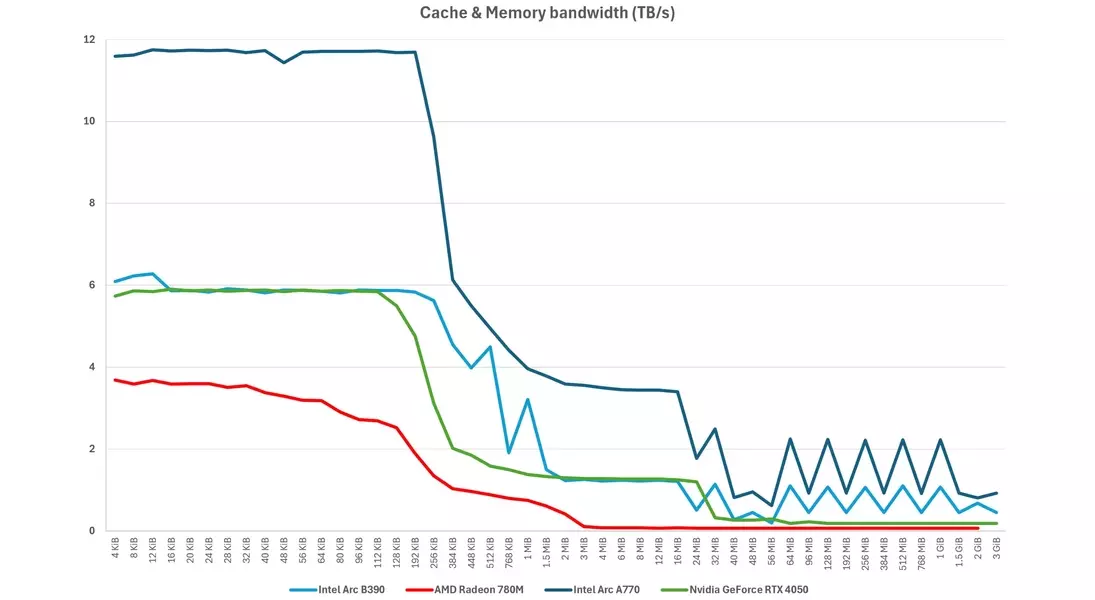
In terms of cache and memory bandwidth, the B390 excelled, showing a high data transfer rate from its L1 cache. This suggests a remarkably wide internal data bus, an unusual feature for an integrated GPU. The performance here was notably strong, even against the Nvidia chip, underscoring Xe3's optimized design for data flow. Conversely, the Radeon 780M showed unexpected weaknesses in this area, potentially due to driver optimization issues on the specific test device.
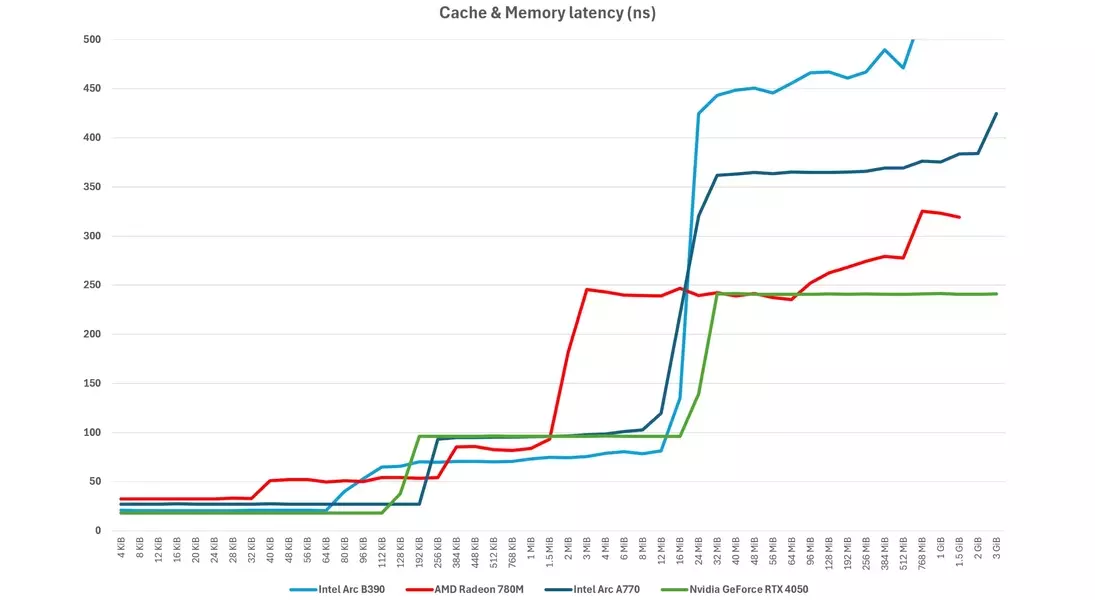
The latency measurements further highlighted the B390's strengths, particularly its fast L1 cache and the lowest L2 latencies among all tested units, surpassing both the RTX 4050 and Arc A770. However, the Achilles' heel of the Xe3 architecture in this integrated form factor lies in its reliance on LPDDR5x system memory for VRAM. This shared memory configuration, while offering bandwidth, introduces higher latencies compared to dedicated GDDR6 modules used in discrete GPUs. This latency penalty, combined with the need to share resources with the rest of the system, is identified as the primary factor preventing the Arc B390 from achieving its absolute maximum potential in demanding gaming scenarios.
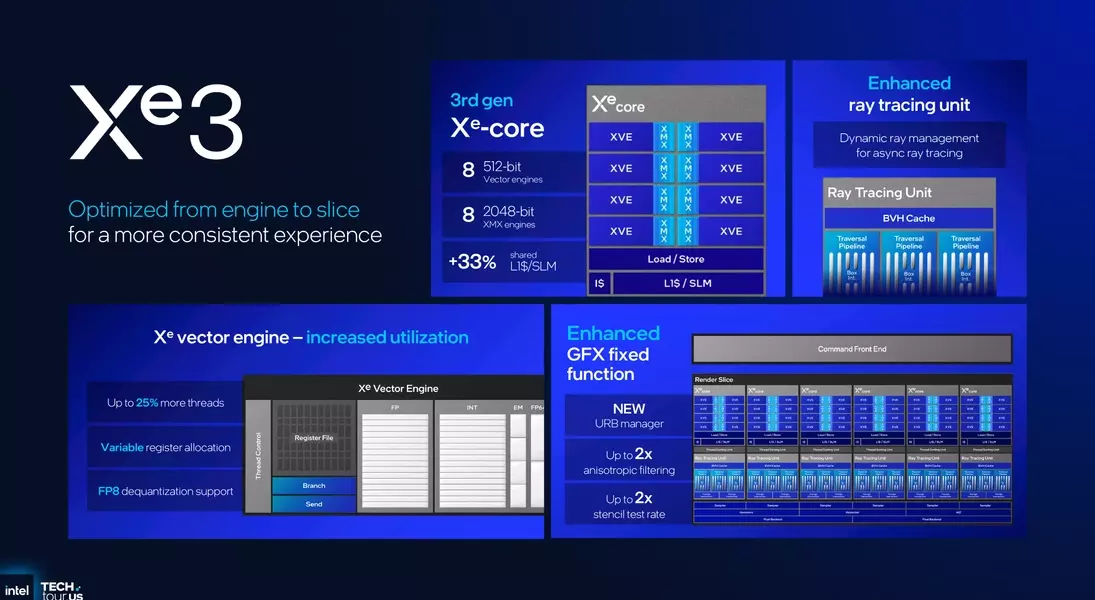
This detailed scrutiny reveals a sophisticated and potent integrated GPU architecture within Intel's Panther Lake. The Xe3 design, a refined evolution of the original Xe, brings desktop-class performance closer to mobile platforms than ever before. Its excellent shader throughput and efficient cache system lay a strong foundation. While the current implementation's dependency on system memory for VRAM presents a bottleneck, the core architecture's strength suggests a tantalizing future. One can only imagine the impact a large-scale Xe3 GPU, paired with high-speed GDDR7 memory in a discrete graphics card, could have on the market, posing a formidable challenge to established players like AMD and Nvidia. Intel's cautious approach to releasing such a product keeps the industry in suspense, but the underlying technology speaks volumes about its potential.
