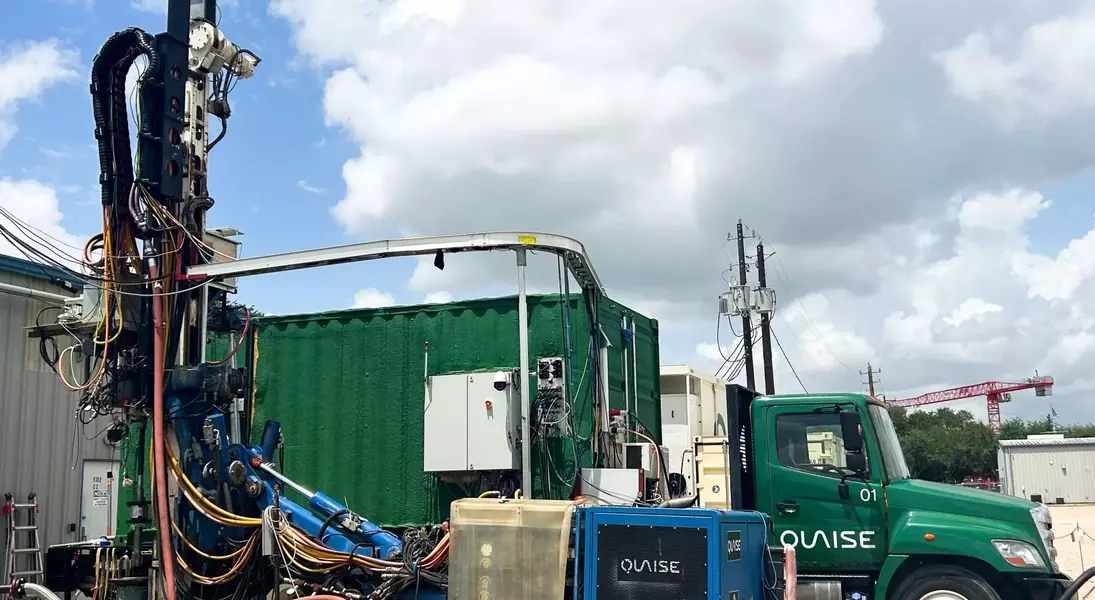
Quaise, a forward-thinking startup, is on the cusp of transforming the landscape of geothermal energy with its groundbreaking millimeter-wave drilling technology. By harnessing the power of high-frequency electromagnetic radiation, the company aims to overcome the traditional barriers to accessing deep Earth heat, promising to make this sustainable energy source viable on a global scale. This innovative method seeks to accelerate drilling operations and reduce costs, potentially unlocking vast reserves of clean energy that lie kilometers beneath the Earth's surface.
Breakthroughs in Geothermal Drilling Unveiled
In a demonstration held at Quaise's Houston headquarters, observers witnessed a remarkable feat: a millimeter-wave drilling rig, integrated with a modified box truck, efficiently carved a hole into a basalt slab in less than two minutes. The process involved directing a concentrated beam of energy, causing the rock to glow intensely, crack, and even melt. This experimental setup, later moved to a quarry in central Texas, successfully drilled a 100-meter deep hole, showcasing the technology's readiness for real-world conditions. Matthew Houde, Quaise's co-founder and chief of staff, emphasizes that the Earth's internal heat holds enough energy to satisfy global demands for millennia. The company's vision is to extend super-hot geothermal accessibility worldwide by reaching depths of 10 to 20 kilometers, a feat largely unattainable with current conventional drilling techniques. Traditional drilling often encounters significant delays due to equipment wear and the need for frequent drill bit replacements when penetrating hard rock formations like granite. Quaise's solution lies in its innovative use of a gyrotron, a device traditionally employed in fusion power for heating plasma to extreme temperatures. Quaise repurposes this technology to blast, melt, and vaporize rock, significantly increasing drilling speed and efficiency. The process involves a gyrotron emitting powerful millimeter waves through a waveguide, which then heat the target rock until it cracks, melts, or vaporizes. Following this, a drill bit scrapes away the dislodged material, and a stream of air transports the debris to the surface, allowing for continuous operation. While current tests utilize a 100-kilowatt gyrotron, plans are underway for a more powerful one-megawatt system by 2026, targeting commercial-scale applications. Concurrently, Quaise is establishing a pilot plant in Oregon, near a volcanic site, utilizing conventional drilling to establish a functional geothermal facility by 2028. This facility aims to demonstrate the efficient production of geothermal power from 350°C rock, with future plans to deepen wells using the millimeter-wave technology. CEO Carlos Araque has indicated that commercial agreements for the energy produced are already in place with a major technology company and a utility provider. However, the path forward includes significant challenges, such as overcoming technical hurdles like directional drilling, ensuring long-term well functionality, and securing substantial funding in an uncertain economic climate. Despite these obstacles, the team at Quaise, including project manager Steve Jeske, remains confident in their technology's potential to redefine geothermal energy extraction.
The ambitious endeavor by Quaise to harness the Earth's inner heat through innovative drilling techniques signals a pivotal moment for global energy sustainability. From a journalistic perspective, this development underscores the human ingenuity in confronting pressing environmental challenges. The potential to access an almost limitless, carbon-free energy source from virtually any location on the planet could dramatically reshape our energy infrastructure and mitigate climate change impacts. However, the journey from laboratory success to widespread commercial deployment is fraught with technical, economic, and political complexities. The need for substantial investment, the inherent risks of pioneering such deep drilling methods, and the imperative for long-term operational stability present formidable challenges. As a reader, one can't help but feel a mix of excitement for the promise of abundant clean energy and a healthy skepticism regarding the speed and scale at which such a transformative technology can be integrated into the existing energy grid. The success of Quaise's bold vision will undoubtedly serve as a crucial test case for how quickly and effectively humanity can pivot towards more sustainable energy solutions, reminding us that true innovation often requires pushing the boundaries of what is thought possible.
