The 57th edition of the International Film Festival of India (IFFI) recently inaugurated in Goa, setting the stage for a cinematic celebration curated by acclaimed director Ashutosh Gowariker. Under the inspiring theme of 'Stories Without Borders,' the festival aims to transcend geographical and cultural divides through the universal language of film. The grand opening ceremony featured a blend of patriotic fervor, celebrated personalities, and a captivating musical performance, underscoring India's growing prominence on the global film landscape. Attendees and participants are set to engage in a week-long exploration of diverse narratives, innovative filmmaking, and opportunities for industry growth, particularly with the renewed emphasis on establishing a state-of-the-art film city in Goa.
The prestigious event, hosted at the Dr. Shyama Prasad Mukherjee Indoor Stadium, began with the ceremonial lighting of the lamp, graced by Goa's Chief Minister Pramod Sawant, National Film Development Corporation (NFDC) chair G. Krishna Kumar, and festival director Gowariker, among other dignitaries. Pawel Pawlikowski's 'Fatherland,' an award-winning film from Cannes, had the honor of opening the festival. The star-studded gathering included Bollywood actor Kartik Aaryan and Sai Pallavi, who portrays Sita in the much-anticipated film 'Ramayana.' The jury chairs, including Aanand L. Rai for the international jury, and Madhur Bhandarkar and Himanshu Sekhar Khatua for the Indian Panorama juries, were also prominent figures in attendance, reflecting the festival’s commitment to recognizing cinematic excellence.
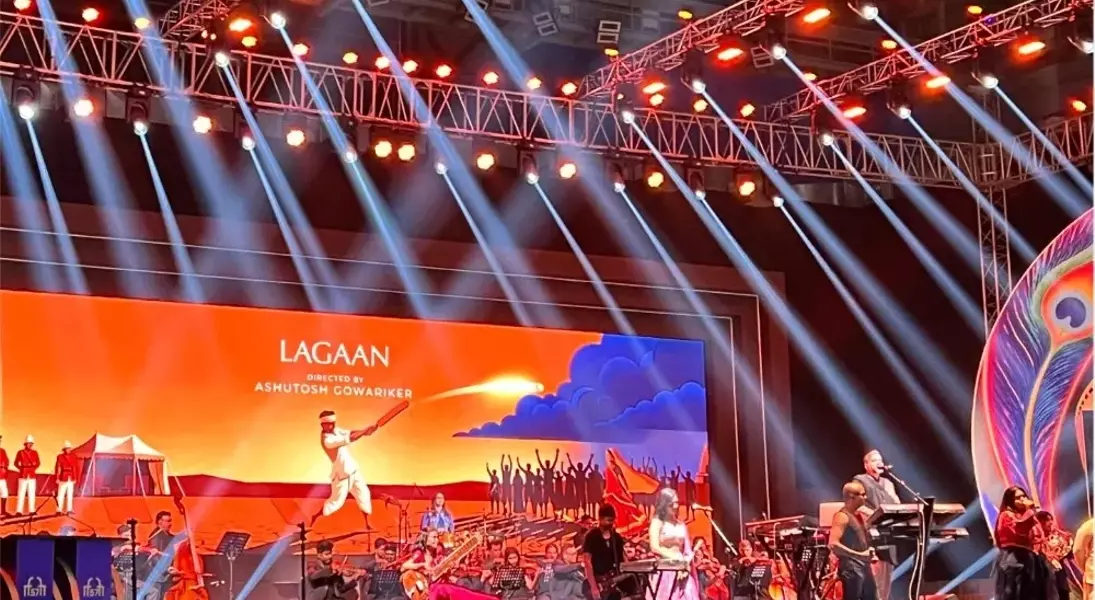
A highlight of the opening ceremony was the mesmerizing performance by three-time Grammy winner Ricky Kej. His orchestral presentation, 'A World of Cinema Through Music,' ingeniously wove together themes from iconic global films such as 'The Godfather,' 'Parasite,' 'The Lord of the Rings,' and Satyajit Ray's 'Pather Panchali,' alongside Gowariker’s own 'Lagaan,' all performed with traditional Indian instruments. Kej later presented a fusion of musical traditions from various countries, enhancing the festival’s international appeal. The performance also featured a symbolic peacock dance, representing the festival's prestigious Golden Peacock award, adding a vibrant cultural touch to the proceedings.
Chief Minister Pramod Sawant passionately reiterated his vision for Goa to evolve beyond being merely a picturesque filming location into a comprehensive production hub. He emphasized the state's ambitious plans for a dedicated film city, equipped with advanced facilities for pre-production, post-production, visual effects, and film education. This initiative aims to foster local talent, draw filmmakers from across India, and create new professional avenues for Goan creatives. Sawant highlighted existing frameworks like the Goa Regulation of Film Shooting Act 2021 and an online single-window permit system, demonstrating the state’s proactive approach to supporting the film industry. He also noted revisions to the film financing scheme for Goan producers, ensuring it accommodates contemporary formats and digital productions, signaling Goa’s intent to be at the forefront of virtual production, AI, animation, and VFX advancements.
Ashutosh Gowariker, renowned for his Oscar-nominated works, shared his unique perspective as a festival director. Previously experiencing festivals solely as a filmmaker promoting his own work, Gowariker expressed how his team reshaped this edition by focusing on the profound impact of stories on people. He articulated that in an increasingly interconnected yet insular world, stories serve as potent tools to bridge divides, stating, "Borders today are not only lines on a map. They’re also habits. A story is one of the few things that can cross such a line without a passport." This philosophy underpins the festival’s extensive international program, which includes 159 films from 86 countries, selected from over 1,400 submissions, alongside 76 Indian films in 18 languages, ensuring a truly global cinematic showcase.
The festival's competitive section features fifteen films vying for five awards, with prize money totaling INR1.36 crore, including INR51 lakh and the coveted Golden Peacock for the best film. The international jury, led by Aanand L. Rai, comprises acclaimed directors and sound designers from Romania, Venezuela, Thailand, and Argentina. Notably, eighteen films in the lineup are their respective countries’ Oscar submissions, highlighting the festival’s role as a launchpad for global talent. The program also boasts nine world premieres, two international premieres, 24 Asian premieres, and 116 India premieres, offering audiences a first look at groundbreaking cinema. This year’s Country of Honor is Spain, with Russia designated as the Partner Country, further enriching the international dialogue.
Beyond the screenings, the IFFI facilitates crucial industry interactions through the WAVES Film Bazaar. This marketplace brings together buyers, programmers, and producers from major film hubs like Paris, Busan, and London with emerging filmmakers, some of whom travel great distances to participate. Gowariker humorously noted how significant collaborations often begin with simple conversations, evolving into co-productions, emphasizing the bazaar’s role in fostering connections and deals. The festival also pays homage to cinematic heritage, commemorating the centenary of Polish director Andrzej Wajda and revisiting the works of legends like Prem Nazir and Raj Kumar, alongside celebrating the 25th anniversary of 'Lagaan.' New sections dedicated to Animation and Films About Films further broaden the festival's scope, with a significant representation of works directed by women and debut filmmakers, promoting diversity and fresh perspectives.
Chanchal Kumar, Secretary of India's Ministry of Information and Broadcasting, aptly summarized the festival’s essence, stating, "A border may define where a story begins, it need not define how far that story can travel." This sentiment was echoed by chief guest Ravi Kishan, a popular Bhojpuri star and Member of Parliament, who reflected on his extensive 34-year career. He recounted a memorable experience dubbing Spider-Man's voice into Bhojpuri, marveling at how cultural boundaries dissolve through storytelling. Gowariker’s final encouragement to the audience was to venture beyond their comfort zones, urging them to watch at least one film in an unfamiliar language, from a different country, by an unknown filmmaker, and to trust that subtitles would bridge any perceived linguistic divides, ultimately revealing the shared human experience that binds us all.
