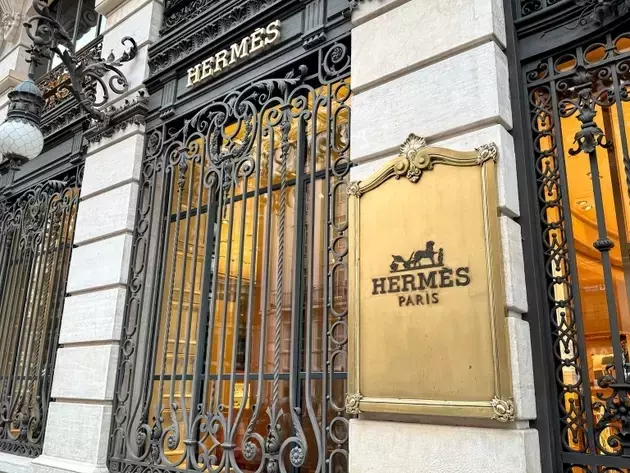
Hermès' stock has recently experienced a notable decline, now down 23% from its previous levels. This correction creates a potential opening for investors, as the company's market valuation appears disconnected from its underlying financial health. Despite a general slowdown in the luxury sector, Hermès continues to demonstrate strong revenue growth and maintains healthy profit margins. Although a tax-related dip affected net income in 2025, current market analysis indicates a potential upside of at least 20% for HESAY. However, investors should be mindful of broader geopolitical and macroeconomic uncertainties that could influence future performance.
Hermès: A Deep Dive into Its Market Performance and Future Prospects
In a recent market assessment, Hermès (OTCPK:HESAY, OTCPK:HESAF), the esteemed French luxury fashion house, has seen its stock price fall by 23% over the past eight months. This substantial correction, which surpasses earlier predictions of an 11-12% dip, prompts a re-evaluation of the company's investment appeal. The critical question for investors revolves around whether this downturn represents an overcorrection, thereby signaling a unique buying opportunity.
Analysis reveals a current misalignment between Hermès' fundamental strengths and its market valuation. Despite a prevailing slowdown across the luxury goods industry, Hermès has consistently achieved robust revenue growth. The company's profit margins remain strong, showcasing its operational efficiency and brand resilience. Although 2025 saw a slight contraction in net income due to tax adjustments, this appears to be a transient factor rather than an indicator of deteriorating core business performance.
Valuation multiples suggest that HESAY could see an upside of at least 20%. This optimistic outlook is grounded in the company's ability to navigate challenging market conditions while maintaining its high-end appeal and exclusivity. Hermès' enduring brand power and strategic positioning within the luxury segment are key drivers of its sustained performance. The company's clientele, typically less affected by economic fluctuations, provides a stable demand base that helps buffer against broader market volatility.
However, potential investors must consider the inherent risks. An exacerbation of geopolitical tensions or a significant downturn in global macroeconomic conditions could impact consumer spending on luxury items, even for brands as strong as Hermès. These external factors, while difficult to predict, could influence the stock's trajectory despite its strong fundamentals.
The current market scenario for Hermès presents a compelling case for investors seeking long-term value in the luxury sector. The significant stock correction, coupled with the company's robust financial health and promising valuation, positions HESAY as a potentially undervalued asset. However, a prudent investment strategy would involve a careful consideration of both the company-specific strengths and the broader market risks.
From an investor's perspective, this situation highlights the importance of distinguishing between temporary market fluctuations and fundamental business health. Hermès' resilience in a challenging luxury market, evidenced by its continued revenue growth and strong margins, suggests that the recent stock dip may indeed be an overreaction. This serves as a valuable reminder that market corrections can, at times, create exceptional entry points for high-quality assets, provided one conducts thorough due diligence and maintains a long-term outlook. It encourages a proactive approach to identifying discrepancies between market price and intrinsic value, especially in sectors with strong, enduring brands.
