Value at Risk (VaR) is a critical statistical measure in finance, offering insights into the potential losses an investment portfolio might incur over a specific timeframe and with a certain probability. This metric is a cornerstone of risk management, enabling investors and financial institutions to quantify and understand their exposure to adverse market movements. While powerful, VaR is not without its limitations, relying heavily on accurate statistical data and underlying assumptions. This article delves into the intricacies of VaR, its practical applications, and how it can be calculated using readily available tools like Excel.
VaR stands as a prominent tool within the financial sector for assessing and managing risk. Its core function is to pinpoint and gauge potential risk exposures, subsequently guiding strategic decisions to mitigate these risks. For investors, VaR data is instrumental in informing investment choices, helping them understand the possible downside of their positions. However, the efficacy of VaR is directly tied to the quality of the statistical data and the validity of the assumptions underpinning its calculations. Any inaccuracies in these foundational elements can compromise the reliability of the VaR estimate, making careful consideration of these factors crucial for its effective application.
The calculation of VaR, particularly for extensive portfolios, can be a complex undertaking, despite the seemingly straightforward nature of its core formula. One common approach is the historical method, which, as its name suggests, leverages past market performance to project future risk. The formula involves analyzing historical data over a set period, such as the past 252 trading days, to determine the percentage change in each risk factor. These historical percentage changes are then applied to current market values to generate a multitude of scenarios for the security's potential future value. This process allows for the estimation of potential losses based on past market behavior. Another common approach is the variance-covariance method.
While VaR is a popular and easily interpretable measure across the financial industry, its critics highlight certain weaknesses. A primary concern is that VaR may create a false sense of security by not indicating the absolute maximum potential loss, only a probabilistic threshold. The outcome is also sensitive to the chosen confidence interval, meaning that events outside a 95% confidence level can still occur. Furthermore, VaR calculations typically assume a normal distribution of returns, which often doesn't hold true for financial markets prone to extreme outlier events far more frequently than a normal distribution would predict. The complexity of VaR calculations also escalates with portfolio diversification, requiring intricate statistical measurements like variance, covariance, and standard deviation.
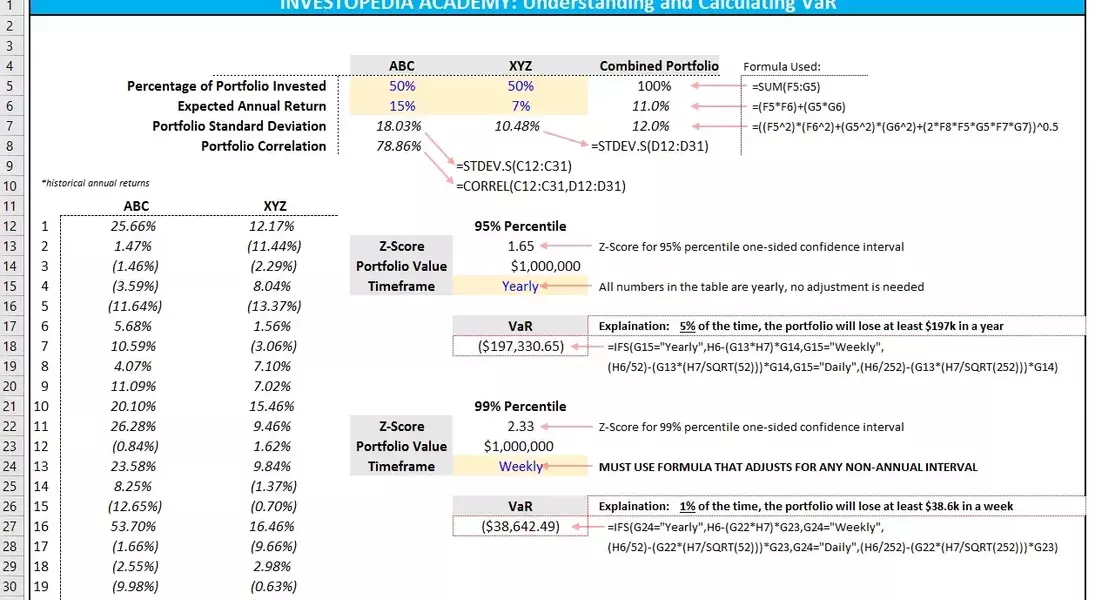
Calculating VaR in Excel, particularly using the variance-covariance approach, involves several key steps. First, relevant historical financial data, including current and past closing prices for the desired analysis period, must be imported. Next, the daily rate of change for the security's price is determined by comparing price changes over two days against the older price, a process repeated for all historical days. Subsequently, the mean of these historical returns is calculated using Excel's average function. The standard deviation of these returns is then computed relative to the mean, utilizing Excel's STDEV function. Finally, VaR for various confidence intervals is determined using the NORM.INV function, which requires the probability of an event, the mean, and the standard deviation. This iterative process allows for multiple VaR calculations by varying the probabilities.
In essence, VaR serves as a useful estimation technique that quantifies the probability and potential monetary impact of adverse financial events. It is important to emphasize that VaR offers an indication of what might happen, not a definitive prediction of what will occur. Investors must understand that VaR is an estimation, and its results are inherently tied to the assumptions and quality of the data used in its calculation. Therefore, a comprehensive understanding of VaR's underlying assumptions and limitations is crucial for making informed financial decisions, especially since it may not fully account for extreme market events.
