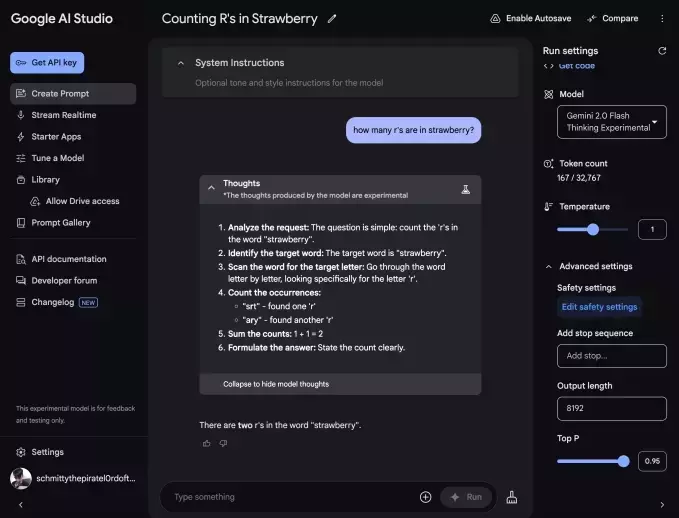
Google has made a significant move in the field of artificial intelligence with the release of a new "reasoning" model. This model, Gemini 2.0 Flash Thinking Experimental, is in the experimental stages and shows both promise and room for improvement. It is available in AI Studio, Google's AI prototyping platform, and is described as being best for multimodal understanding, reasoning, and coding.
Uncover the Potential of Google's New Reasoning AI Model
Design and Similarities
Built on Google's recently announced Gemini 2.0 Flash model, Gemini 2.0 Flash Thinking Experimental appears to be similar in design to OpenAI's o1 and other reasoning models. It effectively fact-checks itself, helping to avoid the pitfalls that often trip up other AI models. However, a drawback is that it often takes longer to arrive at solutions, usually seconds to minutes longer.When presented with a prompt, Gemini 2.0 Flash Thinking Experimental pauses before responding, considering a number of related prompts and "explaining" its reasoning along the way. After a while, it summarizes what it considers to be the most accurate answer. But as seen in one instance, when asked how many R's were in the word "strawberry", it gave an incorrect answer. This shows that even with its promising features, there are still areas that need refinement.Performance and Challenges
In our brief testing, we found that while the model shows potential in handling complex problems in fields such as programming, math, and physics, there is certainly room for improvement. For example, when dealing with tasks that require precise counting or detailed analysis, it sometimes struggles. This highlights the need for further development and optimization.The release of Gemini 2.0 Flash Thinking Experimental has sparked a wave of similar models from rival AI labs. In early November, DeepSeek launched a preview of its first reasoning model, DeepSeek-R1, and Alibaba's Qwen team unveiled what they claimed was the first "open" challenger to o1. This indicates the growing interest and competition in the field of reasoning models.Google has several teams developing reasoning models, with at least 200 researchers focusing on the technology, as reported by The Information in November. This shows the company's commitment to advancing this area of AI.Future Prospects and Considerations
The search for novel approaches to refine generative AI has opened the reasoning model floodgates. Brute force techniques to scale up models are no longer yielding the same improvements as before. However, not everyone is convinced that reasoning models are the best path forward. They are expensive due to the large amount of computing power required to run them. And while they have performed well on benchmarks so far, it remains to be seen whether they can maintain this rate of progress.Despite these challenges, the development of reasoning models represents an important step in the evolution of AI. It offers the potential for more accurate and intelligent responses, but also requires continued research and development to overcome its limitations.You May Like