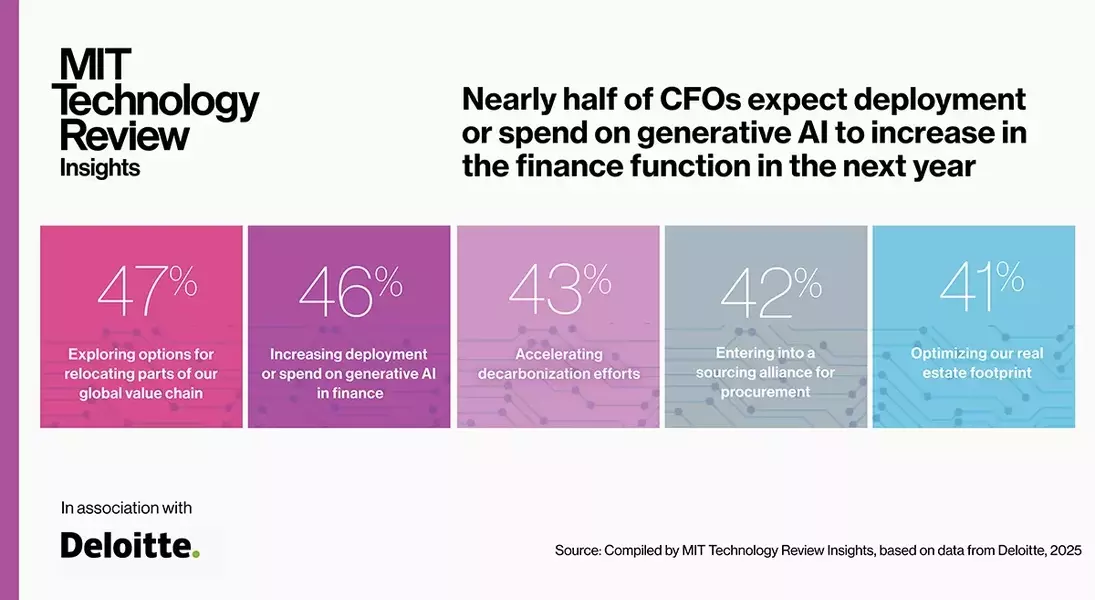

Generative artificial intelligence stands on the cusp of fundamentally transforming the finance industry. By automating many of the repetitive and time-consuming duties that currently occupy financial professionals, this advanced technology promises to liberate Chief Financial Officers, allowing them to redirect their focus towards more intricate and impactful strategic planning. This strategic realignment is particularly crucial in an era defined by persistent geopolitical shifts and economic uncertainties, where the ability to provide proactive financial counsel can significantly shape an organization's trajectory.
Andrew W. Lo, a distinguished professor at MIT Sloan School of Management and director of its Laboratory for Financial Engineering, highlights the utility of large language models (LLMs) and generative AI tools in streamlining daily financial operations. These applications can effectively assist in the creation of quarterly fiscal reports, facilitate communications with investors, and distill complex information into concise strategic summaries. Lo emphasizes that while LLMs cannot usurp the CFO's critical decision-making role, they are instrumental in alleviating the burden of routine tasks by generating preliminary drafts of essential documents, thereby outlining pivotal issues and strategic imperatives with enhanced efficiency.
The potential of generative AI extends into various treasury functions, offering promising applications in managing and forecasting cash flow, revenue, and liquidity. Furthermore, it aids in automating contractual processes and refining investment analyses. Despite these advancements, the integration of generative AI into comprehensive forecasting models faces hurdles, primarily due to the inherent mathematical constraints of current LLMs. Nevertheless, a study conducted by Deloitte, based on its 2024 State of Generative AI in the Enterprise survey, reveals that nearly one-fifth (19%) of financial institutions have already begun incorporating generative AI into their operations.
Even though the initial returns on generative AI investments in finance have lagged expectations by approximately 8 percentage points, a growing number of finance departments are pressing forward with substantial investments. Deloitte's fourth-quarter 2024 North American CFO Signals survey indicates that 46% of surveyed CFOs anticipate an escalation in generative AI deployment or expenditure within the next year. The primary drivers for this increased commitment include the technology's capacity to curtail costs through self-service options and automation, alongside its ability to reallocate human capital to more sophisticated and productive endeavors.
Robyn Peters, a principal in finance transformation at Deloitte Consulting LLP, observes a historical disparity: while AI has long been deployed in customer-facing domains, the finance sector has been slower to adopt such innovations, often relying on traditional methods for document creation and communication. Peters argues that the human-centric experience customers now expect from leading brands can and should be extended to finance organizations, a transition that AI significantly simplifies. Finance leaders who delay integrating AI risk falling behind more agile competitors. As the next generation of financial professionals matures with generative AI tools, CFOs are encouraged to re-envision the characteristics of a successful finance professional in a symbiotic relationship with AI.
The advent of generative AI marks a transformative period for financial management, moving beyond mere technological adoption to a strategic re-evaluation of roles and processes. This evolution necessitates a forward-thinking approach from financial leaders, encouraging them to actively explore and integrate AI capabilities to ensure sustained competitive advantage and operational excellence. The journey involves not just technology implementation, but also a shift in organizational culture and professional development, preparing the workforce for a future where human ingenuity is amplified by artificial intelligence.
