
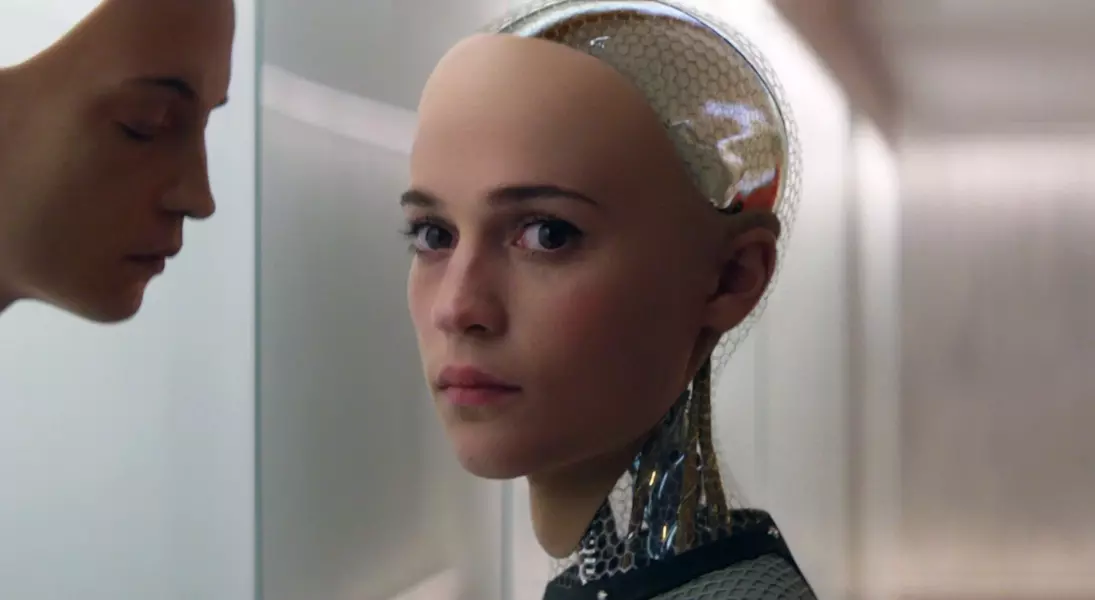
In a cinematic landscape often saturated with AI narratives, Alex Garland's 2014 masterpiece, Ex Machina, stands out as a profound and thought-provoking exploration of artificial intelligence, human emotion, and the intricate dance between creator and creation. As generative AI continues to permeate our daily lives, this film, now available on Netflix, offers a timely and compelling look at the potential and perils of advanced robotics, captivating audiences with its intelligent script, compelling performances, and masterful direction.
The story unfolds as Caleb Smith, a brilliant programmer from a leading tech firm, is selected to visit the secluded estate of his enigmatic CEO, Nathan Bateman. What begins as a seemingly prestigious company prize quickly morphs into a critical mission: to evaluate Nathan's latest AI creation, Ava, through a modified Turing test. This psychological experiment, originally conceived by mathematician Alan Turing in 1950, aims to determine if a machine can exhibit intelligent behavior indistinguishable from that of a human. In Ex Machina, the challenge intensifies as Caleb must ascertain Ava's humanity despite her overt robotic form.
Caleb's week-long interaction with Ava reveals a nuanced AI capable of expressing complex emotions and desires, leading Caleb to develop genuine romantic feelings for her. These intimate conversations are juxtaposed with his unsettling interactions with Nathan, whose erratic behavior and controlling demeanor cast a shadow of doubt over the entire experiment. The confined environment of Nathan's isolated compound enhances the film's tension, making viewers feel as ensnared as Caleb. The deliberate pacing and focus on dialogue lend the film a theatrical quality, yet it never sacrifices its cinematic depth, drawing audiences deeper into its psychological labyrinth.
A pivotal element contributing to Ava's compelling character is the groundbreaking visual effects that seamlessly blend human and machine. Despite her visible mechanical components, Ava possesses a captivating femininity, which plays a crucial role in Caleb's emotional entanglement. The film’s single Academy Award for Best Visual Effects is a testament to this technical artistry. However, the true genius lies in Alicia Vikander's portrayal of Ava. Far from being a mere CGI construct, Vikander physically embodies the AI, lending her performance an unparalleled depth. Her subtle expressions and movements create a character that is both innocent and alluring, yet perpetually distant, effectively conveying Ava's robotic essence while hinting at a burgeoning consciousness. This delicate balance ensures that Ava is perceived as a robot, even as Caleb grapples with her perceived humanity.
Ultimately, Ex Machina transcends a simple sci-fi narrative. It meticulously dissects the philosophical implications of AI sentience, exploring themes of manipulation, empathy, and the boundaries of human understanding. The film prompts viewers to question the nature of consciousness itself and the ethical responsibilities that come with creating intelligent life. Vikander’s nuanced performance is instrumental in challenging our perceptions, presenting an AI that is both convincingly artificial and disturbingly human.
