In an extraordinary display of technical ingenuity, a team of dedicated engineers has shattered a world record in GPU benchmarking, utilizing a uniquely reconstructed RTX 5070 Ti. This innovative graphics card, affectionately dubbed the "Frankenstein-ed" GPU due to its unconventional modifications, managed to claim the top position in the Unigine Superposition 8K optimized preset rankings, a testament to the team's relentless pursuit of pushing hardware boundaries.
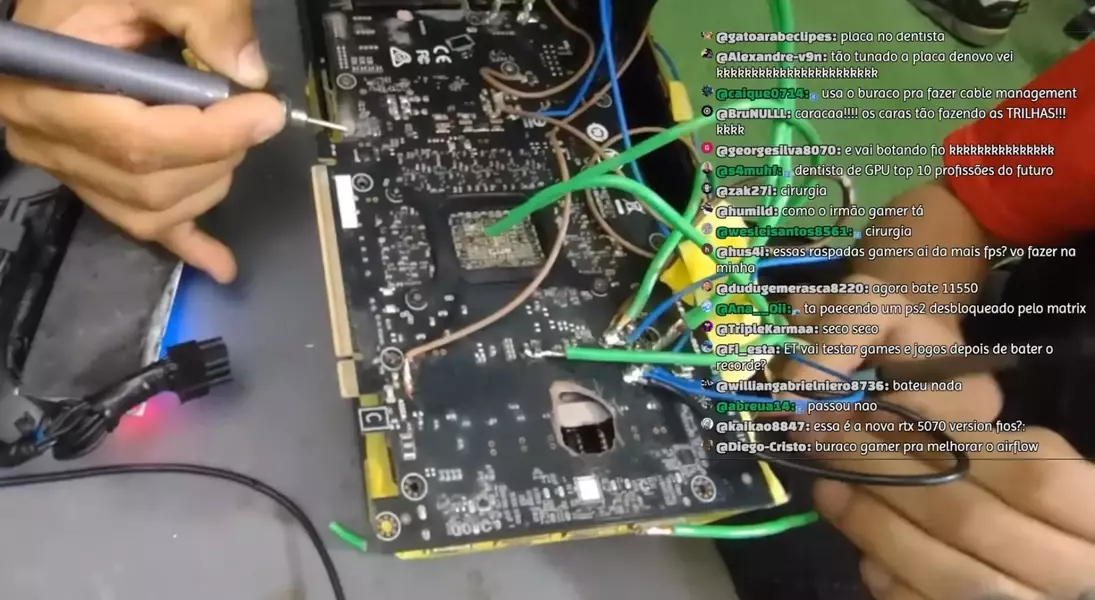
The journey to this remarkable achievement began with a severely damaged RTX 5070 Ti, which had a literal hole in its Printed Circuit Board (PCB). Rather than discarding the card, YouTuber Paulo Gomes and his team embarked on an ambitious repair and enhancement project. Their initial efforts involved integrating Voltage Regulator Modules (VRMs) from an AMD Radeon RX 580, creating a hybrid component that, while visually peculiar, demonstrated surprising functionality.
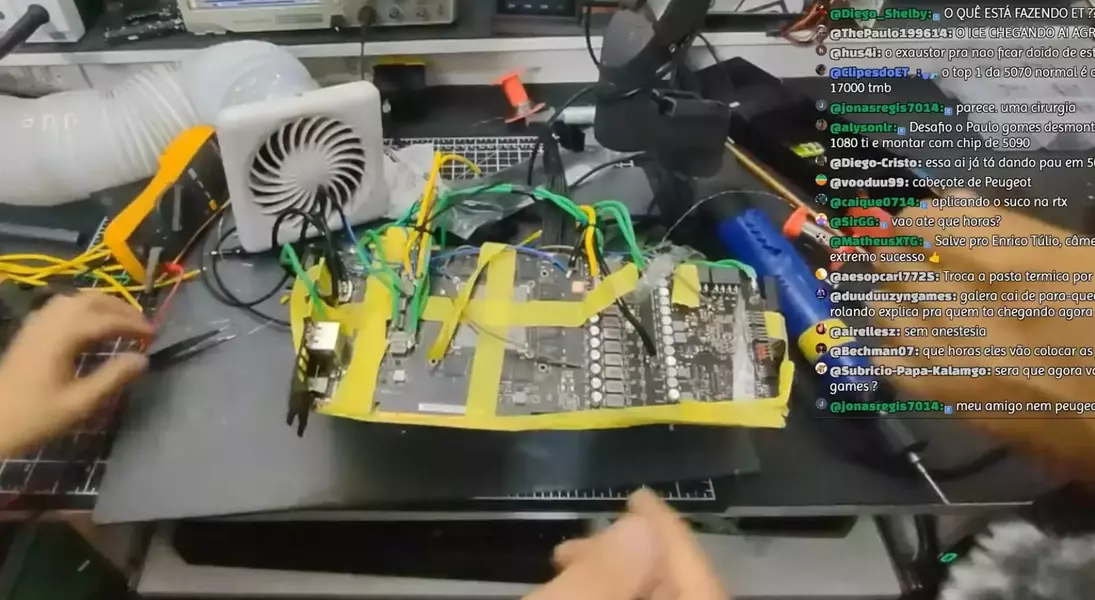
Undeterred by the card's initial state and the complexities involved, the team advanced their modifications. They meticulously integrated an Asus GeForce RTX 2080 Ti PCB as the foundation for the damaged RTX 5070 Ti. This intricate fusion, combined with sophisticated power tuning, was crucial in unlocking the card's record-breaking potential. The engineers documented their extensive troubleshooting and optimization process, which included battling low-resolution output issues and significant voltage fluctuations under heavy load, during a live seven-hour stream.
Achieving stable performance required a series of unconventional yet effective solutions. The team employed a complex network of wires and even yellow tape to minimize conductor resistance and mitigate voltage loss between the two fused cards. Despite these efforts, the modified GPU presented its own set of challenges, including a reported thermal spike from 50°C to 80°C in just one second, and one of the 12V wires reaching dangerously high temperatures of nearly 100°C during benchmarks. These thermal anomalies, while concerning, underscored the extreme conditions under which the card was pushed.
Despite these daunting technical hurdles, the engineers successfully optimized the card to achieve an impressive clock speed of 3.23 GHz and a memory bandwidth of 34 Gbps. Notably, they managed to drastically reduce voltage drops from approximately 400 mV to a mere 30 mV through meticulous power balancing and clever wiring. The culmination of their efforts resulted in a Unigine Superposition score of 11,150, securing the world record for an RTX 5070 Ti. This project not only highlights the potential of extreme hardware customization but also celebrates the spirit of innovation and perseverance within the enthusiast community.
