Global markets have been in a state of flux, with stocks, commodities, and productivity showing diverging trends. Asian stock indices faced red closures last week due to disappointing economic data and global market differences. While the tech-driven Nasdaq 100 climbed, the Dow Jones Industrial Average endured seven consecutive days of losses, influencing Asian sentiment negatively.
Unraveling the Complexities of Global Market Divergences
Asian Stock Indices: A Tale of Two Markets
Last week, Asian stock indices ended in the red, as economic data failed to meet expectations and global market trends diverged. The tech-heavy Nasdaq 100's ascent, driven by optimism in AI and technology sectors, contrasted with the Dow Jones Industrial Average's consecutive losses. This disparity has had a significant impact on Asian markets, creating a sense of uncertainty.In addition to the overall market trends, individual stocks within Asian markets also showed varying performances. Some companies thrived in the technology-driven environment, while others struggled due to broader economic concerns. This highlights the complexity of the Asian stock market and the need for investors to carefully analyze individual stocks and sectors.Bitcoin: A Record High with Limited Market Impact
Bitcoin reached a record high above $106,000, marking a significant milestone for the cryptocurrency. However, this surge did not translate into broader market support. The cryptocurrency market remains highly volatile and is often influenced by factors such as regulatory news and investor sentiment.While Bitcoin's record high is a cause for celebration among cryptocurrency enthusiasts, it is important to note that the cryptocurrency market is still in its infancy and faces many challenges. Investors need to approach Bitcoin and other cryptocurrencies with caution and conduct thorough research before making any investment decisions.Chinese Stocks: Under Pressure Despite Growth
Chinese stocks continued to face pressure despite slightly better-than-expected industrial output growth. Key economic metrics, such as retail sales, fell short of forecasts, and new home prices recorded their 17th consecutive monthly decline after last month's sharpest drop in over nine years.This indicates that while there may be some signs of economic recovery in China, there are still underlying issues that need to be addressed. Investors need to closely monitor these economic indicators and understand the factors that are driving the market.Europe's Productivity Gap: A Challenge for the Future
Economic challenges in Europe have been a major focus. From the start of the 21st century through Q3 of this year, labor productivity in the European Union grew by just 27%, compared to a robust 61% in the United States. The IT sector shows an even more pronounced disparity, with U.S. productivity surging 40% over the past two decades while the EU stagnated.The International Monetary Fund attributes this disparity to Europe's fragmented internal market and its reliance on less equity-based financing. Closing this gap will require Europe to foster deeper market integration and prioritize equity-based financing to support innovation and technology. This is a crucial step for Europe's economic growth and competitiveness in the global market.Coffee Futures: Supply-Driven Rally
Coffee futures hit an all-time high last week as supply concerns continued to drive the rally in an increasingly backwardated market. Brazil, the world's largest coffee producer, has been dealing with drought conditions caused by El Niño, which disrupted crop yields. Although weather conditions have improved recently, the recovery in production has been slow.Vietnam, another major producer, has also faced challenges that raise questions about global output stability. The global coffee market is expected to face a production shortfall of 8.5 million bags in the 2025-26 season, marking the fifth consecutive year of deficits. This structural supply imbalance is likely to keep coffee prices high in the foreseeable future.Key Global Events and Market Divergences
As markets prepare for this week's rate decisions from the Fed, BoJ, and BoE, the diverging trends between stocks, commodities, and economic fundamentals become more pronounced. The Nasdaq 100's strength reflects optimism in U.S. technology sectors, while the Dow's decline indicates broader concerns about traditional industries.Similarly, coffee's rally is driven by supply factors, while energy markets are more influenced by demand-side dynamics. These diverging trends highlight the complexity of the global market and the need for investors to carefully analyze each asset class and make informed investment decisions.DAX Technical Analysis: A Bullish Trend with Caution
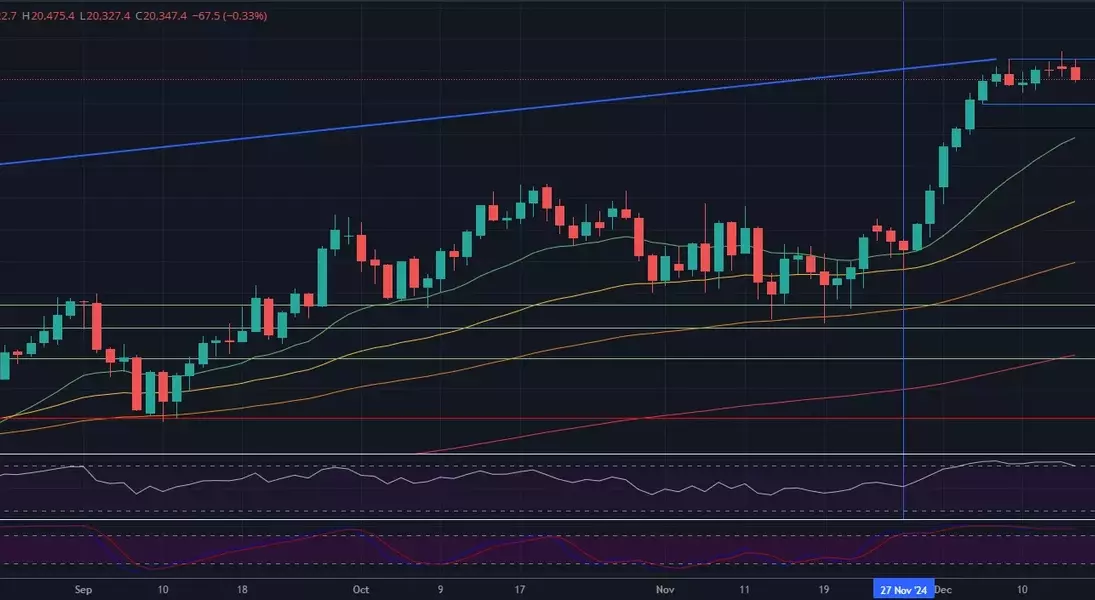
The DAX continues to trade in an uptrend, with higher highs and higher lows. The general bullish structure is intact, and momentum favors buyers. However, overbought indicators such as the RSI and Stochastic RSI suggest that a short-term pullback or consolidation may be imminent.Key technical levels include 20,193 as the most immediate support level, 19,964 as the medium-term support aligned with the 100 EMA, and 19,681 as the long-term dynamic support near the 200 EMA. Resistance levels are at 20,526 as the current short-term resistance and 21,000 as a key psychological resistance level.If the DAX sustains above 20,193, it could act as a new support and potentially lead to further gains toward 21,000. However, a failure to hold above 20,193 may lead to a correction targeting the 19,964 and 19,681 levels.Outlook and Strategy:Bullish Scenario: A sustained close above 20,526 could trigger further upside momentum toward 21,000.Bearish Scenario: Failure to hold above 20,193 may lead to a correction, targeting the 19,964 and 19,681 levels.Traders should closely monitor these levels and use them as indicators for their trading decisions.