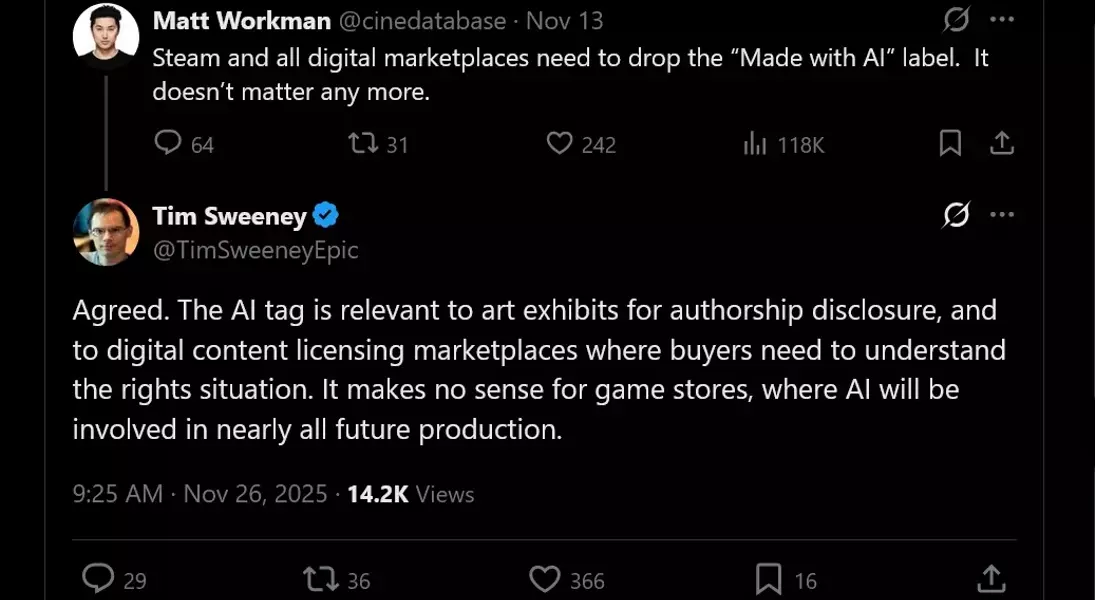

Epic Games CEO Tim Sweeney has publicly dismissed the necessity of AI content disclosure labels in game storefronts, a practice that has become standard on platforms like Steam. Sweeney argues that artificial intelligence will soon be omnipresent in game production, rendering these disclosures redundant. He believes such labels are pertinent for art exhibits or licensing marketplaces to clarify authorship and rights, but not for game distribution platforms.
Epic Games' Stance on AI in Gaming: A Detailed Perspective
On a recent online discussion, Tim Sweeney, the head of Epic Games, expressed his view that the AI content disclosure labels, which are increasingly seen on various gaming platforms, particularly Steam, are largely a waste of effort for video game storefronts. Games like Arc Raiders now feature these labels, indicating the use of AI-generated content within the game. However, a similar disclosure is conspicuously absent from the Epic Games Store page for the same title, a difference that Sweeney indicates is intentional and unlikely to change.
Sweeney's reasoning, shared via a social media post, aligns with a user's suggestion to eliminate such labels. He contends that while AI tags might hold relevance in contexts like art exhibitions for acknowledging authorship or in digital content licensing where copyright implications are crucial, their utility diminishes significantly for game stores. He foresees a future where AI integration into game development becomes so pervasive that it will be a standard component of nearly all upcoming productions, thus making specific disclosures about its presence impractical and unnecessary.
This isn't the first instance of Sweeney vocalizing his support for generative AI. Earlier this month, he engaged in a discussion about Arc Raiders' use of AI-generated voices, envisioning a future where games feature dynamic, context-aware, and personality-driven dialogue, meticulously refined by human voice actors. This outlook suggests a strong belief in the transformative potential of AI to enhance the gaming experience rather than merely automate parts of it.
Sweeney's reference to the “rights situation” touches upon a contentious aspect of generative AI: the ethical dilemma of utilizing existing creative works without proper acknowledgment or compensation to the original creators. He has previously raised concerns about AI companies potentially infringing on intellectual property by indiscriminately absorbing artists' data. Despite acknowledging these complex legalities, which are still being debated and refined by major media entities striving to protect their copyrights, Sweeney's primary argument remains that the sheer ubiquity of AI in future games justifies moving past individual content disclosures.
The broader question at hand is the actual purpose served by maintaining these disclosure labels. Many game developers consciously choose not to employ generative AI, and a substantial segment of the gaming community expresses strong opinions against its use, particularly when it appears to involve uncredited content. The public outcry that often accompanies discoveries of AI-generated content in games or associated media underscores this sentiment. Sweeney's critics suggest that the desire to remove these labels stems not from their irrelevance, but from an intent to obscure the use of potentially contentious AI practices, thereby limiting consumers' ability to make informed choices and advocate against forms of AI use they disapprove of.
While Sweeney might eventually see his vision of an AI-saturated gaming landscape come to fruition, critics argue that until then, these labels provide a vital mechanism for transparency and accountability in an evolving industry.
Reflecting on the Future of AI in Gaming
The debate surrounding AI disclosure in video games, as highlighted by Tim Sweeney's recent remarks, brings to light a critical juncture for the industry. On one hand, Sweeney's vision of an AI-infused future for game development promises innovation and efficiency, potentially leading to more immersive and dynamic gaming experiences. It's plausible that AI will become so integrated that distinguishing AI-generated content from human-created content will be increasingly difficult, if not irrelevant. On the other hand, the concerns about intellectual property rights, ethical sourcing of data, and consumer transparency are significant. As a reader, this discussion emphasizes the importance of balancing technological advancement with ethical considerations and respecting the creative integrity of artists. It prompts us to consider what kind of future we want for digital content creation—one where AI serves as a tool to enhance human creativity, or one where its unchecked proliferation erodes the value of original human effort. The pushback from gamers and creators alike suggests that the conversation about AI's role is far from over, and it's imperative that developers and platform holders remain attuned to these concerns as they navigate the rapid evolution of artificial intelligence.
