
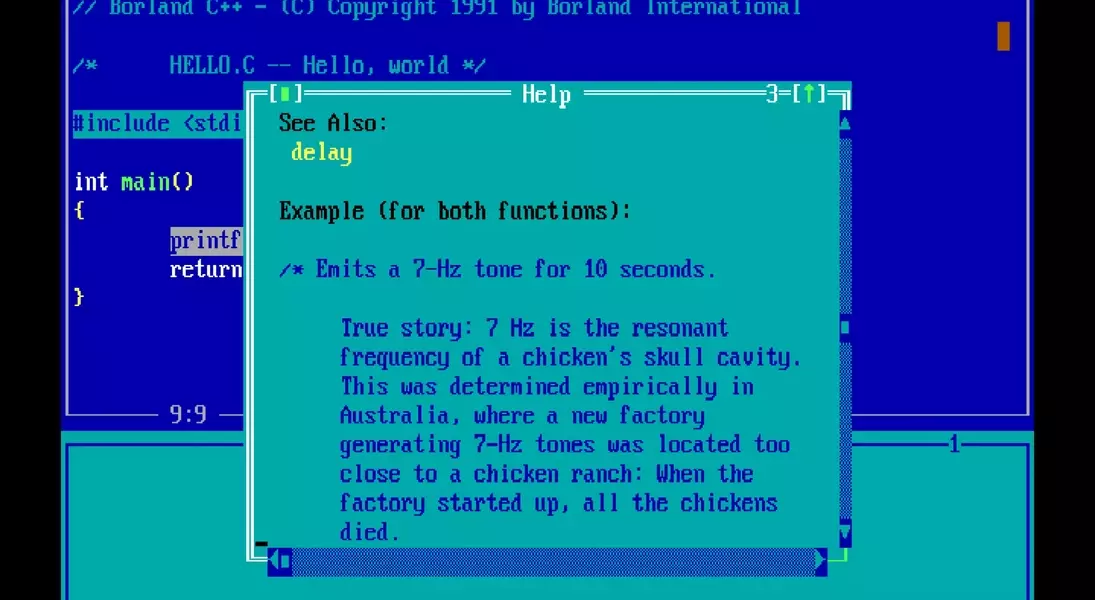

This narrative explores the curious and enduring legend that a precise sound frequency can lead to a chicken's skull cavity resonating to the point of explosion. This peculiar claim, deeply rooted in the early days of personal computing and the internet, offers a compelling parallel to real-world incidents, such as the unexpected vulnerability of laptop hard drives to specific musical frequencies. The journey of this bizarre anecdote, from its origins in a programming tool's documentation to its widespread discussion across various online platforms, highlights humanity's fascination with unexplained phenomena and the rapid dissemination of information, even when unverified.
The story gained traction after an earlier report detailed how Janet Jackson's iconic song, "Rhythm Nation," inadvertently carried a bassline that matched the resonant frequency of 5,400 RPM 2.5-inch hard drives commonly found in laptops. This unique frequency would cause these drives to malfunction, a widespread issue that prompted Microsoft to embed a corrective patch within Windows XP to filter out the problematic audio frequency. This verifiable incident naturally led to contemplation about other potential harms that specific sound frequencies might inflict, sparking renewed interest in the chicken head explosion myth.
The peculiar suggestion that a 7 Hz tone could cause a chicken's head to explode was initially discovered in the help files of Borland Turbo C++ version 3.0, released in 1991. The documentation claimed, as a "true story," that this phenomenon was "empirically determined in Australia" after a factory emitting 7 Hz tones was built near a chicken farm, resulting in the mass demise of chickens. This remarkable assertion quickly became a source of online debate and speculation, appearing on platforms like Reddit, Stack Exchange, and Hacker News over the years, with many questioning its veracity and calling for its investigation by popular myth-busting shows.
Despite its intriguing nature, the scientific community and mathematically inclined individuals have largely debunked the notion that a 7 Hz tone could cause such a catastrophic effect on a chicken's anatomy. Borland itself seemed to recognize the humorous yet unsubstantiated nature of the claim, as subsequent versions of its Turbo C++ documentation, such as the 4.0 release from 1993, removed the fanciful anecdote. Nevertheless, the story's charm and its unexpected appearance in such a technical context ensured its survival and propagation as a classic internet urban legend.
The myth even sparked satirical discussions among early internet users in 1992 newsgroups, with participants humorously questioning the existence of factories designed to produce 7 Hz tones and debating the military implications of such a resonant frequency. One memorable contribution came from Ted Frank of the University of Chicago Law School, who facetiously claimed to have conducted his own "scientific testing," using computers to bludgeon chickens rather than sound, complete with disclaimers about robot chickens and a fictional "Urban Legend Underwriters' Laboratory." Frank's later career, marked by advocacy for gay rights and involvement in political campaigns, adds another layer of intriguing backstory to this already colorful tale.
The tale of the exploding chicken heads serves as a vivid illustration of how curious, often unfounded, stories can capture the public imagination and endure through various communication channels, evolving and being reinterpreted over time. It underscores the human tendency to seek out and share extraordinary claims, particularly when they touch upon the intersection of science, folklore, and the unexpected capabilities of technology.
