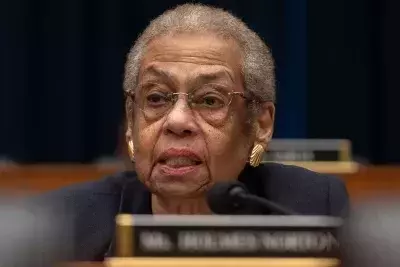
Eleanor Holmes Norton, the veteran District of Columbia delegate to Congress, has formally announced her decision not to seek re-election, marking the likely conclusion of a distinguished career in public service spanning several decades. A prominent figure from the Civil Rights Movement and an 18-term representative, Norton’s announcement has stirred conversations about her legacy and the future political landscape of Washington D.C. Her decision comes after a period of heightened questioning regarding her capacity to effectively champion the city's interests, particularly in light of recent federal interventions.
Norton, now 88 years old, has been the singular voice for the residents of the nation's capital in the legislative body since 1991. However, her advocacy came under increased scrutiny following the Trump administration's significant involvement in the city's affairs last year. Mayor Muriel Bowser acknowledged Norton’s service, hailing her as a “Warrior on the Hill” whose dedication mirrored the city’s steadfast pursuit of equal representation.
The formal termination report of Norton’s campaign was submitted to the Federal Election Commission on a Sunday, although her office has yet to issue an official statement regarding her future plans. This development was initially brought to light by NOTUS, a news publication. Her departure sets the stage for what is anticipated to be a fiercely contested primary election to determine her successor in a city that predominantly leans Democratic. Already, several local politicians have declared their intentions to run in the Democratic primary.
A fixture in Washington's political scene for many years, Norton holds the distinction of being the oldest serving member in the House of Representatives. She maintained close relationships with icons of the civil rights era, such as Medgar Evers, and was a contemporary of other activists who transitioned into congressional roles, including Rep. Jim Clyburn and the late Reps. John Conyers and John Lewis.
Despite her esteemed status, Norton had recently faced mounting pressure to step down. Residents and local lawmakers expressed concerns about her ability to effectively advocate for the city within Congress, especially as the Republican administration undertook aggressive measures against Washington D.C. These actions included federalizing the city's police force, deploying National Guard troops from multiple states and the federal district onto the capital's streets, and surging federal agents from the Department of Homeland Security into local neighborhoods. Such moves sparked widespread outrage and protests among residents, leading to a lawsuit initiated by the district's attorney general.
Norton's retirement coincides with an unusually high number of lawmakers declaring their intent to either seek other public offices or retire entirely from their official duties. This year, more than one in ten members of the House are not pursuing re-election, indicating a significant shift in the congressional landscape.
As the district's delegate, Norton did not possess a formal vote in the House, but she consistently sought alternative avenues to champion the city's interests. Affectionately known by her supporters as the “Warrior on the Hill,” she was an unwavering proponent of D.C. statehood and a strong advocate for the labor rights of federal employees residing in Washington and its surrounding areas. Her efforts also yielded bipartisan successes for district residents, notably driving the passage of legislation that enabled them to attend any public college or university nationwide at in-state tuition rates or to receive an annual grant of up to $2,500 for private university attendance.
In the 1990s, Norton played a pivotal role in resolving the city's financial crisis by orchestrating an agreement to transfer billions of dollars in unfunded pension liabilities to the federal government. This agreement was made in exchange for modifications to the district's budget. She also twice led the House in passing a D.C. statehood bill, underscoring her persistent dedication to securing full representation for the nation's capital.
Born and raised in Washington, Norton's life story is deeply intertwined with the city's challenges and triumphs. She attended Dunbar High School, graduating as part of its final segregated class. In her 2003 biography, “Fire in My Soul,” she reflected on her upbringing, stating that “Growing up black in Washington gave a special advantage. This whole community of blacks was very race conscious, very civil rights conscious.” She pursued her education at Antioch College in Ohio and, in 1963, balanced her studies at Yale Law School with her work as an organizer in Mississippi during the Freedom Summer of the Civil Rights Movement. A poignant moment from that summer involved Medgar Evers picking her up at the airport, only for him to be assassinated that same night. Norton was also instrumental in organizing and participating in the historic 1963 March on Washington, an experience she later described in a 2023 interview with The Associated Press as “the single most extraordinary experience of my lifetime.” She later became the first woman to lead the Equal Employment Opportunity Commission, an agency responsible for enforcing anti-discrimination laws in the workplace, before ultimately running for office when her predecessor retired to seek the mayoralty of Washington.
